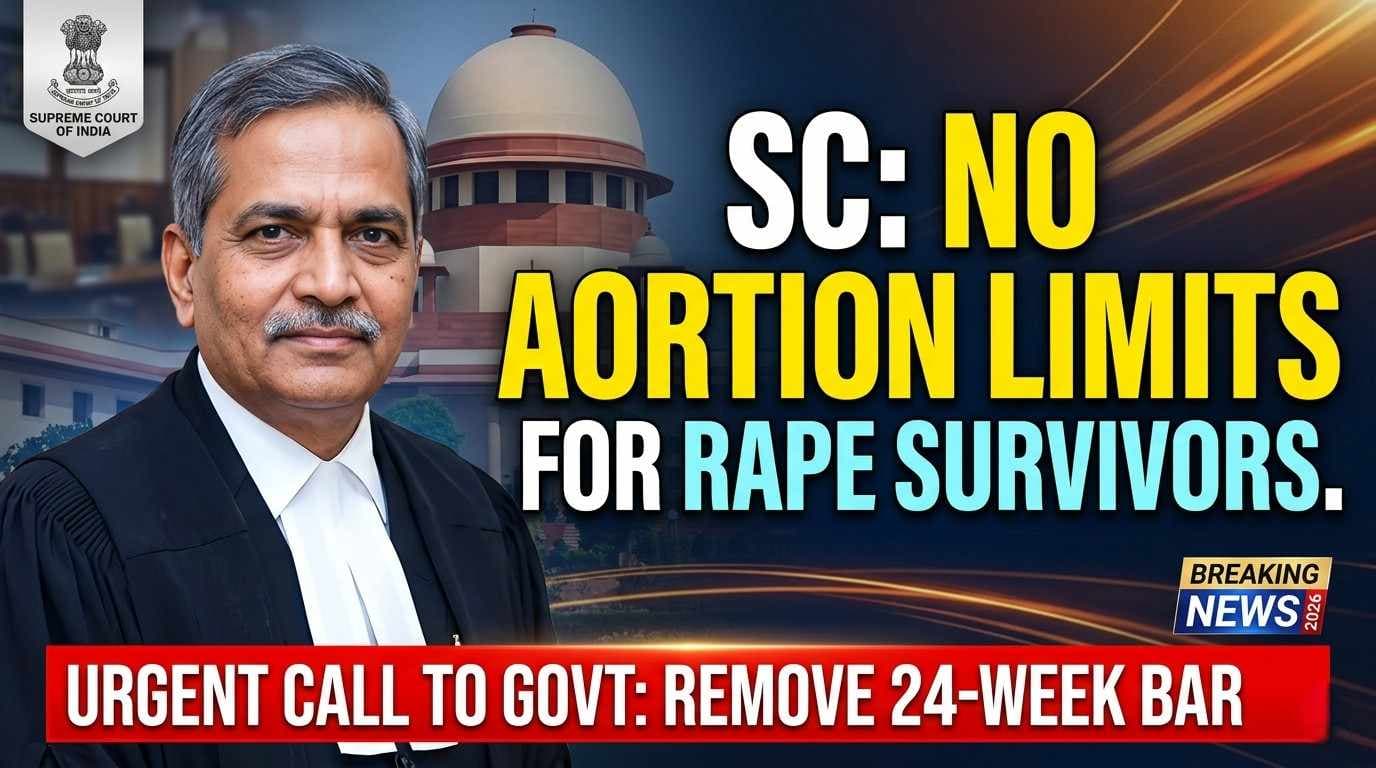
In a powerful call for legislative evolution, the Supreme Court of India has urged the Central government to remove gestational time-related restrictions for rape survivors seeking to terminate late-stage pregnancies. On Thursday, April 30, 2026, a Bench led by Chief Justice of India (CJI) Surya Kant emphasized that the legal framework governing abortions must be "organic" and remain in sync with evolving social realities and the fundamental dignity of women.
The Court’s observations came during the hearing of a curative petition filed by AIIMS, which sought to reconsider a recent decision allowing a 15-year-old girl to terminate her pregnancy of over 30 weeks. While medical professionals raised concerns about the advanced stage of the pregnancy and the potential for a "live birth with severe deformities," the Bench pivoted the focus back to the survivor's mental and physical health.
"Please amend your law... that when there is pregnancy due to rape etc., the time limitation will not be there," stated CJI Kant. He noted that a minor child cannot be forced to bear the life-altering burden of a pregnancy resulting from sexual assault, characterizing the situation as a tragic conflict of "foetus vs. child."
The hearing saw a deep philosophical and legal debate over the rights of the unborn versus the rights of the mother. When medical reports suggested that continuing the pregnancy briefly might improve outcomes for the foetus, the Bench was quick to question whether such predictions should override the trauma of the survivor. "Too much focus on the child (foetus) and not the mother who has gone through such pain," CJI Kant remarked.
Justice Joymalya Bagchi, also on the Bench, highlighted the importance of parental agency and mental health. He noted that while medical data should be shared with the family, the ultimate "call" must be based on the survivor’s mental well-being. "Give respect to your citizen," the Justice added, reinforcing that the State should not act as a barrier to reproductive autonomy in cases of extreme hardship.
Under the current Medical Termination of Pregnancy (MTP) Act, the upper limit for most categories of women, including rape survivors and minors, is 24 weeks. Termination beyond this period is generally only permitted in cases of substantial foetal abnormalities. By urging the Centre to waive these limits for survivors of sexual assault, the Supreme Court is pushing for a shift from a purely clinical, age-based approach to one rooted in constitutional values of liberty and maternal dignity.
The Court’s stance reflects a growing judicial consensus that an unwanted pregnancy resulting from a crime is a "grave injury to mental health." The Bench made it clear that the law should act as a shield for the vulnerable, rather than a rigid set of prohibitions that compounds the original trauma of the assault.
As the government considers this judicial recommendation, the legal community views it as a potential turning point for reproductive rights in India. If the law is amended as suggested, it would place India among the few jurisdictions globally that prioritize a survivor's autonomy over strict gestational milestones, ensuring that the "organic" nature of the law truly serves the citizens it aims to protect.