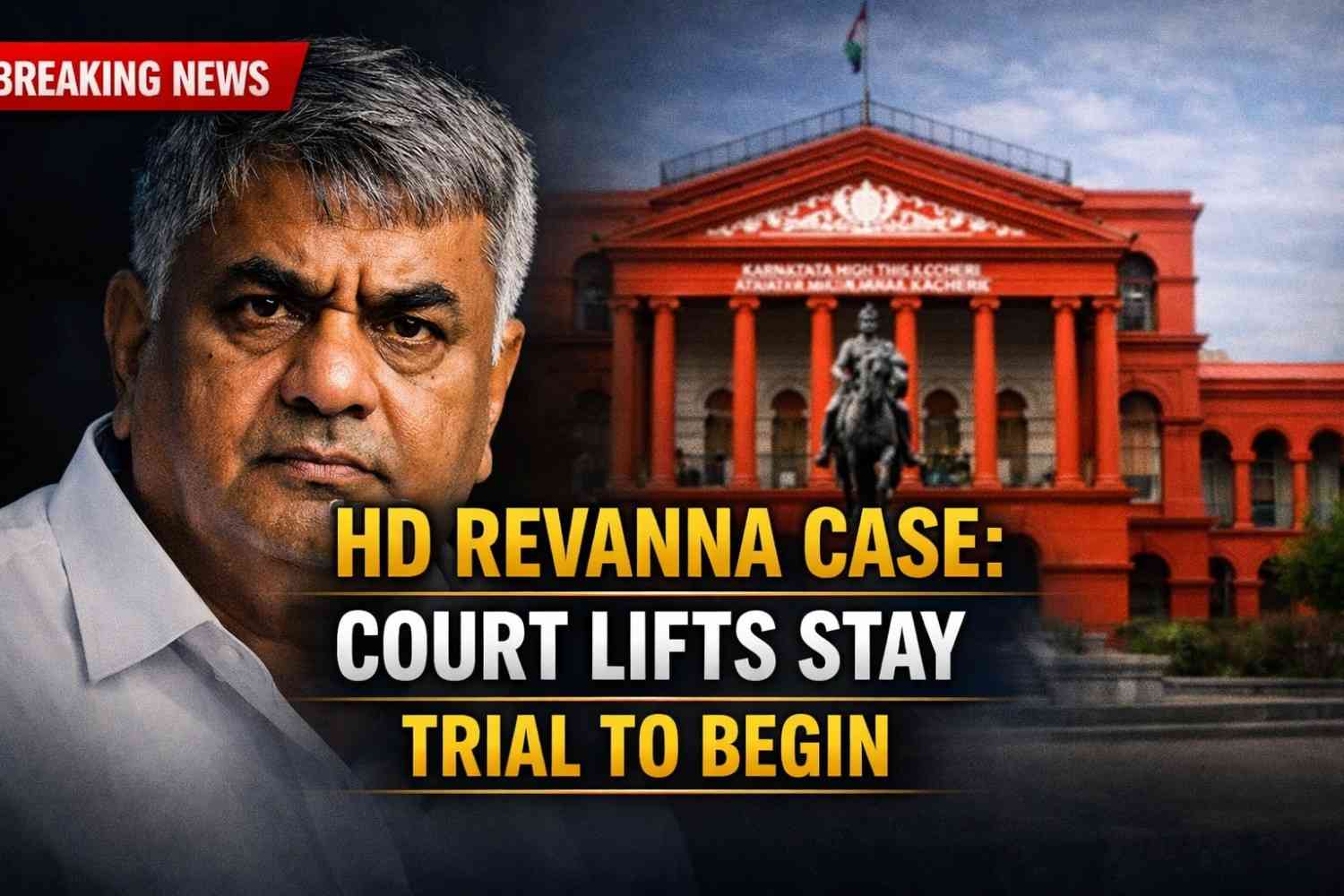
In a significant development that could accelerate the legal proceedings against senior Janata Dal (Secular) leader H.D. Revanna, the Karnataka High Court has vacated the interim stay order that previously prevented a trial court from framing charges against him. The case pertains to the alleged kidnapping of a woman in connection with the high-profile sexual assault scandal involving his son, Prajwal Revanna.
Justice S. Sunil Dutt Yadav, presiding over the matter, expressed strong displeasure over the repeated requests for adjournments by the petitioner’s counsel. The Court observed that despite explicit directions to be prepared for arguments, the lack of readiness suggested a lack of due diligence in pursuing the matter.
The case traces back to 2024, amidst a storm of allegations involving sexual harassment and the circulation of explicit videos. The prosecution’s case is centered on a complaint filed by the son of a woman who had reportedly worked at H.D. Revanna’s residence for over six years.
According to the complaint, the woman was allegedly kidnapped by one Satish Babanna on the instructions of H.D. Revanna. The complainant alleged that his friend had alerted him to a video purportedly showing the sexual assault of his mother. When the complainant confronted Babanna and requested his mother’s return, the request was allegedly denied.
The SIT (Special Investigation Team), tasked with investigating the various facets of the Prajwal Revanna scandal, subsequently named H.D. Revanna as a key accused in this abduction case. While the JD(S) leader was granted bail by a special court in May 2024—a decision later upheld by the High Court in August 2024—he has been seeking to quash the entire criminal prosecution through a petition in the High Court.
In January 2025, the High Court had granted a temporary shield to Revanna by directing the trial court not to proceed with the framing of charges. This interim order was intended to remain in force while the High Court deliberated on Revanna's petition to quash the case.
However, the tide turned during recent hearings. On January 29, 2026, the Court noted that the petitioner was not ready to proceed with the merits of the case. Despite objections from the state's Senior Counsel, the Court exercised judicial discretion to grant one final opportunity, extending the stay until the next hearing on February 5, with a clear warning: the petitioner must be ready to argue.
When the matter came up on February 5, the petitioner’s counsel once again moved an adjournment memo. The reason cited was that the Senior Counsel was out of station for a trial in another court.
Justice Yadav was not inclined to accept this justification. In a sternly worded order, the Court clarified the hierarchy and the expectations of a High Court.
"At the outset, it is noticed that a memo for adjournment before the High Court, which is a Court of record, cannot be moved on the ground that counsel has been engaged in a matter to appear before a trial court. Such a request ought not to be made before the High Court," the judge noted.
The Court further remarked that the repeated delays indicated that the petitioner did not intend to pursue the matter with the necessary diligence. "There is no other inference that can be drawn... In light of the unreasonable request for adjournment sought for, the interim order in operation stands vacated," the bench ruled.
The vacation of the stay is a major procedural blow for H.D. Revanna. The "framing of charges" is a critical stage in a criminal trial. It is the point where the judge examines the evidence presented by the prosecution to decide if there is a prima facie case to proceed to trial.
With the stay lifted, the Special Court for People’s Representatives is now free to proceed with this stage. If charges are framed, H.D. Revanna will have to formally plead "guilty" or "not guilty," marking the official commencement of the trial where witnesses will be examined.
The High Court’s decision reflects a growing intolerance in the Indian judiciary toward "adjournment culture," especially in high-stakes cases involving influential public figures. By flagging that a High Court’s schedule cannot be dictated by a lawyer’s commitments in a lower trial court, Justice Yadav has sent a clear message about judicial discipline.
Legal experts suggest that while Revanna still has the right to argue his "quash petition" (now listed for February 26), he no longer enjoys the luxury of pausing the trial court proceedings in the meantime. This "dual track" means the trial court can move forward even while the High Court considers the legality of the entire investigation.
As the legal battle intensifies, all eyes are now on the Special Court in Bengaluru. For the victim’s family, the vacation of the stay represents a step toward a trial that has seen multiple delays. For H.D. Revanna, the challenge is now twofold: defending the kidnapping allegations in the trial court while simultaneously trying to convince the High Court that the prosecution itself is politically motivated or legally unsustainable.
The case remains a focal point of Karnataka's political and legal landscape, serving as a reminder of the complexities involved when high-profile political lineages meet the rigors of criminal law.