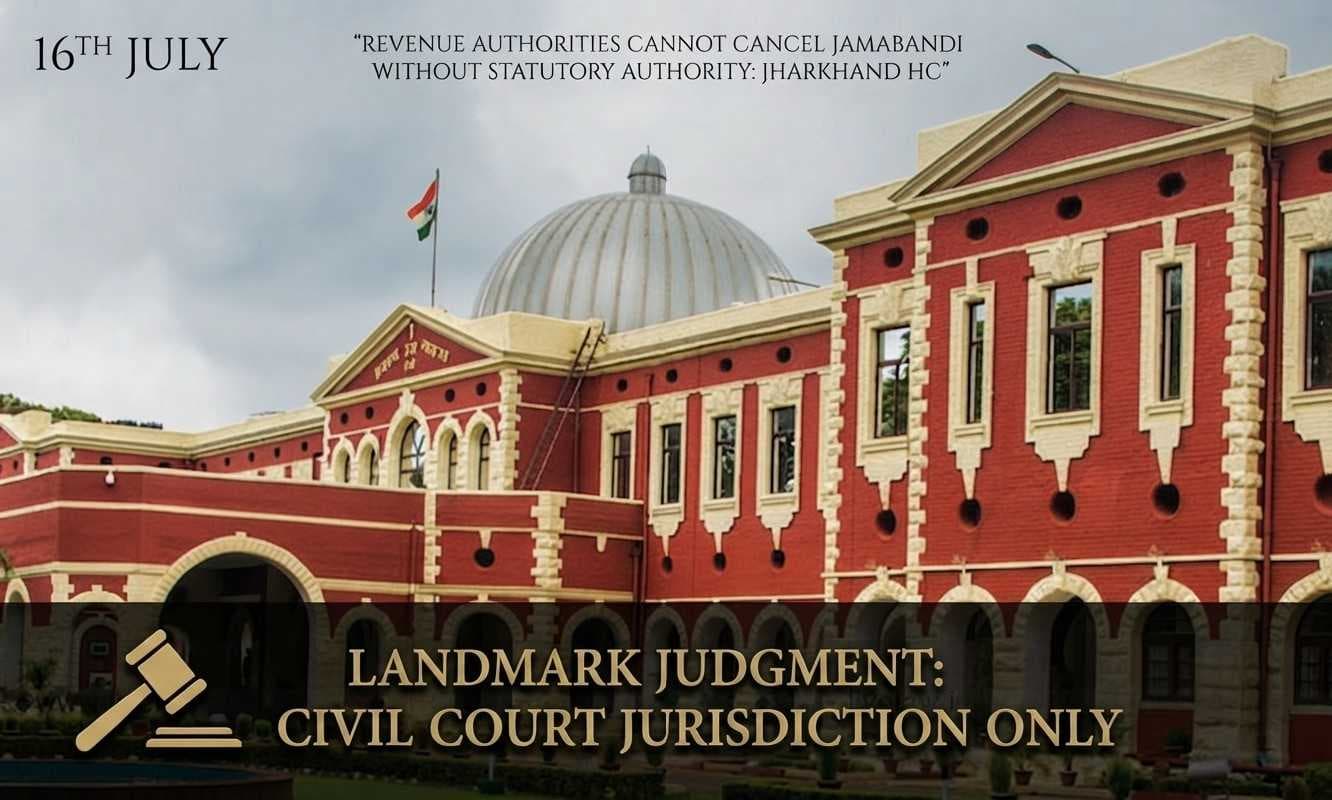
The Division Bench comprising Chief Justice M.S. Sonak and Justice Rajesh Shankar delivered the judgment in a Letters Patent Appeal concerning the cancellation of a jamabandi by revenue authorities. The Court examined whether revenue officials possessed the legal authority to set aside a jamabandi that had been in operation for an extended period in favour of a raiyat.
The Bench observed that the statutory framework governing land records and revenue administration does not confer upon revenue authorities the power to cancel a jamabandi once it has been recorded and is running in favour of a tenant. In the absence of any express provision enabling such action, the Court concluded that revenue officials lack the jurisdiction to interfere with an existing jamabandi.
Furthermore, the Court emphasized that, so long as a jamabandi remains operative in favour of a raiyat, revenue authorities are under a duty to accept rent tendered by the tenant and to issue appropriate rent receipts. This obligation persists unless a competent civil court, exercising its jurisdiction over civil disputes relating to land rights, passes an order setting aside the jamabandi.
The judgment clarified that the appropriate forum for challenging the validity or continuation of a jamabandi is a civil court, not the revenue department. Parties aggrieved by a jamabandi must therefore seek relief through a civil suit, where the court can adjudicate the matter after considering evidence and applying the relevant principles of property and tenancy law.
By delineating the limits of executive power, the decision reinforces the principle that administrative authorities cannot override judicial determinations or settle substantive rights without statutory backing. The Court noted that allowing revenue authorities to cancel a long-standing jamabandi would undermine the stability of land records and could lead to arbitrary interference with established tenancy rights.
The ruling also carries practical implications for revenue officials, who must now refrain from attempting to cancel jamabandis on their own initiative and instead direct parties to pursue civil remedies. For raiyats, the judgment affords protection against unilateral cancellation of their recorded tenancy, ensuring that any alteration to their status requires judicial scrutiny.
In sum, the Jharkhand High Court held that, absent statutory authority, revenue authorities cannot cancel a long-running jamabandi; the remedy lies exclusively before a civil court, and revenue officials must continue to accept rent and issue receipts unless a court orders otherwise.