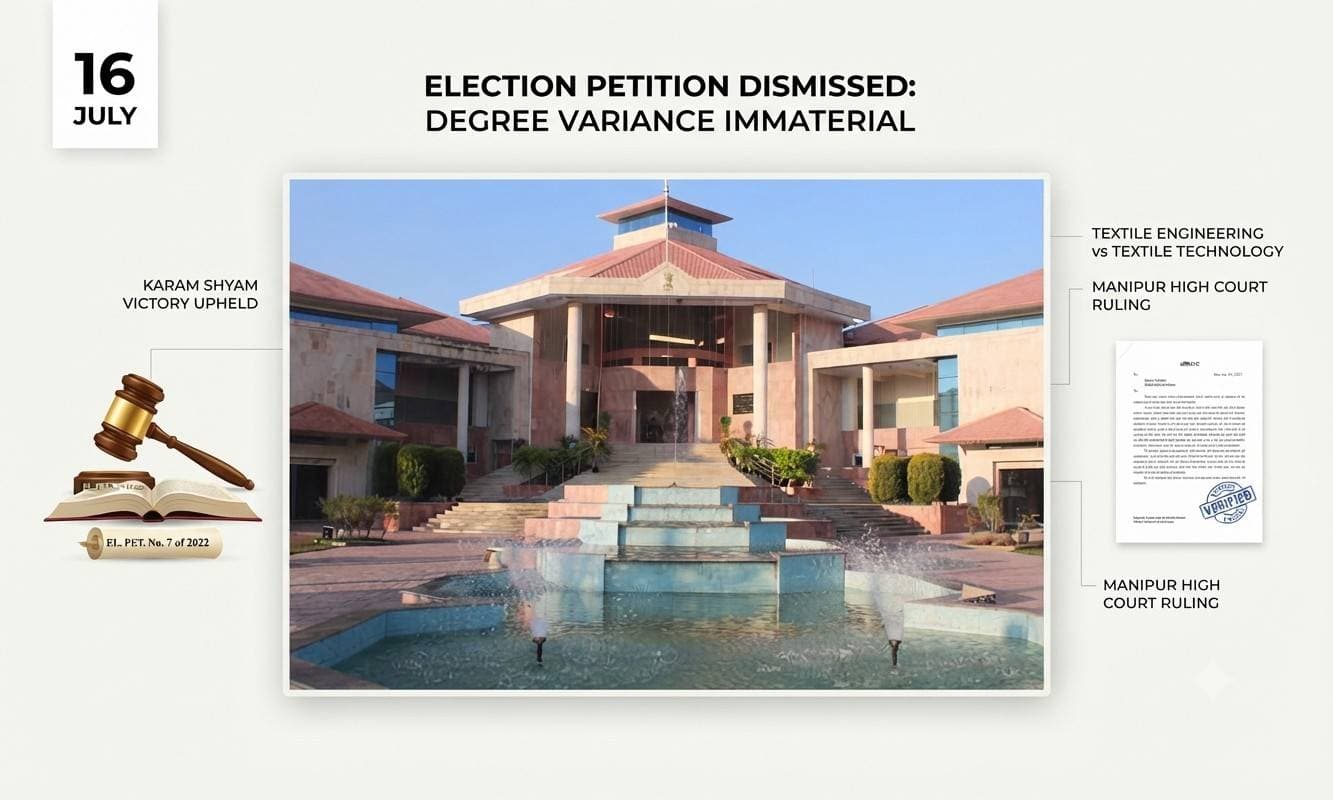
The Manipur High Court dismissed the election petition filed by Congress candidate Okram Joy Singh challenging the victory of Bharatiya Janata Party’s Karam Shyam in the Langthabal constituency of the 2022 Assembly elections. The petitioner alleged that the returned candidate had failed to disclose his educational qualification accurately and had omitted details of non‑agricultural land holdings in Form‑26.
Chief Justice M Sundar, who authored the order, observed that there was no dispute that Karam Shyam had pursued a four‑year Bachelor’s programme at the Government Central Textile Institute, Kanpur, and had successfully completed the course in 1987. The sole point of contention was the nomenclature used in the affidavit: the candidate had entered “Textile Engineering” whereas the university awarded the degree in “Textile Technology”.
The court examined the distinction between substantial and insubstantial mis‑disclosures as laid down by the Supreme Court in earlier election jurisprudence. It concluded that the variance between the two terms did not qualify as a substantial mis‑disclosure because the essential fact—that the candidate possessed a four‑year Bachelor’s degree in a textile‑related discipline from a recognised institute—remained undisputed. The bench emphasized that the voter’s informed choice depends on the awareness of the candidate’s educational background in broad terms, not on the precise nomenclature of the course.
In its reasoning, the court stated that any voter who attended the polling booth on 28 February 2022 would have known for certain that the returned candidate held a four‑year Bachelor’s degree pertaining to the textile industry from the Government Central Textile Institute. Consequently, a voter valuing a graduate‑level qualification would have supported the candidate irrespective of whether the degree was described as Textile Technology or Textile Engineering. The bench added that the opposite viewpoint—that a highly qualified graduate might be ineffective in representing constituents—would also lead to the same electoral outcome, rendering the discrepancy immaterial.
Regarding the allegation of non‑disclosure of non‑agricultural land, the court found no evidence to substantiate the claim. It noted that the petitioner failed to produce material showing that such land existed or that its omission could have influenced the electorate. The bench held that without proof of actual non‑disclosure, the plea could not be sustained.
Applying these principles, the Manipur High Court ruled that the alleged infraction did not materially affect the election result and therefore did not warrant the rejection of the nomination or the annulment of the victory. The court dismissed Okram Joy Singh’s election petition (EL. PET. No. 7 of 2022) and, in the same order, disposed of Karam Shyam’s election recrimination petition (EL. RECR. PET. No. 5 of 2022), which had challenged the petitioner’s claim.
The decision reinforces the precedent that minor variations in the description of academic qualifications, where the underlying fact of possessing the requisite degree is undisputed, are insufficient to constitute a ground for setting aside an election under the Representation of the People Act, 1951. It also underscores the evidentiary burden on challengers to demonstrate that any alleged non‑disclosure has a tangible impact on the voter’s informed choice.