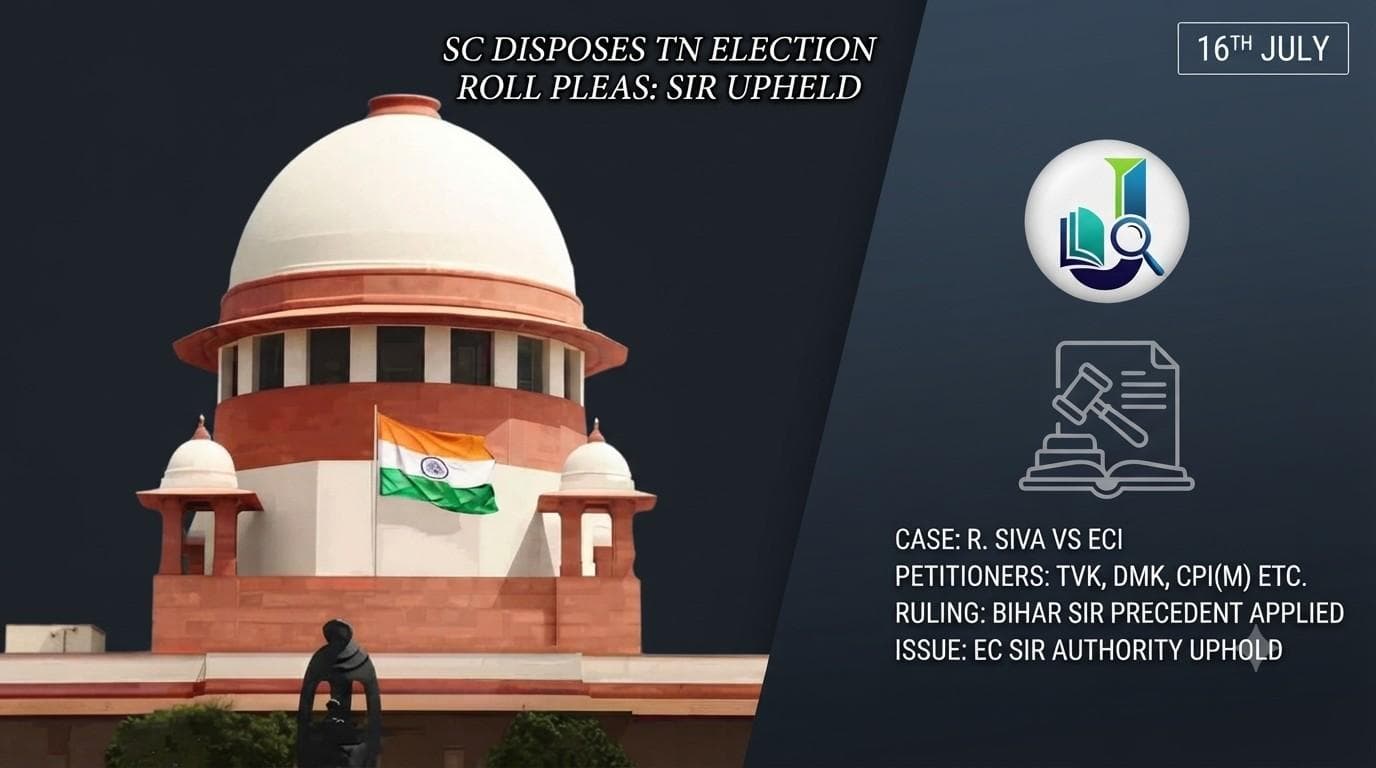
The Supreme Court today disposed of a batch of petitions that questioned the legality of the Election Commission's Special Intensive Revision (SIR) exercise carried out in Tamil Nadu. The bench comprising Chief Justice Surya Kant, Justice Joymalya Bagchi and Justice V Mohana passed the order after noting that the question of the Commission's authority to conduct such a revision had already been settled in the Bihar SIR judgment.
The petitioners, which included the Tamilaga Vettri Kazhagam (TVK), leaders of the Dravida Munnetra Kazhagam (DMK), members of the Communist Party of India (Marxist), Lok Sabha member Thol Thirumavalavan, former State MLA K Selvaperunthagai and several other individuals, contended that the SIR notified by the Election Commission was unlawful. They argued that a Special Summary Revision (SSR) had already been completed in the state between October 2024 and 6 January 2025, during which the electoral roll had been updated to reflect migration, deaths and the removal of ineligible voters. The revised roll was published on 6 January 2025 and had been continuously updated thereafter.
Despite the completion of the SSR, the Election Commission issued a fresh notification for a SIR, introducing new guidelines that required citizenship verification, particularly for persons whose names did not appear in the 2003 electoral roll. The petitioners submitted that by imposing documentation requirements akin to a citizenship test, the Commission was effectively exercising a power that belongs exclusively to the Union Government under the Citizenship Act, 1955. They described the SIR as amounting to a de facto National Register of Citizens (NRC).
The petitions further alleged that the SIR violated several constitutional provisions, namely Articles 10, 14, 19, 21 and 326, by infringing the right to vote, the right to equality, freedom of expression, protection of life and personal liberty, and the principle of universal adult suffrage. It was also contended that the exercise undermined the basic structure of the Constitution and the federal principle. In addition, the petitioners claimed that the SIR contravened statutory requirements under Sections 21 and 23 of the Representation of the People Act, 1950, asserting that the exercise amounted to a de novo preparation of electoral rolls without any recorded reasons or justification.
In contrast, the All India Anna Dravida Munnetra Kazhagam (AIADMK) had filed an application supporting the SIR, describing it as a legitimate and necessary measure to preserve the sanctity of elections and to prevent voter fraud.
The bench, after hearing the arguments, observed that the question of the Election Commission's power to conduct a Special Intensive Revision had already been considered and upheld in the Bihar SIR batch of cases. Relying on that precedent, the Court found no merit in the fresh challenges raised in the Tamil Nadu petitions and consequently disposed of the batch. The order clarified that the petitioners remain at liberty to pursue any other legal remedies available under the law.
Notice on the petitions challenging the Tamil Nadu SIR had been issued in November of the preceding year. The case is titled R. Siva versus Election Commission of India, bearing W.P.(C) No. 1109 of 2025.