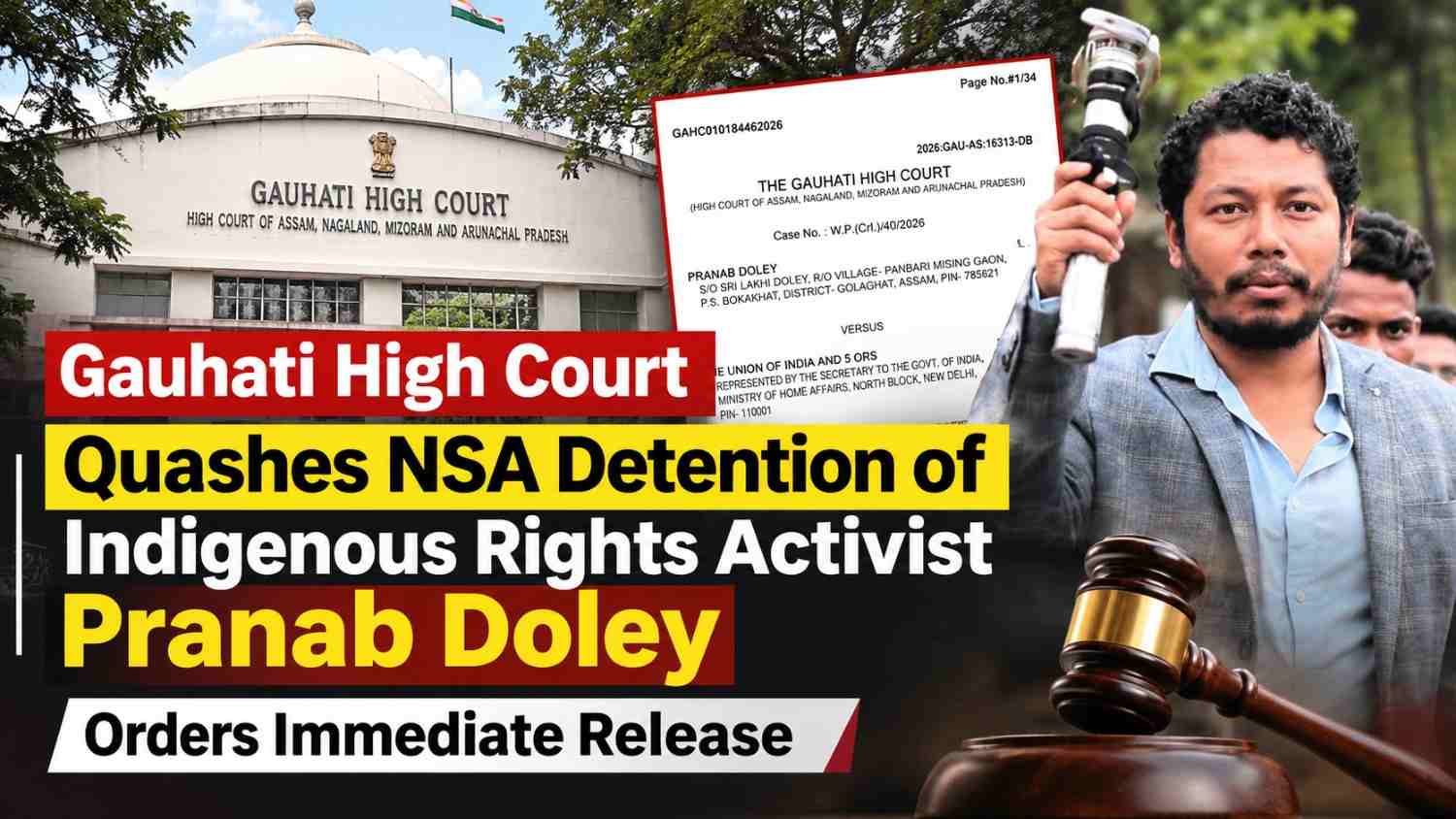
Guwahati, November 6, 2026: The Gauhati High Court has quashed the preventive detention of indigenous rights activist Pranab Doley under the National Security Act, 1980 (NSA), citing serious procedural lapses and violations of constitutional safeguards. The Court also directed the authorities to release him from preventive detention immediately.
A Division Bench comprising Justice Kalyan Rai Surana and Justice Susmita Phukan Khaund delivered the judgment on November 6, 2026, in a habeas corpus petition filed by Pranab Doley under Article 226 of the Constitution of India.
The case arose after the Assam Government passed a detention order against Doley on July 30, 2026, under Section 3(2) of the National Security Act, 1980. The State Government claimed that his activities were prejudicial to the maintenance of public order and the security of the State.
The detention order referred to several criminal cases registered against him, allegations relating to protests and road blockades, foreign visits and certain financial transactions. The authorities also relied on an incident dated June 28, 2026, at Hatikhuli in Golaghat district, involving a protest at the proposed Assam Tea Tribe Museum and ATDC-Hyatt project site.
Challenging his detention, Doley approached the High Court, arguing that the authorities had failed to follow the legal and constitutional requirements for preventive detention.
One of the major issues examined by the Court was the reliance placed by the authorities on 13 criminal cases against Doley. During the proceedings, it was brought to the Court's notice that he had been acquitted in nine cases and discharged in one case. Another case was stayed by the High Court, while the remaining cases were at different stages of proceedings.
The Bench observed that the detention authorities had failed to properly disclose the actual status of these criminal cases while passing the detention order. The Court also noted that the facts relating to his acquittal and discharge had not been properly placed before the detaining authority.
Relying on the Supreme Court's decision in Dharamdas Shamlal Agarwal v. Police Commissioner, the Court observed that important facts which could influence the decision of the detaining authority must be placed before it. Failure to disclose such material information affects the required subjective satisfaction of the authority and can make a detention order legally invalid.
The Court further examined whether Doley had been provided with all the relevant documents necessary to challenge his detention.
It found that although copies of the FIRs in the 13 criminal cases were supplied to him, copies of charge-sheets in 11 cases and other investigation materials relied upon by the authorities had not been furnished.
The Bench also pointed out that certain allegations relating to road blockades and damage to public property did not contain sufficient details, including the specific dates, times and places of the alleged incidents.
The Court observed that a person detained under the National Security Act must be provided with sufficient information and relevant documents to understand the grounds of detention and make an effective representation against it. The failure to supply such materials affected Doley's constitutional right to challenge his detention.
Another important issue concerned Doley's second representation against his preventive detention dated August 10, 2026.
The judgment records that Doley had submitted his first representation on August 4, 2026. However, at that time, he did not have access to his family members, friends or legal counsel. His father subsequently approached the High Court seeking permission for family members and his lawyer to meet him.
Following the Court's intervention, Doley was allowed to meet his family members and legal counsel. After that meeting, he submitted a second representation on August 10, 2026.
The High Court observed that Doley could make an effective representation against his detention only after getting access to his family, friends and lawyer. Therefore, the second representation was considered to be his detailed representation against the detention order.
The Bench held that the Superintendent of District Jail, Golaghat, was required to forward this representation to the Central Government, State Government, detaining authority and Advisory Board. However, the representation was not forwarded and considered by the concerned authorities.
The Court held that the failure to deal with the second representation was fatal to the continued preventive detention of Doley.
The Bench also examined the allegations relating to his foreign visits and financial transactions. The State Government had referred to 14 foreign visits and several foreign remittances received by Doley over the years to support its decision to detain him.
However, the Court found that the authorities had failed to establish how these foreign visits or financial transactions were connected with any activity threatening the security of the State or affecting public order.
The Court observed that repeated foreign visits, by themselves, cannot become a ground for preventive detention or justify restricting a person's fundamental right to travel.
It further noted that the authorities had failed to establish any connection between the foreign remittances and the protest activities attributed to Doley. The long gap between the earlier foreign transactions and the detention order had also broken the required live and proximate link between the alleged activities and the purpose of detention.
After examining these issues, the Gauhati High Court identified four major reasons for quashing the detention order: reliance on stale criminal cases without properly disclosing their status, failure to provide relevant documents, non-consideration of the second representation dated August 10, 2026, and the absence of a sufficient connection between foreign travel and financial transactions and the alleged activities.
The Court also observed that the detaining authority had failed to properly apply its mind to whether ordinary criminal law was insufficient to deal with the activities attributed to Doley before resorting to preventive detention.
Accordingly, the Division Bench allowed the writ petition and set aside the detention order dated July 30, 2026, along with the grounds of detention issued by the Assam Government.
The Court directed that Pranab Doley be released and set at liberty forthwith from preventive detention. Both parties were directed to bear their own costs.
The judgment highlights the importance of following constitutional safeguards while exercising the power of preventive detention. Although the National Security Act empowers the government to detain individuals in certain circumstances, such power must be exercised in accordance with the law and constitutional requirements.
The decision also reinforces that a detained person must receive relevant documents and a proper opportunity to challenge the detention. Authorities must consider important facts fairly and deal with representations without unnecessary delay.
Case Details:
Case Title: Pranab Doley v. Union of India and Others
Case Number: W.P.(Crl.)/40/2026
Court: Gauhati High Court
Bench: Justice Kalyan Rai Surana and Justice Susmita Phukan Khaund
Date of Judgment: November 6, 2026