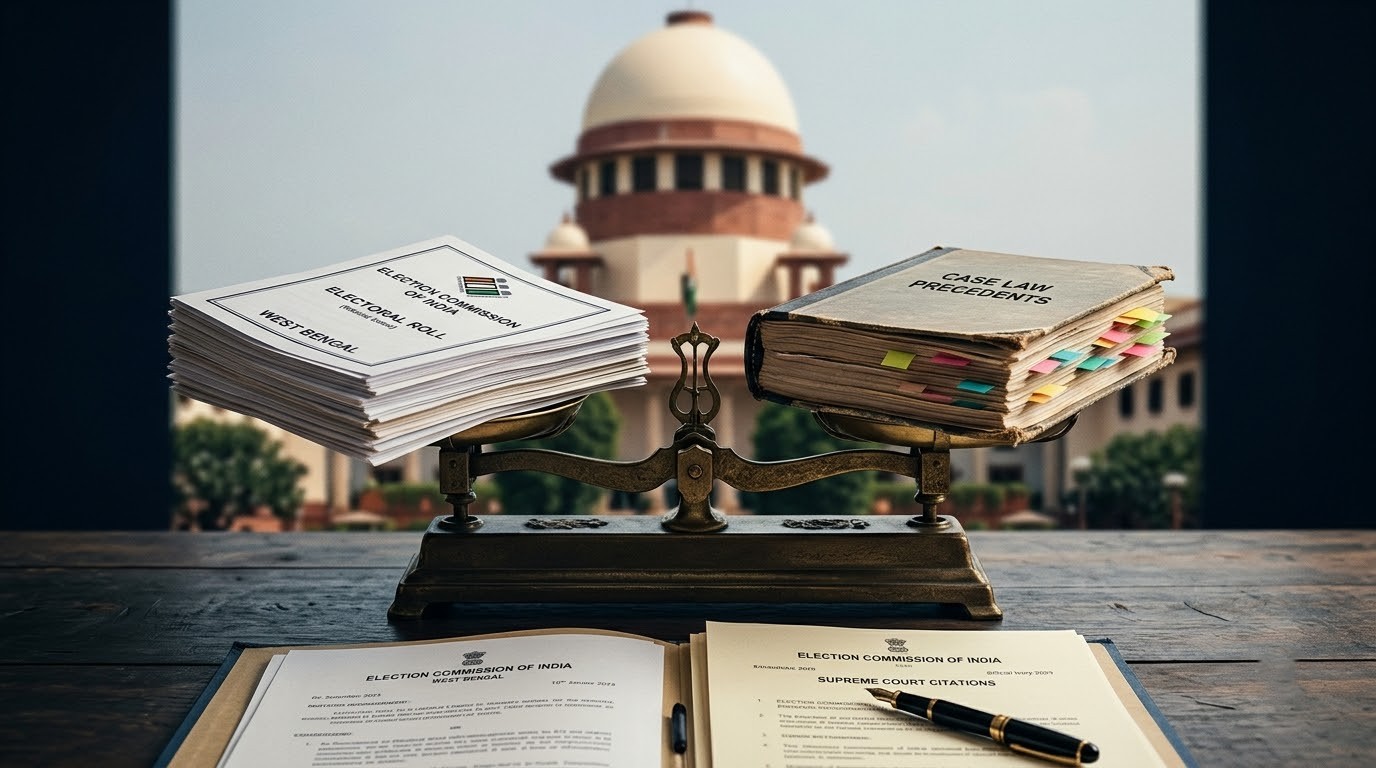
The Election Commission of India (ECI) has informed the Supreme Court that the 16.10 lakh appeals filed against the inclusion of voters following the Special Intensive Revision (SIR) in West Bengal were instituted by officers of the State's Chief Electoral Officer (CEO) in their statutory capacity under the Representation of the People Act, 1950. The Commission submitted that these officers were authorised to file the appeals pursuant to specific directions issued by the Supreme Court in April 2026, and that the matters were not placed before the Commission for prior approval.
The position was set out in a counter-affidavit filed on October 26 by Deputy Election Commissioner Bhanu Prakash Yeturu on behalf of the Chief Election Commissioner Gyanesh Kumar and Election Commissioners Sukhbir Sandhu and Vivek Joshi. The affidavit responds to a petition challenging 14 alleged unilateral decisions concerning the SIR exercise, specifically questioning the authority under which the mass appeals were filed in the name of the ECI.
What Authorised The Filing Of 16.10 Lakh Appeals Against Voter Inclusions In West Bengal?
The ECI asserts that officers of the CEO's office in West Bengal filed the appeals as statutory authorities under the RP Act, 1950, relying on Supreme Court orders dated April 1 and April 6, 2026, which expressly contemplated appeals by ECI authorities aggrieved by voter inclusions and directed appellate tribunals to hear them.
The petition under challenge had relied on an August 12, 2026 noting attributed to Election Commissioner Sukhbir Singh Sandhu, which questioned who had authorised the filing of the appeals and by whom. The petitioner sought production of the relevant authorisation, approval, and decision-making records.
In its affidavit, the ECI cited the Supreme Court's orders in Mostari Banu v. Election Commission of India dated April 1, 2026 and April 6, 2026. These orders were passed in the context of the SIR exercise where the Court had appointed judicial officers to adjudicate claims and objections, and subsequently directed the constitution of appellate tribunals to hear appeals against exclusions from the electoral rolls.
The April 1 order recorded the submission of the ECI's counsel that appellate tribunals would have access to relevant records in appeals filed both by persons challenging exclusions and by ECI authorities challenging inclusions. The Court directed the tribunals to examine complete records, including reasons given by the adjudicating officers, evolve their own procedure consistent with natural justice, and afford affected parties a fair hearing.
The April 6 order reiterated this framework. It clarified that the alleged non-availability of reasons for rejection of objections by adjudicating officers could be raised before the Appellate Tribunals by persons excluded from the voters' list or by objectors and authorities of the ECI aggrieved by the inclusion of certain names.
The ECI's affidavit states that under the RP Act, the CEO, District Election Officer (DEO), Electoral Registration Officer (ERO), and Assistant Electoral Registration Officer (AERO) are the authorities responsible for electoral rolls. It submits that a communication dated October 22, 2026 received from the office of the CEO, West Bengal, confirmed that the appeals were filed by officers of that office in their capacity as authorities under the Act. The Commission maintains that these officers possessed the authority to file the appeals as per the Supreme Court's orders and that the matters were not brought to the Commission.
Date | Supreme Court Order / Event | Key Direction Regarding Appeals |
|---|---|---|
April 1, 2026 | Mostari Banu v. ECI Order | Recorded ECI counsel's submission that appellate tribunals would hear appeals by ECI authorities against inclusions; directed tribunals to examine complete records and ensure natural justice. |
April 6, 2026 | Mostari Banu v. ECI Order | Clarified that ECI authorities aggrieved by inclusions could raise non-availability of reasons before Appellate Tribunals. |
August 12, 2026 | Internal ECI Noting (attributed to EC Sukhbir Sandhu) | Questioned authorisation for filing 16.10 lakh appeals; formed basis of petition challenging unilateral decisions. |
October 22, 2026 | Communication from CEO, West Bengal to ECI | Confirmed appeals filed by CEO's office officers as statutory authorities under RP Act, 1950. |
October 26, 2026 | ECI Counter-Affidavit Filed | Asserted statutory authority of CEO/DEO/ERO/AERO officers to file appeals per Supreme Court orders; matters not referred to Commission. |
The Commission's stance draws a distinction between the statutory hierarchy under the RP Act and the Commission's own decision-making process. By identifying the CEO, DEO, ERO, and AERO as the designated authorities for electoral roll management, the affidavit argues that the filing of appeals by the CEO's office officers fell within their statutory mandate and was further sanctioned by the Supreme Court's procedural directions for the SIR appellate process.
The petition challenging the SIR decisions remains pending before the Supreme Court. The counter-affidavit seeks to demonstrate that the volume of appeals filed was not an unauthorised executive action but a consequence of the Court's own directions establishing an appellate mechanism accessible to electoral authorities.