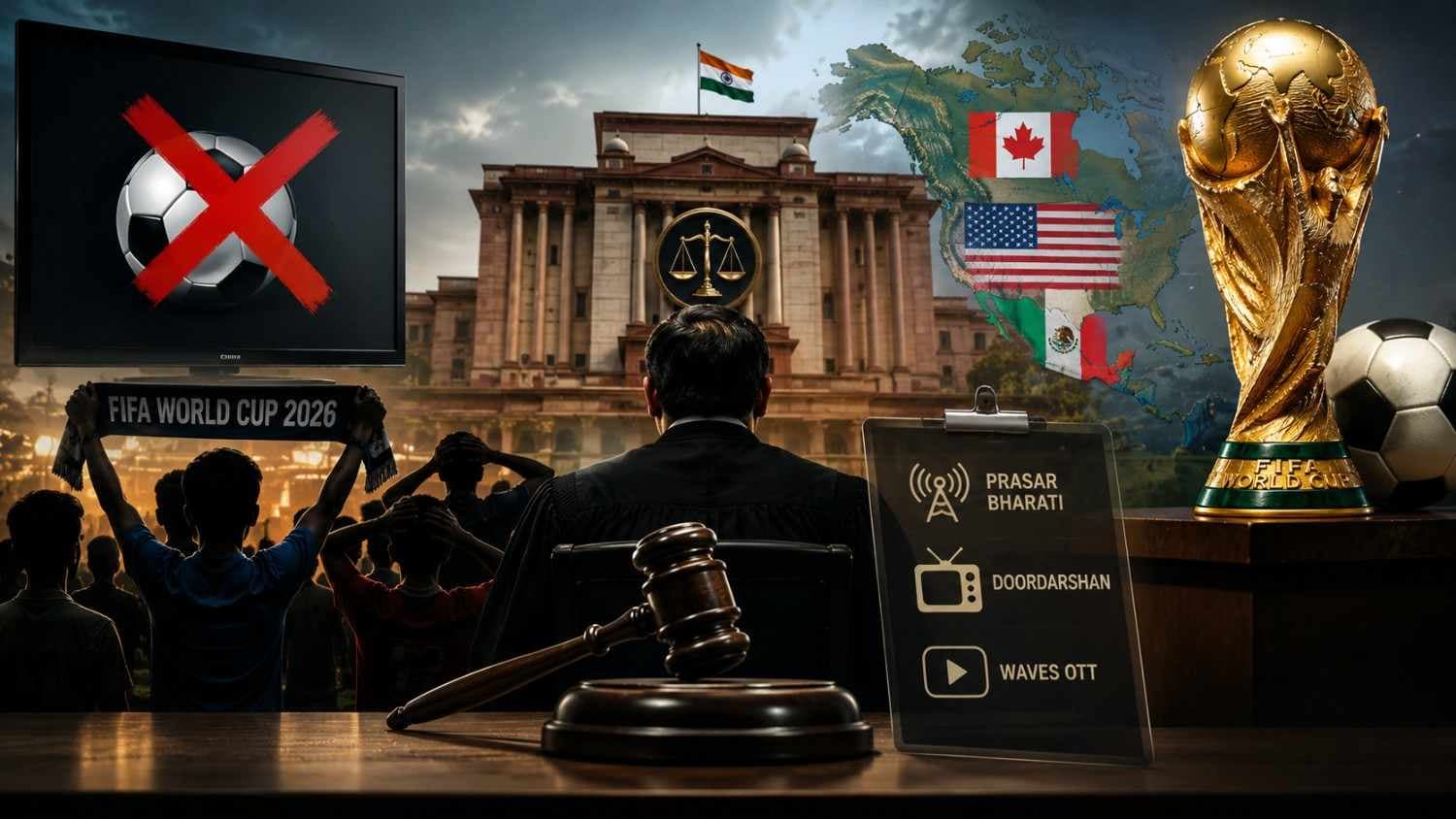
With the FIFA World Cup 2026 just a month away, football fans in India find themselves in an unprecedented state of uncertainty. Despite being one of the world's largest viewership markets, no major broadcaster has yet secured the media rights for the tournament in India. In response to this looming blackout, the Delhi High Court has stepped in, issuing a notice to the Union Government and Prasar Bharati to explore how the "beautiful game" can reach the masses via free-to-air platforms.
The petition, filed by advocate Avdhesh Bairwa, highlights a startling reality: while previous editions were easily accessible via platforms like Sony or JioCinema, the 2026 cycle has seen a complete stalemate in negotiations. Reports suggest that FIFA initially valued the Indian rights at nearly $100 million, but even after slashing the price to $35 million due to a lack of market interest, no private deal has been finalized. This has left the broadcast future of the 104-match tournament hanging by a thread.
The legal argument hinges on the Sports Broadcasting Signals (Mandatory Sharing with Prasar Bharati) Act, 2007. The petitioner contends that because the FIFA World Cup is notified as a "sporting event of national importance," the government has a duty to ensure citizens aren't deprived of access. Denying millions of fans the chance to watch the event, the plea argues, is a violation of their fundamental right to receive information and participate in the nation's burgeoning sports culture.
Justice Purushaindra Kumar Kaurav, presiding over the matter, noted that while the petition is structured as a writ, the reliefs sought are inherently in the nature of a Public Interest Litigation (PIL). Senior Advocate Vaibhav Gaggar, representing the petitioner, emphasized that a "nudge" from the court is necessary to push the Ministry of Information and Broadcasting (MIB) and Prasar Bharati into action. The goal is to secure at least the high-stakes matches—the opening game, quarter-finals, semi-finals, and the final—on Doordarshan and DD Sports.
Beyond the legal technicalities, the lack of interest from private broadcasters is largely attributed to the "unfavorable" match timings. With the tournament hosted across the United States, Canada, and Mexico, many marquee matches are scheduled for 12:30 AM or 3:30 AM IST. For private entities, these late-night slots make it difficult to recover high licensing costs through traditional advertising, leading to the current deadlock in rights acquisition.
However, the petitioner argues that India’s engagement with football cannot be measured solely by ad revenue. Citing data from the 2022 World Cup, which saw over 745 million digital interactions from India, the plea stresses that the social and cultural impact of the tournament outweighs the commercial challenges. Ensuring access through the public broadcaster’s infrastructure—including the WAVES OTT platform—is presented as the only viable solution to prevent a total blackout.
The Delhi High Court has now asked the respondent authorities to obtain instructions and file their replies, with the matter listed for further hearing on May 20, 2026. This leaves a very narrow window for the government to negotiate with FIFA. If the court's intervention leads to a breakthrough, it could set a massive precedent for how global sporting events are treated as public goods in the digital age.
In conclusion, the next few days will be critical for the millions of Indian fans waiting for a "kick-off" on their television screens. Whether through a last-minute deal or a mandatory public broadcast, the hope remains that the FIFA World Cup trophy will be visible in every Indian household. For now, the ball is firmly in the court of the government and Prasar Bharati.