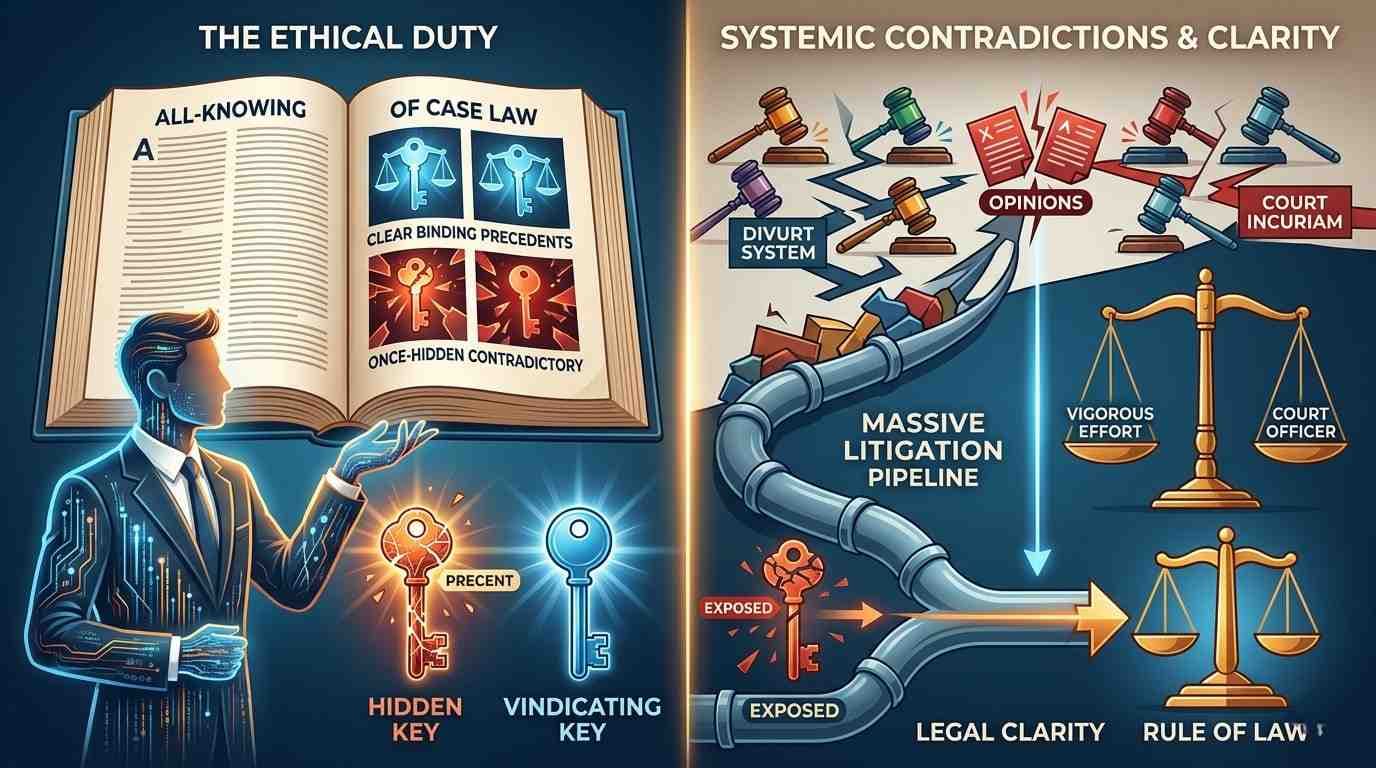
In the high-stakes arena of courtroom litigation, the traditional strategy has always been intuitive: highlight the precedents that vindicate your client and quietly ignore the ones that do not. For decades, legal battles have been treated as adversarial chess matches where revealing a vulnerability is seen as tactical surrender. However, a major ruling from the Supreme Court has fundamentally challenged this practice. The apex court declared that advocates carry a binding ethical obligation to bring all relevant judgments to the court's notice—even those that directly damage or contradict their own case.
This directive targets a growing structural problem within the modern legal architecture: the crisis of conflicting judicial opinions. In an era where courts have become heavily polyvocal, thousands of orders, rulings, and observations are generated daily across diverse jurisdictions. This massive volume of legal data makes it nearly impossible for any individual judge to stay abreast of every minor shift in precedent. When lawyers actively choose to conceal adverse rulings, different benches of the exact same High Court frequently end up delivering contradictory conclusions on identical points of law, throwing the entire legal system into a state of profound uncertainty.
The Supreme Court explicitly clarified that an advocate's role cannot be reduced to winning at all costs. While lawyers are expected to make every legitimate, vigorous effort to secure a favorable outcome for their clients, this ambition must be strictly balanced with their foundational duty as officers of the court. True professional competence is not demonstrated by pretending opposing interpretations do not exist, but by confronting them openly. A practitioner's command over the law is proven when they can present a seemingly damaging precedent and successfully distinguish it based on the specific facts of the dispute at hand.
By suppressing unfavorable decisions, practitioners do more than just compromise professional ethics; they actively actively increase institutional inefficiency. Hidden precedents routinely lead to per incuriam decisions—rulings passed in ignorance of a binding statutory provision or a higher court's previous judgment. These flawed orders inevitably trigger a long chain of subsequent appeals, reviews, and corrections, unnecessarily inflating the nation's already massive litigation backlog. Transparency at the briefing stage is therefore reframed not just as a moral ideal, but as an essential mechanism for administrative efficiency.
Crucially, the apex court emphasized that this responsibility to preserve legal consistency does not rest solely on the shoulders of the Bar. The relationship between the Bar and the Bench is an interdependent partnership, and the judiciary bears its own independent, tri-fold duty. Even if a counsel fails to cite a crucial piece of case law, a judge is independently required to apply the correct law, maintain strict consistency with established precedent, and actively prevent flawed rulings. However, expecting a single judge handling a chaotic roster of nearly a hundred diverse matters a day to catch every single omission is a structural impossibility.
This reality underscores the necessity of shared institutional accountability. The entire justice delivery system functions optimally only when both constituents operate with a unified sense of service to the rule of law rather than a narrow focus on individual victories. When a lawyer acts as a transparent guide to the entire legal landscape of an issue, the court can make informed decisions right away, drastically reducing the time spent resolving subsequent disputes.
Ultimately, this ruling sets a new baseline for professional discipline and institutional integrity in Indian courts. It transforms the practice of law from a strategic game of hide-and-seek into an authentic search for legal clarity. By demanding that advocates present a complete and unfiltered view of applicable law, the Supreme Court is working to eliminate systemic contradictions, streamline trial procedures, and ensure that predictability remains the bedrock of the country's legal order.