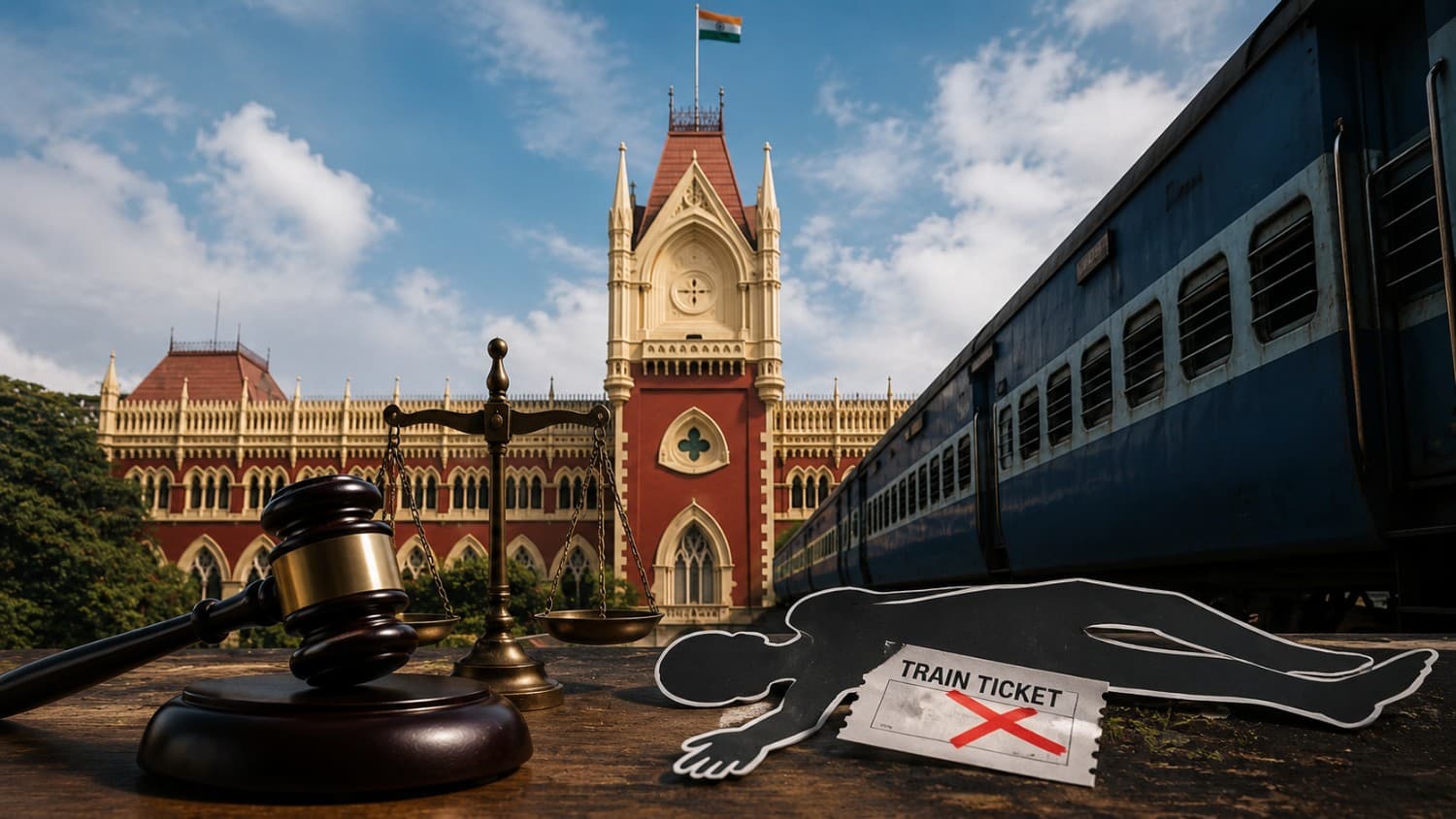
The Calcutta High Court has observed that in cases of railway untoward incidents involving deceased passengers, the non-recovery of a ticket from the victim’s person or belongings cannot, by itself, lead to the conclusion that the deceased was travelling without a valid ticket. Justice Biswaroop Chowdhury made this observation while allowing an appeal filed by the family of Bappu Pal against the order of the Railway Claims Tribunal, which had rejected their claim for compensation.
The Tribunal had dismissed the claim on two grounds: first, that the claimants failed to establish that the deceased was a bona fide passenger, and second, that there was insufficient proof that the death resulted from a fall from a running train. The High Court, however, found these conclusions to be unsupported by the evidence on record.
The Court placed significant reliance on the testimony of Pintu Pal, the deceased’s brother, who stated unequivocally that Bappu Pal had purchased a ticket and boarded the train on April 9, 2019. The Court noted that there was no material inconsistency in Pintu Pal’s statement when compared to his earlier deposition before the Railway Protection Force (RPF) authorities. This consistency, the Court held, lent credibility to his account and supported the inference that the deceased had indeed possessed a valid ticket at the time of travel.
Furthermore, the High Court took note of the police report filed under Section 174 of the Code of Criminal Procedure, 1973, which recorded the seizure of a ticket in connection with the incident. Although the ticket was not produced in court, the Court observed that its mention in the official record corroborated the claim that the deceased had been in possession of a ticket. The absence of physical recovery, the Court clarified, could be attributed to the circumstances of the accident — the deceased having fallen from a moving train amid heavy rush — and should not be used to disadvantage the claimants.
The Court emphasized that it is not uncommon in such cases for the family of the victim to be unable to produce an eyewitness to the fall, particularly when the incident occurs in crowded conditions. In such situations, reliance must be placed on available circumstantial evidence, including police records, railway documents, and credible oral testimony. The Court observed that in many railway untoward incident cases where tickets are not recovered, courts may appropriately look to such evidence to determine the passenger’s bona fides.
Drawing on general human behaviour, the Court also observed that a person would not ordinarily risk travelling without a ticket given the likelihood of detection and the attendant penalties, including fines and possible prosecution. It further held that it would be unjust to saddle a deceased individual with an allegation of ticketless travel when they are no longer in a position to defend themselves or explain the absence of the ticket.
Based on these considerations, the Calcutta High Court concluded that the evidence was sufficient to establish that Bappu Pal was a bona fide passenger at the time of the incident. Accordingly, the Court held that his death constituted an ‘untoward incident’ under Section 123(c) of the Railways Act, 1989, thereby entitling his dependants to compensation under Section 124A of the same Act.
The High Court set aside the order of the Railway Claims Tribunal and directed the Railways to pay a sum of Rs 8 lakh as compensation, along with interest at the rate of 6% per annum from the date of filing of the claim case. The amount is to be deposited before the Registrar General of the Calcutta High Court within a period of eight weeks from the date of the order.
The case, titled Anamika Halder (Pal) & Ors. v. Union of India, bears Case No. F.M.A. 1152 of 2025 and arose from the tragic demise of Bappu Pal on April 9, 2019, following his fall from a running local train during peak hours. The judgment reinforces the principle that procedural and evidentiary hurdles arising from the unfortunate circumstances of a victim’s death should not be allowed to undermine a legitimate claim for compensation under the Railways Act.