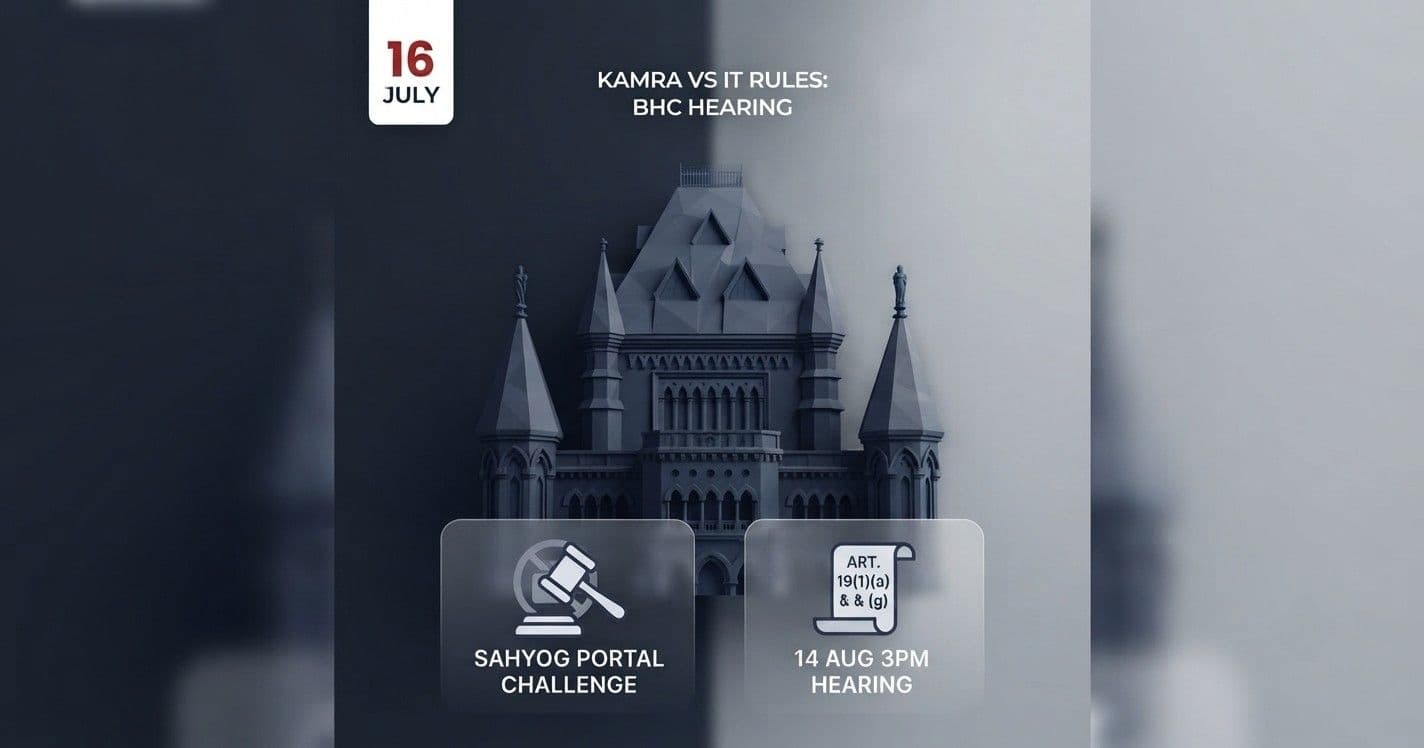
Kunal Kamra instituted a writ petition before the Bombay High Court earlier this year assailing the Sahyog Portal and the amendment to Rule 3(1)(d) of the IT Rules, 2021. The petitioner contends that the portal and the amended rule enable the blocking of online content on social media intermediaries without the procedural safeguards mandated by Section 69A of the Information Technology Act, 2000. The challenge is framed as a violation of the freedom of speech and expression guaranteed under Article 19(1)(a) of the Constitution and also as an infringement of the right to carry on any occupation, trade or business under Article 19(1)(g).
The petition further argues that the Sahyog Portal operates as a parallel mechanism to the statutory blocking framework, thereby circumventing the requirements of prior notice and hearing prescribed under the Blocking Rules. It asserts that the impugned provisions lack statutory legitimacy because they cannot be traced to any enabling provision in the IT Act; specifically, Section 79(3)(b) merely grants exemptions to intermediaries and does not confer authority to create an independent takedown regime.
In addition, the petitioner challenges the delegation of blocking powers to state governments and departments, maintaining that such authority resides exclusively with the Union under List I of the Seventh Schedule to the Constitution.
Court Proceedings and Observations
The matter was mentioned before a division bench comprising Acting Chief Justice Ravindra Ghuge and Justice Gautam Ankhad. Senior Advocate Navroz Seervai, representing Kamra, pointed out that despite multiple opportunities, the Union government had not yet filed its affidavit in response to the petition. He emphasized that the case concerns a fundamental right and urged the court to expedite the government's response.
Additional Solicitor General Anil Singh, appearing for the Centre, sought an extension until August to place the government's reply on record. Seervai opposed this request and pressed for an early hearing, arguing that delay would prejudice the petitioner's right to a timely adjudication.
After hearing the submissions, the bench directed the Centre to file its affidavit by 29 July 2026. It also granted Kamra until 6 August 2026 to file a rejoinder to the government's response. The matter has been fixed for hearing on 14 August 2026 at 3:00 p.m.
When Seervai urged the court to record that the extension would be the government's last chance to file its response, Acting Chief Justice Ghuge declined to make such a remark on the record.
Legal Contentions Raised in the Petition
The petition contends that the Sahyog Portal permits the blocking of online content without prior notice to the affected user, thereby violating principles of natural justice. It argues that this practice contravenes the free speech guarantee under Article 19(1)(a) and also impacts the right to practice any profession under Article 19(1)(g).
Reliance is placed on the Supreme Court's judgment in Shreya Singhal v Union of India (2015), which struck down Section 66A of the IT Act for being vague and overbroad. The petitioner asserts that the Sahyog Portal and the amended Rule 3(1)(d) suffer from similar infirmities and are therefore ultra vires the parent statute.
The plea further argues that the impugned provisions create a blocking framework that runs parallel to the procedure laid down in Section 69A and the Blocking Rules, yet they do not incorporate the safeguards of prior notice, hearing, and reasoned orders. This, according to the petitioner, renders the mechanism manifestly arbitrary and violative of Articles 19(1)(a) and 19(1)(g).
Finally, the petitioner maintains that the power to issue directions for blocking information cannot be delegated to state governments, as the legislative field for such measures is occupied exclusively by the Union under List I of the Seventh Schedule.
Implications of the Court’s Direction
By fixing a timeline for the Centre's reply and the petitioner's rejoinder, the Bombay High Court seeks to ensure that the matter proceeds to substantive hearing without undue delay. The direction underscores the court's willingness to monitor the government's compliance with procedural obligations in cases involving fundamental rights.
The upcoming hearing on 14 August 2026 will allow the bench to examine the rival contentions on the constitutionality of the Sahyog Portal and the amended IT Rule. The outcome may have bearing on the scope of intermediary liability, the extent of executive powers to block online content, and the protection of free speech in the digital sphere.