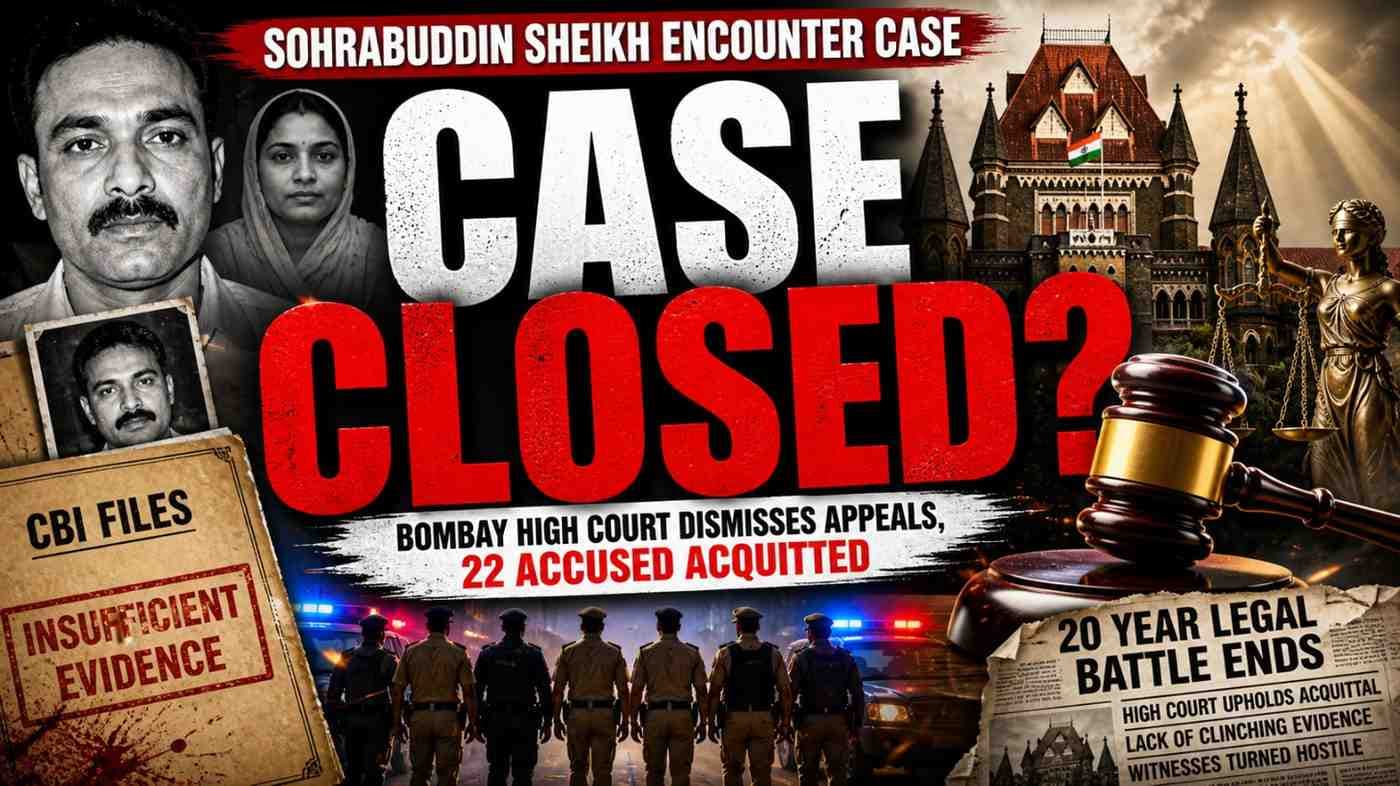
The Bombay High Court has officially dismissed the appeals challenging the acquittal of 22 people, including police personnel from Gujarat, Rajasthan, and Andhra Pradesh, in the Sohrabuddin Shaikh encounter case. The bench, while delivering the verdict, noted that the evidence presented by the Central Bureau of Investigation (CBI) was insufficient to link the accused to the alleged crime. This ruling marks a definitive legal conclusion to a case that has spanned nearly two decades and generated significant national discourse.
The case originated from an incident in 2005 involving the death of Sohrabuddin Shaikh, his wife Kausar Bi, and their associate Tulsiram Prajapati. While the prosecution alleged that the encounters were cold-blooded murders carried out as part of a larger conspiracy, the defense maintained that the officers were acting in the line of duty against a known criminal with alleged terror links.
In its detailed analysis, the High Court emphasized that the "prosecution has to stand on its own legs." The bench observed that a large number of witnesses had turned hostile during the trial, leaving a void in the evidentiary chain. The court reiterated the fundamental legal principle that suspicion, however strong, cannot take the place of proof in a criminal trial. It found no reason to interfere with the 2018 judgment of the special CBI court, which had originally cleared the accused of all charges.
The judgment also touched upon the difficulty of proving a "criminal conspiracy" under Section 120B of the IPC (now under the Bharatiya Nyaya Sanhita). The Court noted that conspiracy requires a "meeting of minds" to commit an illegal act, and in this instance, there was no documented or oral evidence that could bridge the gap between the actions of the individual officers and a collective criminal plan.
For the legal community, this verdict highlights the critical role of witness protection and the challenges faced by investigative agencies in high-profile cases involving state officials. The court’s insistence on "clinching evidence" serves as a reminder of the high burden of proof required in cases involving the death penalty or life imprisonment.
As the warrants of legal finality are stamped on this case, the focus shifts to the broader implications for police reforms and the accountability of investigative agencies. The acquittal of the 22 accused signifies that, in the eyes of the law, the allegations of a fake encounter remain unproven due to a lack of substantiating facts.
In conclusion, the Bombay High Court's decision brings to an end one of the most closely watched legal battles in recent Indian history. By upholding the trial court’s findings, the judiciary has reinforced the necessity of a rigorous evidentiary standard, ensuring that convictions are based strictly on verifiable truth rather than public perception or circumstantial narratives.