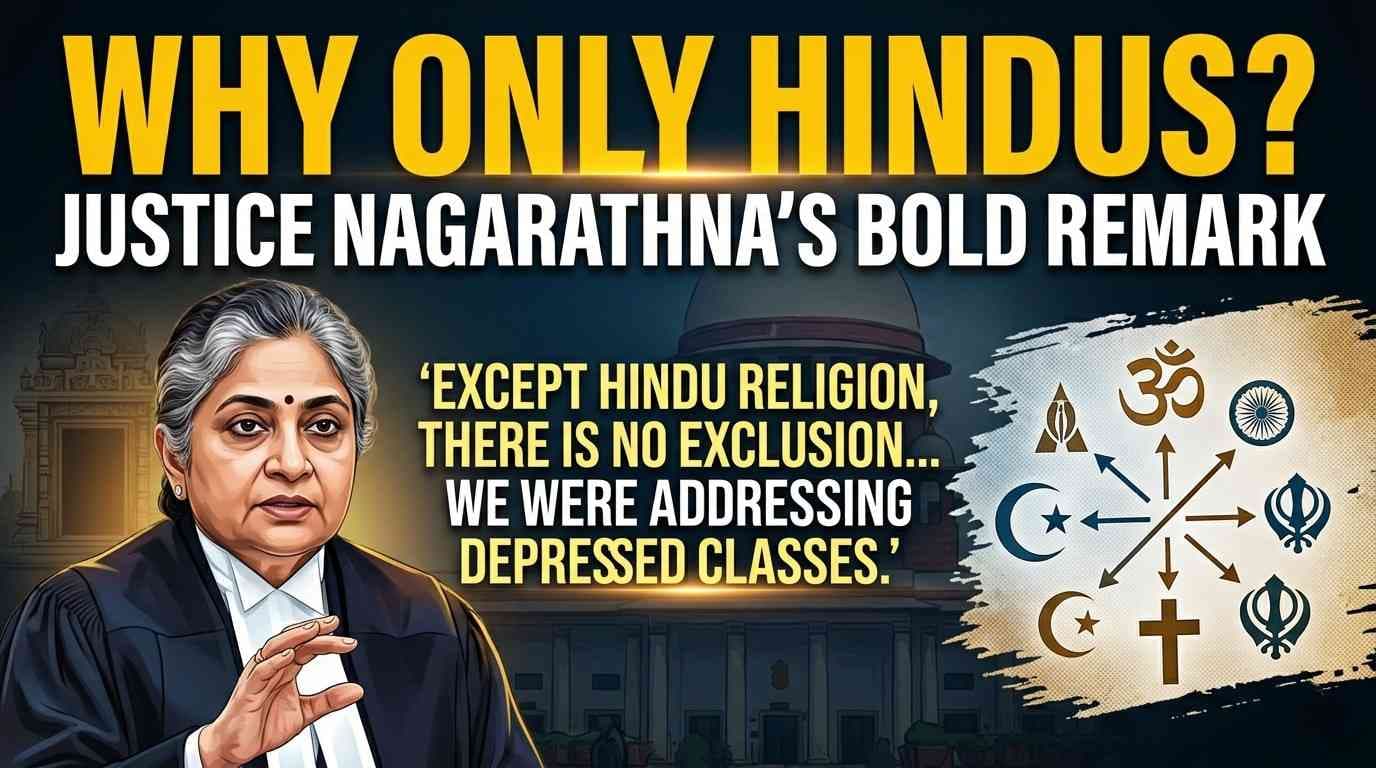
During the ninth day of hearings in the high-profile Sabarimala reference case, Justice BV Nagarathna of the Supreme Court provided a significant perspective on the historical and social foundations of Article 25(2)(b) of the Constitution. The provision, which empowers the State to make laws for "throwing open of Hindu religious institutions of a public character to all classes and sections of Hindus," was the subject of intense debate regarding its scope and the exclusion of other faiths from its text.
Justice Nagarathna remarked that the constitutional framers were deeply conscious of the specific social realities of Hindu society at the time of drafting. She noted that the explicit mention of Hindu temples was a direct response to the prevalent practice of excluding "depressed classes" or specific castes from places of worship. According to her observation, the provision focused on Hinduism because the unique challenges posed by the caste system were not mirrored in the internal structures of other religions like Islam, Christianity, or Zoroastrianism.
The observation came in response to arguments raised by counsel suggesting that applying Article 25(2)(b) exclusively to Hindu denominations could be seen as discriminatory. The advocate argued that since the "Explanation" to Article 25 includes Buddhists, Jains, and Sikhs within the definition of "Hindus," the law effectively subjects these groups to State-led social reform while leaving Muslim, Christian, and Parsi institutions untouched under their respective denominational rights in Article 26.
Justice Nagarathna countered this by highlighting that the framers did not see a need to include other religions in this specific reformatory provision because they did not exhibit the same systematic, caste-based exclusion. "Except Hindu religion, there is no exclusion," she stated, adding that the framers were addressing a specific historical grievance related to the "depressed classes" that was unique to the Hindu social order of that era.
The discussion highlights a fundamental tension in Indian constitutional law: the balance between the State’s power to enforce social reform (Article 25) and the right of religious denominations to manage their own affairs (Article 26). The lawyers supporting the review of the 2018 Sabarimala judgment argued that if a denomination has a settled practice, the State should not use "social reform" as a blanket tool to override essential religious traditions.
The advocate involved in the colloquy pushed back against the Justice’s observation, suggesting that divisions and exclusions are, in fact, prevalent across various religions in different forms. This exchange brings to the forefront the question of whether the "social reform" power of the State should be applied uniformly across all faiths or remain a specific remedy for the historical inequities found within Hindu society.
This hearing concludes the side supporting the review of the original 2018 judgment, which had opened the Sabarimala temple to women of all ages. A diverse range of senior advocates and legal experts have presented arguments over the last nine days, touching upon the "Essential Religious Practices" test and the constitutional morality of religious traditions.
As the Bench, led by Chief Justice Surya Kant, prepares to hear the respondents, Justice Nagarathna’s comments serve as a reminder of the "transformative" nature of the Indian Constitution. The case continues to explore whether the intent of the framers to abolish caste-based discrimination can be extended to address gender-based exclusions in the modern era, potentially redefining the relationship between the State and religious institutions for decades to come.