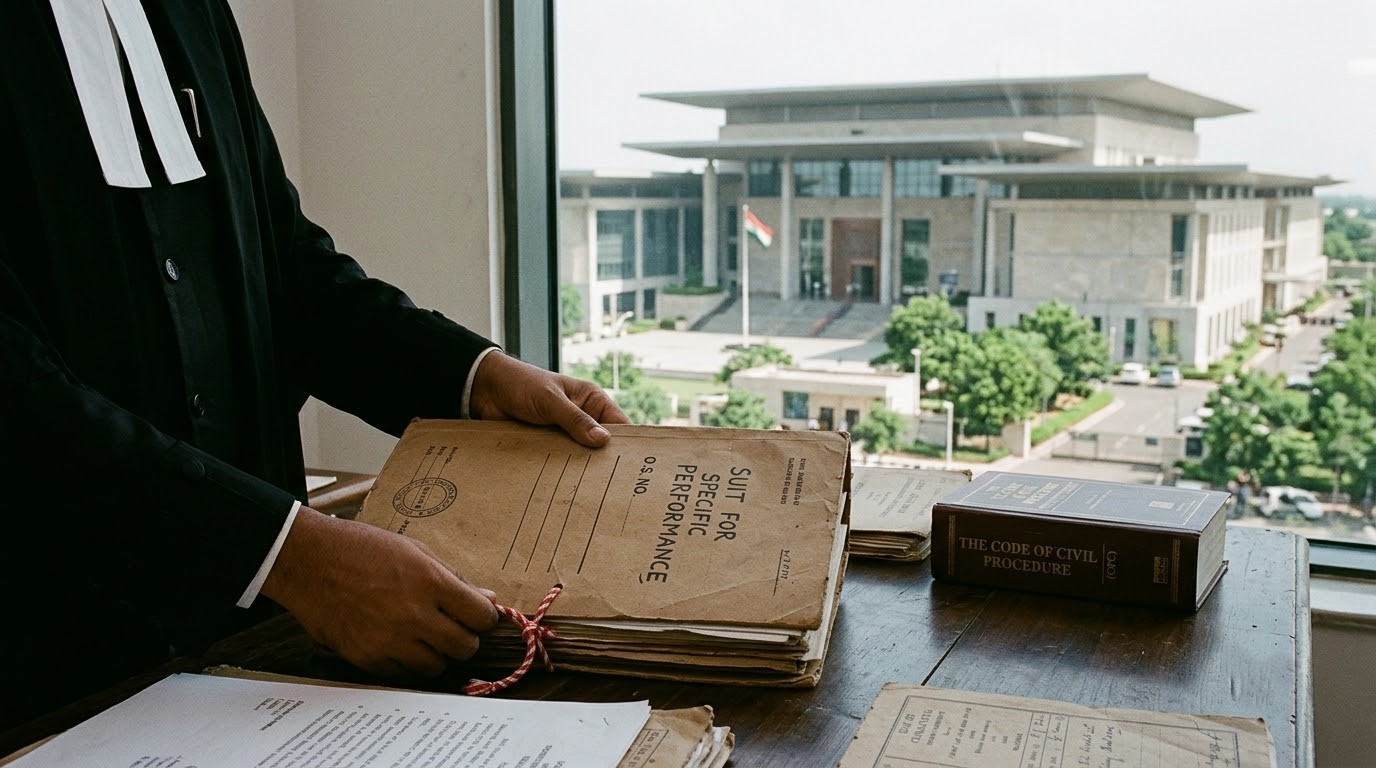
The Andhra Pradesh High Court has delivered a significant judgment restoring a sixteen-year-old civil suit for the specific performance of a sale agreement. A Division Bench comprising Justice D. Ramesh and Justice Alapati Giridhar set aside an earlier ruling of the trial court which had rejected the plaint at the threshold. The appellate court held that disputed questions concerning whether the agreement constituted a concluded contract, whether the signatory possessed the authority to bind co-owners, and whether the land was adequately identified cannot be determined without a comprehensive trial.
The underlying litigation stems from an agreement of sale executed on January 6, 2010, involving roughly 47.50 acres of land situated in Narasimhapuram and Markapuram. According to the plaintiff, the first defendant managed the family properties and executed the agreement in her own handwriting, acting for herself and on behalf of other family members after securing their consent. The total sale consideration was fixed at 2.38 crore rupees, with an initial earnest deposit of 5 lakh rupees paid by the purchaser. The payment schedule required an additional 55 lakh rupees by January 18, 2010, and the remaining 1.78 crore rupees within four months, leading up to the execution of a registered sale deed.
Can a trial court conduct a mini-trial while deciding an application for the rejection of a plaint under Order VII Rule 11 of the CPC?
When considering an application for the rejection of a plaint under Order VII Rule 11 of the Code of Civil Procedure, a court must strictly confine its examination to the averments made in the plaint and the documents accompanying it. The court lacks the legal competence to conduct a mini-trial or adjudicate upon disputed questions of fact at that nascent threshold stage.
The plaintiff maintained that he approached the first defendant on January 10, 2010, equipped with the first instalment of 55 lakh rupees, but she deferred the acceptance and subsequently avoided performance. Upon issuing a legal notice and telegram, the plaintiff discovered that the first four defendants had executed multiple registered sale deeds in favour of third parties to defeat his rights. Consequently, he instituted the suit for specific performance. In response, the defendants sought rejection of the plaint, arguing that the January 6 document was merely an agreement to execute a subsequent agreement, lacked survey numbers and boundaries, suffered from stamp duty and registration deficiencies, and did not establish the first defendant's authority. The trial court accepted these contentions and rejected the plaint.
The High Court scrutinized the document and observed that it detailed the execution date, the extent and location of the property, the consideration amount, the payment timeline, and the obligation to execute a registered sale deed. The Bench noted that the trial court erroneously relied on the abstract principle that an agreement to execute another agreement is unenforceable, without inspecting the actual contents of the document or establishing which essential terms were missing. On the issue of property identification, the High Court observed that while specific survey numbers were absent from the agreement, the plaint schedule provided a description, and the truth of these assertions must be tested through evidence.
Legal Parameter | Trial Court Finding | High Court Appellate Ruling |
|---|---|---|
Nature of Agreement | Treated as an unenforceable agreement to enter into a future agreement. | Held to contain essential terms and prima facie enforceable, subject to trial proof. |
Plaint Rejection Stage | Rejected plaint under Order VII Rule 11 CPC based on preliminary objections. | Set aside rejection, ruling that disputed facts cannot be resolved without a full trial. |
Property Description | Rejected due to lack of survey numbers and boundaries in the document. | Observed that plaint schedule described the property and identity requires trial adjudication. |
To balance equities, the Division Bench allowed the appeals, restored the suit to its original number, and directed the plaintiff to deposit the balance sale consideration of 2.28 crore rupees in the form of fixed deposits within ten days. Furthermore, the High Court directed the trial court to expedite the proceedings and dispose of the suit preferably within a period of six months.