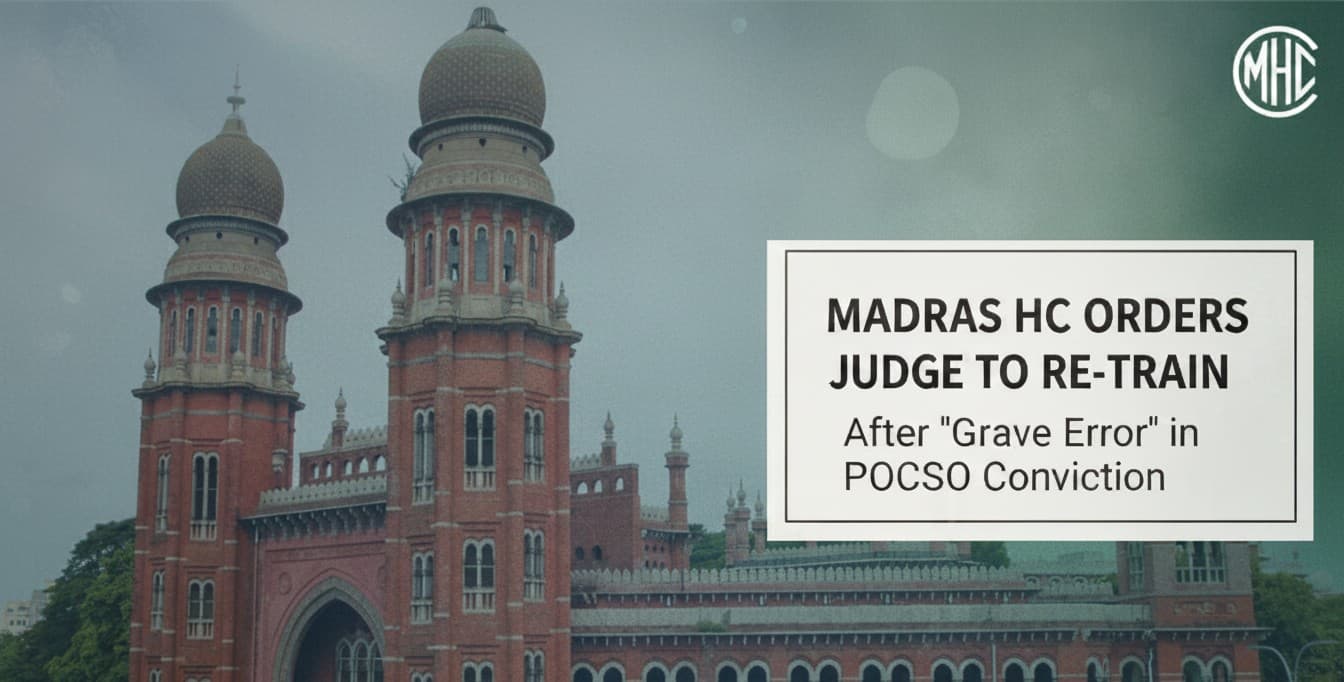
The POCSO Act is one of India's most critical laws, designed specifically to protect children from sexual abuse and exploitation. Cases under this law are extremely serious and often involve lengthy prison sentences. This is precisely why judges handling these cases must be perfectly clear on the law.
The 'Grave Error' Explained Simply
In every criminal case, there are strict rules about what counts as proof and what doesn't. Think of it like a game where only certain types of "cards" (evidence) are allowed to be played to score a conviction.
The error the trial judge made was relying on the wrong "cards." Specifically, they used:
Police Statements (Under Section 161 CrPC): These are statements made to the police during the initial investigation. In court, these statements are generally not considered proof of guilt. They can only be used later to check if a witness is telling the truth (to contradict them).
Magistrate Statements (Under Section 164 CrPC): While these are more formal statements, they still cannot be the main basis for a conviction. The victim or witness must provide their sworn testimony in the court itself.
The Trial Judge treated these investigative statements as the main evidence to convict the accused. The High Court panel noted that once these inadmissible statements were disregarded, there was "absolutely no legal evidence to find the accused guilty."
Because the judge used the wrong evidence, the entire foundation of the conviction crumbled.
The High Court’s Strong Response
The Madras High Court didn't just acquit the accused; it made a powerful statement about judicial quality. It directed the Registry to send the Trial Judge to the Tamil Nadu State Judicial Academy for compulsory training.
This move is highly unusual and sends a clear message: even experienced judges must stay current and adhere to core legal principles. The Court observed how unfortunate it was that a Sessions Judge—an officer empowered to impose the severest penalties—was unaware of such fundamental rules of criminal procedure.