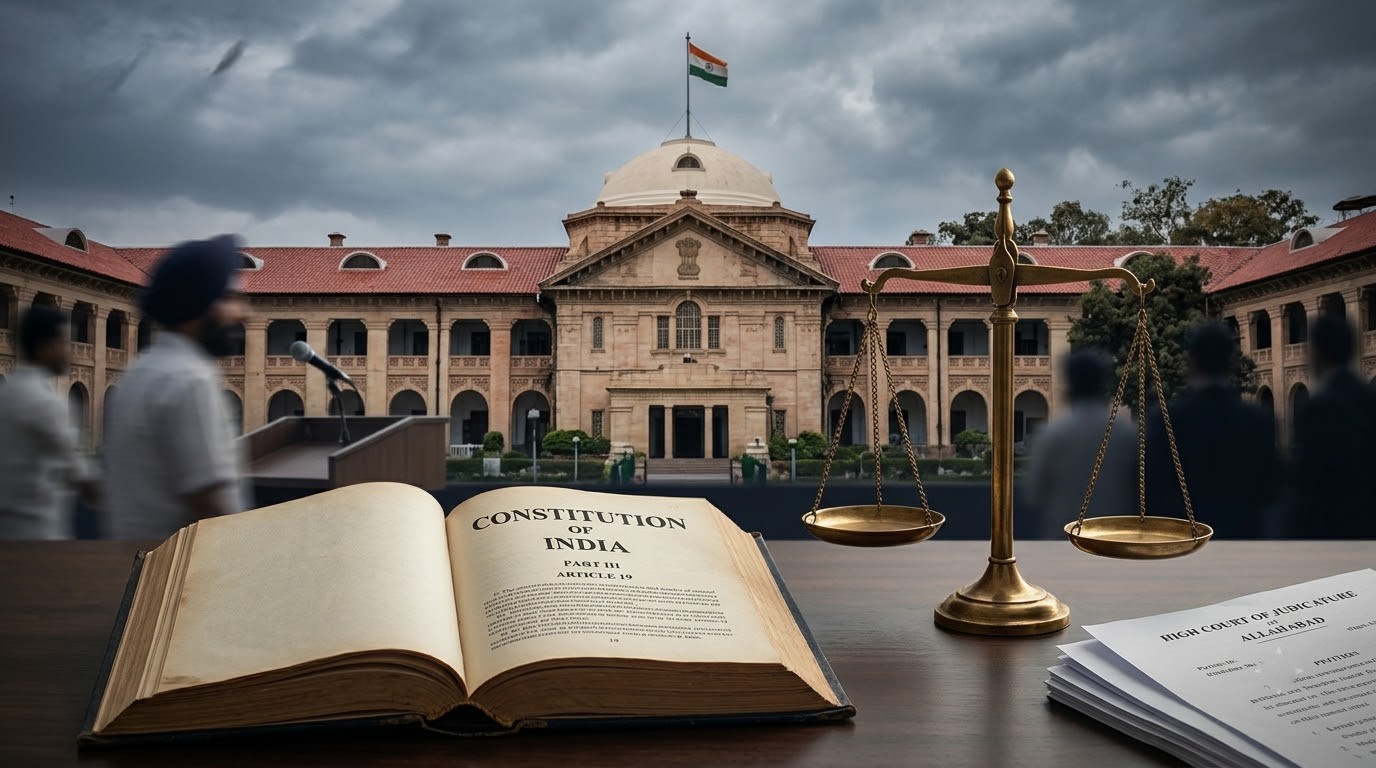
The Allahabad High Court has ruled that remarks made by Congress leader Rahul Gandhi regarding the Sikh community during his visit to the United States in September 2024 are protected by the constitutional guarantee of freedom of speech and expression under Article 19. A single bench of Justice Vikram D Chauhan dismissed a petition filed under Section 528 of the Bharatiya Nagarik Suraksha Sanhita (BNSS) challenging orders of the Varanasi courts which had declined to direct the registration of a First Information Report (FIR) against Gandhi under Section 152 of the Bharatiya Nyaya Sanhita (BNS), 2023.
Background of the Petition
The petition was filed by Nageshwar Mishra and another applicant. They alleged that during his US visit, Gandhi had questioned whether Sikhs in India felt safe wearing turbans or visiting Gurdwaras. The applicants contended that Khalistani terrorist Gurpatwant Singh Pannun had endorsed Gandhi's statement, arguing that this endorsement demonstrated the remarks could be used to advance separatist activities and anti-India propaganda. They submitted that the speech made the work of terrorists easier and could provoke violence and anarchy in India.
The Additional Chief Judicial Magistrate, Varanasi, passed an order on October 17, 2025, rejecting the application for an FIR. Subsequently, the revisional court upheld that order on July 9, 2026. The applicants then approached the High Court challenging both orders.
Elected Representatives Entitled to Raise Minority Concerns
The High Court observed that elected representatives are chosen to carry the voice of the people into the institutions of governance. The bench emphasised that raising public concerns is not an optional courtesy but a core function of a representative. It held that representatives act as channels for public concerns, ensuring that less powerful sections of society are heard in public debate. The Court noted that concerns raised in the legislature or public forums enter the public record, inform citizens, and invite scrutiny of government action, thereby keeping democratic discourse alive and vibrant.
Addressing the specific allegations, the Court stated that questioning the rights of minorities by an elected representative cannot, by itself, constitute an offence. It observed that individuals may disagree with Gandhi's statement, but disagreement alone does not provide grounds to treat the speech as criminal. The bench remarked that disagreeing with one's view is part of a vibrant democracy.
Does Section 152 BNS Apply to Political Speech on Minority Rights?
The Court examined whether the impugned speech attracted the ingredients of Section 152 BNS, which criminalises acts endangering the sovereignty, unity, and integrity of India. This includes purposely or knowingly exciting or attempting to excite secession, armed rebellion, subversive activities, or encouraging feelings of separatism.
The applicants argued that the endorsement of the remarks by a separatist figure indicated the speech could advance separatist activities. Rejecting this contention, the Court held that the speech did not tend to incite violence or disturb public order. It merely articulated the concerns of a certain segment of society. The bench clarified that if a third party misinterprets or appropriates a speech to advance its own ends, the responsibility for any ensuing consequences lies exclusively with that third party, which is amenable to the law for its own acts.
The Court further noted that no material particulars had been placed on record to indicate that the alleged speech resulted in inciting secession, armed rebellion, subversive activities, or encouraged feelings of separatism endangering the sovereignty or unity and integrity of India. Additionally, the applicants had not disclosed the date, time, and place of the alleged speech or placed its complete extract before the Court, relying merely on newspaper reports. Even after the passage of time, no material had been produced to show that the speech had resulted in any offence.
Comparison of Legal Provisions: Sedition vs. Section 152 BNS
Provision | Key Focus | Threshold for Offence |
|---|---|---|
Section 124A IPC (Sedition - Repealed) | Bringing hatred/contempt towards government | Incitement to violence or public disorder |
Section 152 BNS (Acts Endangering Sovereignty) | Exciting secession, armed rebellion, subversive activities, separatism | Purposely or knowingly endangering sovereignty, unity, integrity |
The judgment reinforces the principle that political speech articulating minority grievances, absent a direct call for violence or secession, falls within the protective umbrella of Article 19(1)(a). The Court's refusal to attribute third-party misuse to the speaker sets a significant precedent for the interpretation of Section 152 BNS in the context of democratic discourse.