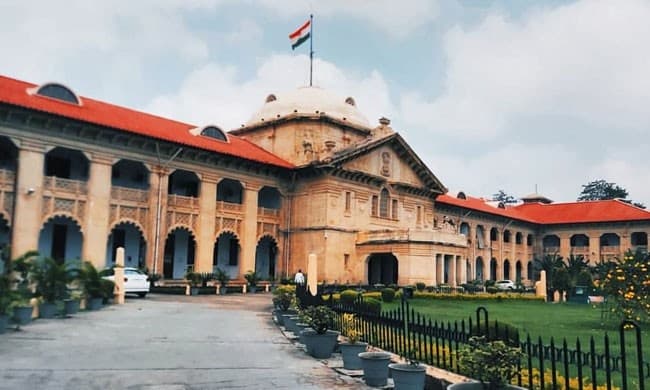
The Lucknow Bench of the Allahabad High Court recently considered a review petition in which the petitioner contended that the impugned judgment should be reopened because a particular page had been omitted, misplaced or not properly tagged in the record. The bench, comprising Justice Karunesh Singh Pawar, examined the limited grounds on which a judgment may be reviewed under the procedural law.
Justice Pawar observed that the mere absence, misplacement or non‑tagging of a document does not, by itself, render a judgment erroneous or susceptible to review. He emphasized that the power to review is confined to situations where the error is apparent on the face of the record and where such error produces a manifest injustice to the party concerned.
The court further explained that a patent error is one that is self‑evident and requires no elaborate argument or extrinsic evidence to be identified. It must be visible from the record itself without the need for interpretation or inference. Only when such an error is present and it leads to a result that is fundamentally unjust can the court entertain a review.
In the present case, the petitioner failed to demonstrate that the omitted page contained any material that would have altered the findings or the order passed by the trial court. The bench noted that the absence of the page did not affect the substantive conclusions reached in the judgment and therefore did not constitute a patent error on the face of the record.
Consequently, the court held that the omission, misplacement or non‑tagging of the page did not satisfy the threshold required for invoking review jurisdiction. The petition was dismissed on the ground that the alleged defect did not cause manifest injustice.
The ruling underscores the restrictive nature of review proceedings. It reaffirms that a party seeking review must show more than a procedural lapse; the lapse must be coupled with an error that is obvious from the record and that results in a clear miscarriage of justice. The decision provides guidance to litigants and subordinate courts on the limited scope of review and discourages the use of review petitions as a remedy for mere administrative shortcomings in the preparation of the record.
By limiting review to cases of patent error causing manifest injustice, the Allahabad High Court seeks to preserve the finality of judgments while ensuring that genuine mistakes that affect the outcome are corrected. The judgment serves as a reminder that the procedural safeguards attached to review are intended to prevent abuse of the process and to maintain judicial efficiency.