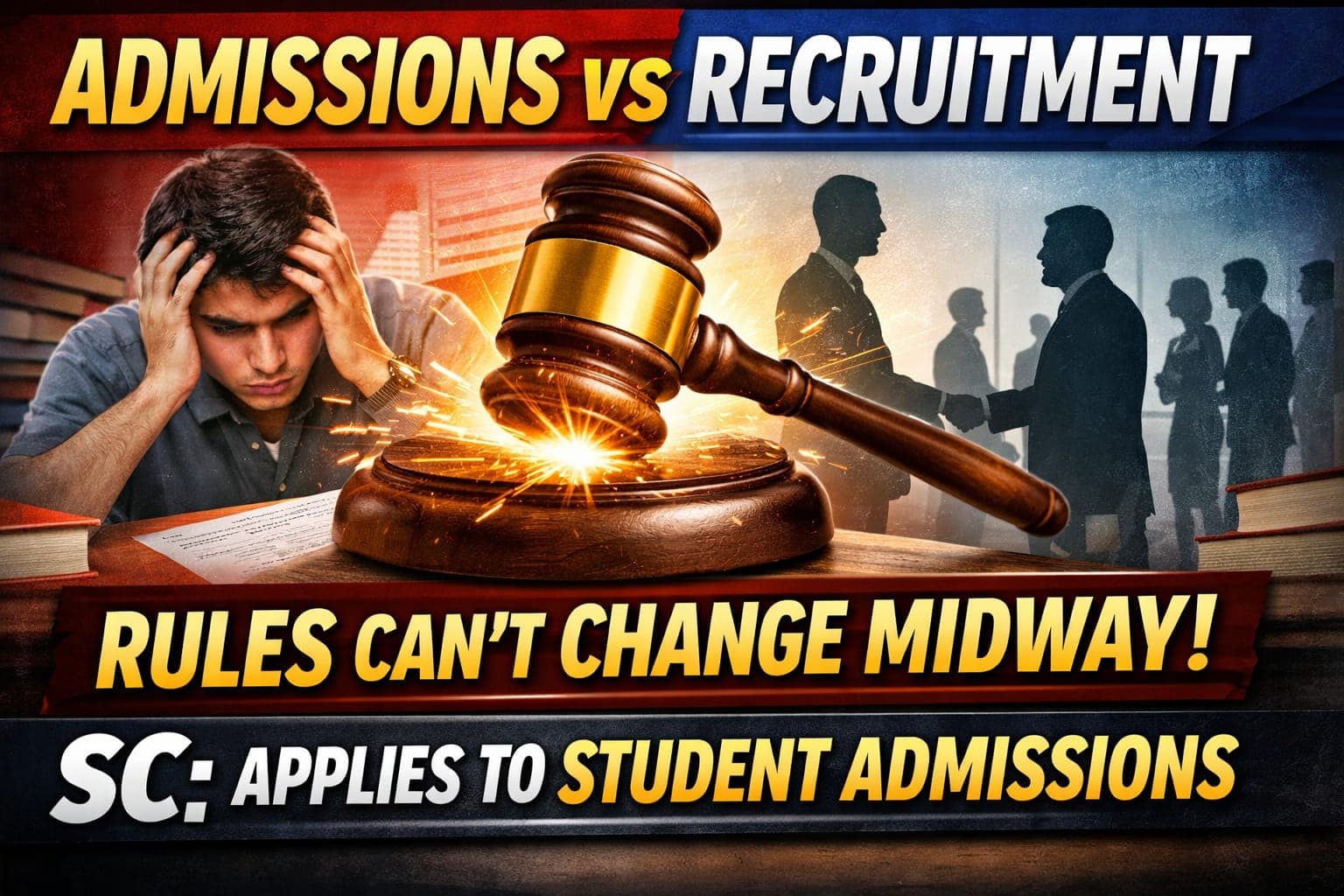
New Delhi: In a landmark judgment reinforcing transparency and fairness in educational admissions, the Supreme Court of India has ruled that admission norms cannot be altered once the process has begun. The Court held that the famous legal principle—"the rules of the game cannot be changed midway"—applies to student admissions just as strictly as it does to government job recruitments.
A Bench of Justices Sanjay Kumar and Alok Aradhe quashed a midstream policy change by the Punjab government regarding the sports quota for MBBS and BDS courses. The Court found the change to be arbitrary, hasty, and tainted by a clear conflict of interest.
The controversy centered on the admission process for the 2024 academic session under the NEET UG sports quota.
Initially, the official prospectus issued by the Baba Farid University of Health Sciences (BFUHS) stated that only sports achievements from Classes XI and XII would be considered for preparing the merit list. However, on August 16, 2024—the very last date for submitting applications—the University sent out an email to all candidates.
This email changed the criteria entirely, allowing candidates to submit sports certificates from any class or year. This "elasticity" allowed achievements from Classes IX and X to be counted, which significantly shifted the rankings in the sports merit list.
While examining the case, the Supreme Court uncovered a startling fact. The policy change was triggered by a representation (a formal request) made by one Ramesh Kumar Kashyap, a roller-skating coach.
Crucially, Mr. Kashyap failed to disclose to the authorities that his own daughter, Kudrat Kashyap, was an aspirant for the same medical admission. Following the change he suggested, his daughter secured the Rank No. 1 in the sports quota merit list.
The Court came down heavily on this "lack of probity," stating:
"The fact that a coach sought a policy change to benefit his own daughter without disclosing his personal interest is sufficient in itself to vitiate (spoil) the modification."
The judgment emphasized that an egalitarian state must avoid situations where "nepotism and arbitrariness walk in through the backdoor."
1. Rules of the Game Must Be Fixed The Bench reiterated that just as the law forbids changing rules after a recruitment process has started, it is equally illegal for an admission process to be left undefined or "elastic" at the start. Such lack of clarity, the court observed, leaves room for authorities to tailor norms to suit their own interests later.
2. Presumption of Mala Fides in Haste The Court noted that the change was pushed through in "undue haste." Under the law, when decisions are taken post-haste without proper justification, a "mala fide" (bad faith) intent can be presumed.
3. Article 14 and Fair Play The Court reminded the Punjab government that under Article 14 of the Constitution, the State is duty-bound to act fairly and reasonably. Keeping norms "elastic" is contrary to the principles of fair play.
Recognizing that the academic session was already underway, the Court chose a path that corrected the injustice without disrupting the entire state merit list.
- For the Appellants: The Court ordered that the appellants, Divjot Sekhon and Shubhkarman Singh, who were initially forced to take seats in a private medical college, must be accommodated in the Government Medical College seats.
- For the Respondents: Consequently, Kudrat Kashyap and Mansirat Kaur (who benefitted from the flawed policy) were directed to be shifted to the private college seats vacated by the appellants.
The Court clarified that the studies and fees already paid by the students would remain unaffected, and they would continue their courses from the current stage in their new colleges.
The Court also noted that the same flawed policy was being continued for the 2025 session. While it did not quash the 2025 process immediately (as many affected parties were not present in court), it granted liberty to the students of the 2025 batch to approach the High Court again.
In its concluding remarks, the Supreme Court directed the State of Punjab to ensure that if it intends to modify its admission policy, it must do so entirely before the start of the admission process each year.
The ruling serves as a stern warning to educational authorities across the country: Transparency is not optional, and "flexibility" in rules cannot be used as a shield for favoritism.
Case Title: Divjot Sekhon Vs State of Punjab And Others
Judgment Date: January 6, 2026
Bench: Justices Sanjay Kumar and Alok Aradhe