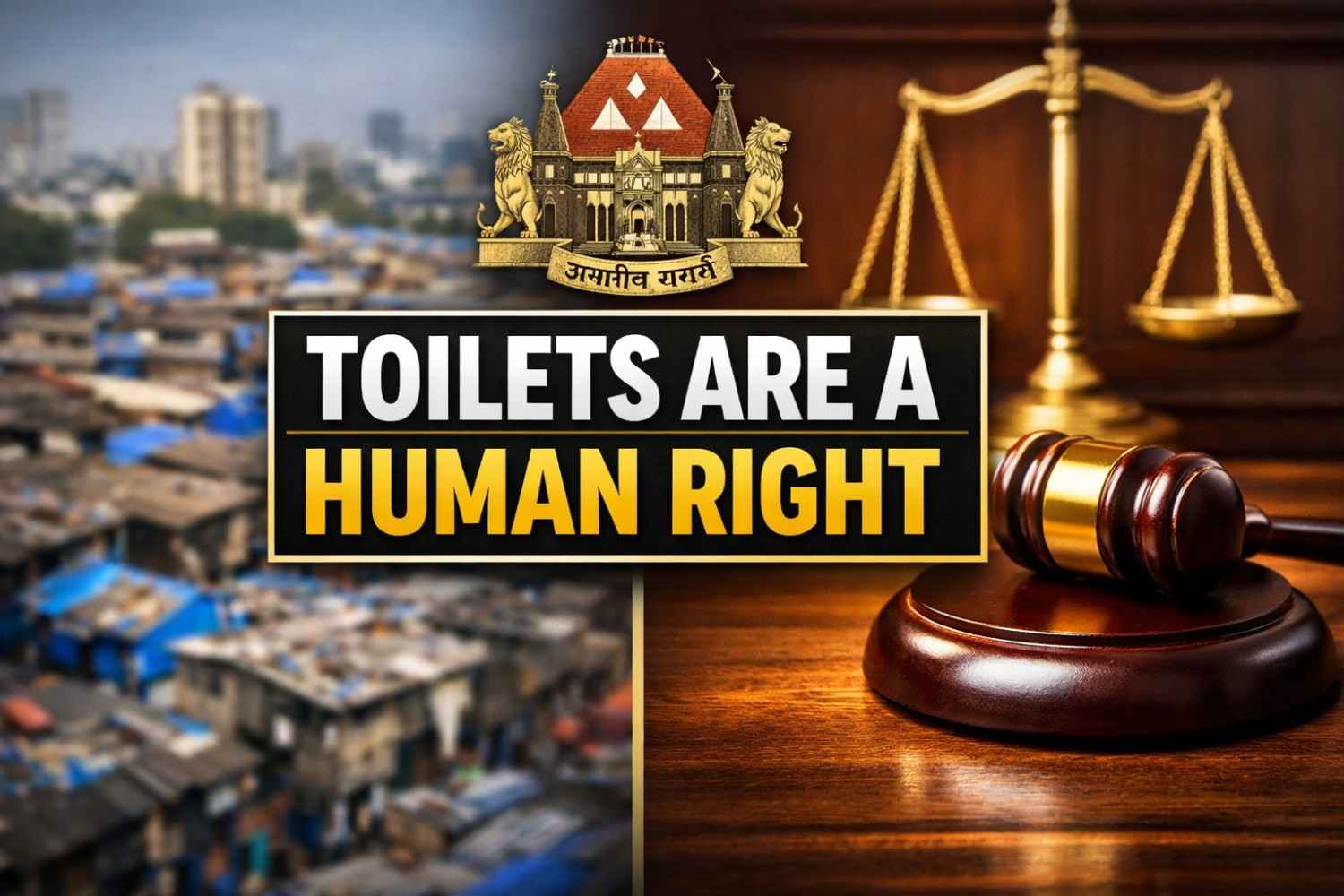
In a significant judgment that reinforces the link between public health and constitutional law, the Bombay High Court has declared that access to adequate sanitation and toilet facilities is a "basic human right." The Court emphasized that this right is an integral part of the Right to Life and Dignity guaranteed under Article 21 of the Indian Constitution, even for residents living in unauthorized slum areas.
A Division Bench comprising Justice G. S. Kulkarni and Justice Aarti Sathe passed the order while hearing a writ petition that highlighted the "deplorable and unhygienic" conditions of public toilets in Buddha Nagar, Govandi.
The legal battle was initiated by Chetan Samajik Pratishthan, a social organization that brought to the Court’s attention the dire situation in Govandi’s Buddha Nagar slum. The area, spanning approximately 1,83,000 square meters on land owned by the Municipal Corporation of Greater Mumbai (MCGM), is home to over 4,000 residents.
Shockingly, the petitioners revealed that there were only 60 toilet seats available for the entire population. To make matters worse, most of these toilets were in a dilapidated condition, broken, and lacked basic hygiene or water supply. Despite a 2019 work order under the Slum Sanitation Programme, no real progress was made in repairing or maintaining these blocks.
The Municipal Corporation argued that the area was an "encroachment" and that certain rehabilitation schemes were pending. However, the High Court rejected these excuses. The Bench noted that once a large population begins residing in an area—whether authorized or unauthorized—the State cannot turn a blind eye to their basic needs.
"Once large populations reside in slums... the Municipal Corporation cannot abdicate its statutory and constitutional obligations to provide and maintain basic civic amenities," the Court observed.
The judges further clarified that permitting encroachments to grow into slums does not give the authorities a "free pass" to ignore human dignity. Sanitation is not a matter of "charity" or "convenience," but a core duty of the local government.
- Sanitation as a Human Right: The Court held that without proper sanitation, a person cannot live with dignity. This makes toilet facilities a fundamental right under Article 21 (Right to Life).
- Equality Before Law: The Bench noted that providing substandard facilities to slum dwellers while others enjoy better services is a violation of Article 14 (Right to Equality).
- Inadequacy is Dereliction of Duty: The ratio of 60 toilets for 4,000 people was termed "grossly inadequate." The Court stated that such neglect reflects a serious failure by municipal officers.
- No Excuses for SRA Schemes: The Court ruled that a pending Slum Rehabilitation Authority (SRA) scheme for a small portion of land cannot justify the neglect of the larger population’s health and hygiene.
Taking a stern view of the situation, the Bombay High Court issued several time-bound directions:
- Construction of New Blocks: The MCGM must identify open spaces within the Buddha Nagar area and construct additional toilet blocks commensurate with the population size. This must be completed within two months.
- Immediate Repairs: The existing 60 toilet seats must be repaired, cleaned, and made functional immediately.
- Daily Maintenance: The Court ordered daily upkeep and maintenance of these facilities to ensure they remain usable and hygienic.
- Supervision: The concerned Assistant Municipal Commissioner has been tasked with the direct supervision of these works to ensure no further delays occur.
This judgment serves as a powerful reminder to civic bodies across India. It establishes that the "Right to Life" is not a hollow concept; it includes the right to a clean environment and basic sanitation. By linking toilet facilities to Article 21, the Bombay High Court has ensured that even the most marginalized citizens can demand their right to live with dignity.
For the residents of Govandi, this order brings a ray of hope for a cleaner and healthier future. For the legal community, it marks another step forward in the evolution of socio-economic rights in India.
- Case Details: Chetan Samajik Pratishthan & Anr. v. The Municipal Corporation of Greater Mumbai & Ors.
- Citation: Writ Petition No. 4225 of 2024.