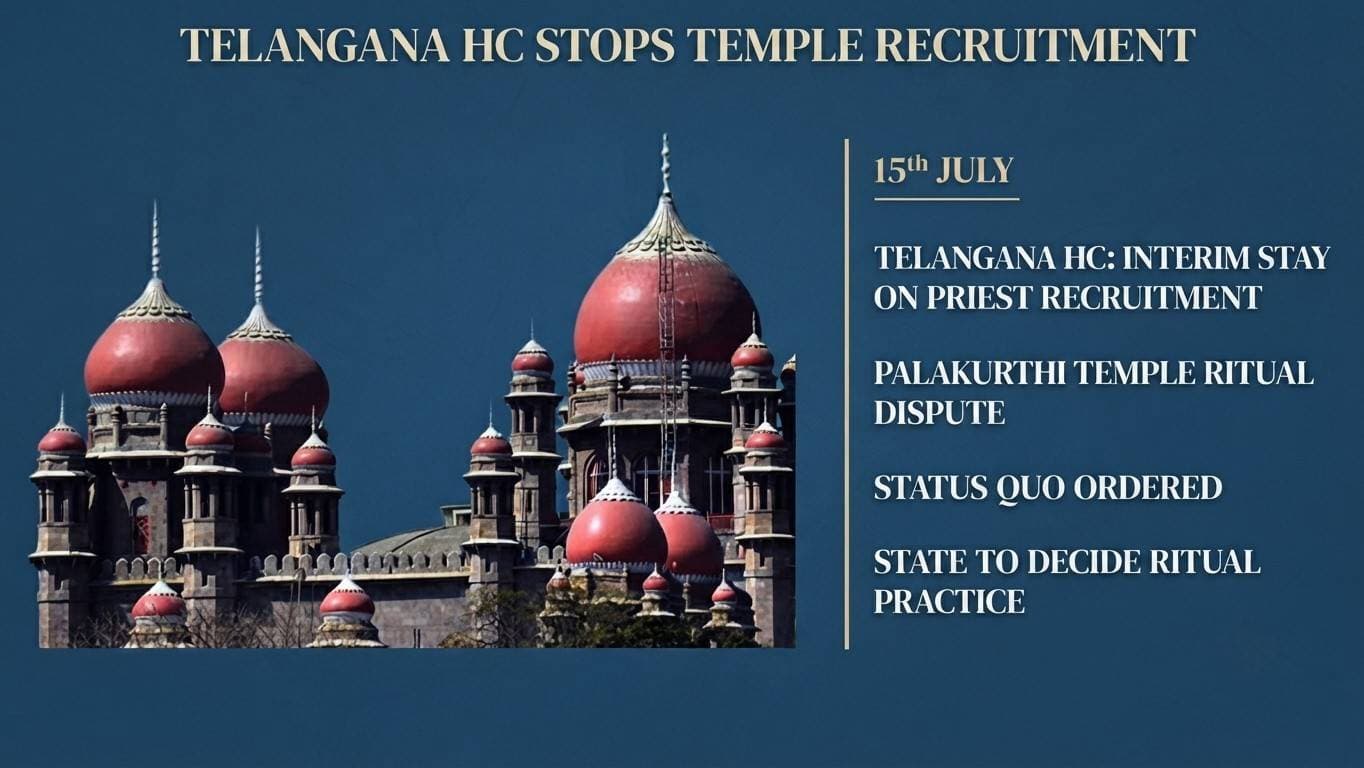
The Telangana High Court, presided over by Justice Surepalli Nanda, issued an interim direction restraining the State Government from proceeding with the recruitment notification for priest positions at the Sri Someshwara Laxminarasimha Swamy Devasthanamining priest posts at the Sri Someshwara Laxminarasimha Swamy Devasthanam in Palakurthi. The order came after a petition was filed challenging the recruitment process on the ground that it would prejudice an ongoing dispute concerning the ritual tradition observed at the temple.
The Court observed that the dispute over the ritual procedure has been pending for a considerable period and that the State Government is the appropriate authority to determine the correct ritual practice to be followed at the temple. It emphasized that allowing recruitment to proceed before the dispute is settled could result in a fait accompli that would undermine the State’s eventual decision on the ritual matter.
In its reasoning, the Bench noted that the recruitment notification, if implemented, would appoint priests who might be required to perform rituals according to a procedure that is presently contested. The Court held that such a situation could create a conflict between the appointed priests and the eventual decision of the State on the ritual tradition, thereby causing unnecessary litigation and administrative difficulty.
The Court further held that the balance of convenience favoured maintaining the status quo. It reasoned that the petitioners would suffer irreparable harm if the recruitment were allowed to continue, as the appointed priests might be compelled to follow a ritual practice that could later be altered or declared invalid by the State. Conversely, the State would not be prejudiced by a temporary halt in recruitment, as the posts could be filled after the dispute is resolved.
Accordingly, the Telangana High Court directed the State Government to expeditiously decide the dispute over the ritual tradition and to file a status report detailing its decision. Until such a decision is communicated, the authorities are restrained from issuing any further recruitment notification for priest posts at the temple.
The order underscores the Court’s approach of the judiciary’s role in preventing administrative actions that could pre‑empt the resolution of substantive disputes concerning religious practices. It also highlights the principle that the State, as the custodian of public religious institutions, must determine the appropriate ritual procedure before any personnel appointments that could affect the performance of those rituals are made.
Legal practitioners note that the decision may have broader implications for similar cases where recruitment to religious posts is contested on the basis of alleged changes to ritual observances. The judgment signals that courts are likely to intervene at an early stage to preserve the status quo and to require the concerned governmental authority to settle the underlying dispute before permitting any consequential administrative steps.
The parties to the proceeding include the petitioners who challenged the recruitment notification, the State Government represented by its appropriate department, and the temple trust or management body responsible for the administration of the Sri Someshwara Laxminarasimha Swamy Devasthanam. The Court’s direction is addressed to the State Government, which is required to take the necessary steps to resolve the ritual dispute and to inform the Court of its decision within a reasonable time.