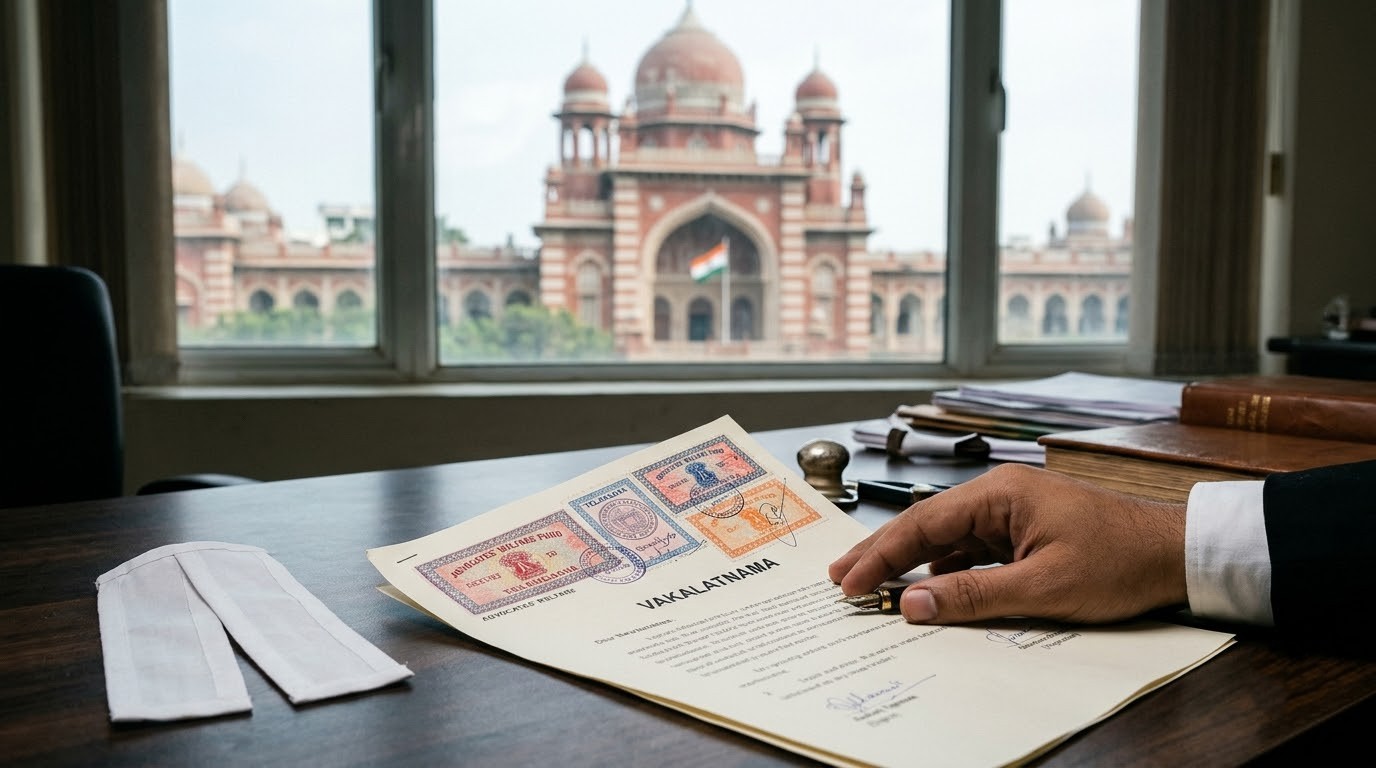
A Division Bench of the Telangana High Court, comprising Acting Chief Justice P. Sam Koshy and Justice Narsing Rao Nandikonda, has upheld the constitutional validity of Sections 12 and 12A of the Telangana Advocates Welfare Fund Act, 1987. The provisions mandate the affixation of a welfare fund stamp of ₹250 on every Vakalatnama filed by advocates. The court dismissed a petition filed by advocate Vijay Gopal, appearing in person, who challenged the levy as a violation of fundamental rights and a colourable exercise of legislative power.
Does the mandatory welfare stamp violate an advocate's right to practice under Article 19(1)(g)?
The court held that the ₹250 stamp is not a toll on the right to practice but a minimal contribution towards a social security net. It constitutes a valid exercise of legislative power under Entries 23 and 26 of the Concurrent List and does not violate Article 19(1)(g) or Article 19(1)(c) of the Constitution.
Petitioner's contentions on legislative competence and colourable legislation
The petitioner argued that the subject matter fell exclusively under Entry 78 of List I (Union List), which governs persons entitled to practice before High Courts. He contended that the State legislature lacked competence to enact the provision. The petitioner further submitted that the progressive enhancement of the stamp value from ₹8 in 1992 to ₹250 in 2025 constituted colourable legislation. He also argued that the amendments enhancing the stamp value lacked fresh Presidential assent as required under Article 254(2) of the Constitution, rendering them repugnant to central laws.
State's defence: Statutory welfare measure under Concurrent List
The State defended the provisions, asserting that the Act is traceable to Entries 23 (Social Security and Social Insurance) and 26 (Legal, Medical and Other Professions) of List III (Concurrent List). It submitted that the Welfare Fund Committee is a statutory body, not a private association, and the levy is statutory in nature, earmarked for a specific welfare purpose. The State clarified that the filing section's refusal to accept a Vakalatnama without the stamp merely gives effect to a subsisting statutory mandate.
Court's reasoning: Social welfare measure, not a restriction on practice
The Bench observed that the impugned provisions constitute a social welfare measure for the betterment of the legal profession. The court emphasized the uncertainty inherent in the life of a professional at the Bar, noting that illness, accident, or sudden death can end a career and a household's security simultaneously. The Bench articulated that the stamp, costing the contributor little, becomes immediate financial support for a widow, an orphaned child, or an aged parent when other help is unavailable.
The court stated that a society expecting its members to serve it must also expect them to bear a small share of the burden of caring for one another. The sum collected is slight and is not a toll on the right to practise; rather, it is the thread by which the profession ties together those who are fortunate with those who fall into hardship. The Bench concluded that the uncertainty of life is not an argument for removing the safeguard but the strongest reason for keeping it.
Legislative competence and distribution of funds
The court held that the creation of such safeguards falls within the State's domain under Entries 23 and 26 of the Concurrent List. The exercise of legislative power was found to be valid and not repugnant to central laws or fundamental rights. As per the petitioner's submission, 86% of the collection is allocated to the Telangana Advocates Welfare Fund and 14% to the Telangana Advocates Clerks Welfare Fund. The court found no constitutional infirmity in this distribution or in the statutory framework establishing the fund.
Disposition
The Telangana High Court dismissed the writ petition, upholding the validity of Sections 12 and 12A of the Telangana Advocates Welfare Fund Act, 1987. The court declared that the Act and the Fund are neither unconstitutional nor ultra vires the Constitution.
Aspect | Petitioner's Argument | Court's Holding |
|---|---|---|
Legislative Competence | Falls under Entry 78, List I (Union List); State lacks power. | Traceable to Entries 23 & 26, List III (Concurrent List); State competent. |
Nature of Levy | Colourable legislation; progressive hike from ₹8 to ₹250. | Valid social welfare measure; minimal contribution, not a tax on practice. |
Article 254(2) / Presidential Assent | Amendments enhancing value lack fresh Presidential assent. | No repugnancy to central law found; assent issue not sustained. |
Fundamental Rights (Art. 19(1)(g)/(c)) | Unreasonable restriction on right to practice/association. | Not a toll on right to practice; valid regulation for social security. |