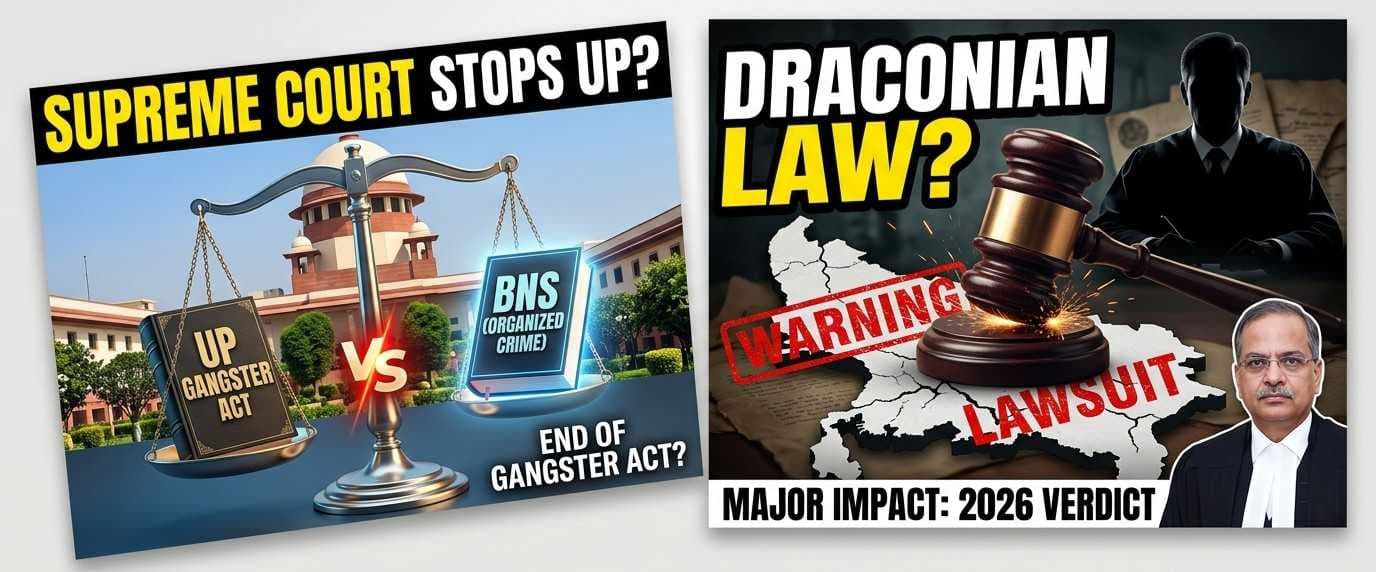
The Supreme Court of India has recently referred a series of petitions challenging the constitutional validity of the Uttar Pradesh Gangsters and Anti-Social Activities (Prevention) Act, 1986, and its 2021 Rules to a larger three-judge bench. This decision, led by Chief Justice Surya Kant, comes amid arguments that the Act contains "draconian" provisions that may conflict with newly enacted central laws.
The legal challenge, specifically raised in a plea by Samajwadi Party leader Irfan Solanki, targets several key sections of the Act, including those defining a "gangster" and those governing the attachment of property. Petitioners argue that these provisions violate fundamental rights under Articles 14, 20(2), and 21 of the Constitution by allowing individuals to be labeled as gangsters based on mere allegations rather than objective proof.
A critical point of contention is the alleged "repugnancy" of the State law to the Bharatiya Nyaya Sanhita (BNS). Specifically, lawyers argue that Section 111 of the BNS already defines and penalizes "organised crime" at the national level. Because the UP Gangsters Act operates in the same legal field but with different procedures, the court must determine if the state law remains valid under the current federal legislative framework.
The Supreme Court noted that its ruling will have a nationwide impact, as many other states have similar legislative frameworks. Consequently, the Court has invited the Advocates General of Gujarat, Maharashtra, Karnataka, and the NCT of Delhi to participate in the proceedings, as their respective organized crime laws (such as MCOCOA and GUJCTOC) could be affected by the verdict.
Parallel to the constitutional challenge, the Court has recently emphasized strict procedural compliance. In a March 2026 judgment, the Court quashed an FIR because the "Gang Chart"—a mandatory document for invoking the Act—lacked the required signatures and did not result from a joint meeting between the District Magistrate and the Superintendent of Police. This highlights a growing judicial trend of ensuring that "perilous" laws are not misused through administrative shortcuts.
The three-judge bench is scheduled to begin final hearings on the matter on May 21, 2026. The Union of India has also been made a party to the case to provide its stance on the interaction between state gangster acts and the new central criminal codes.