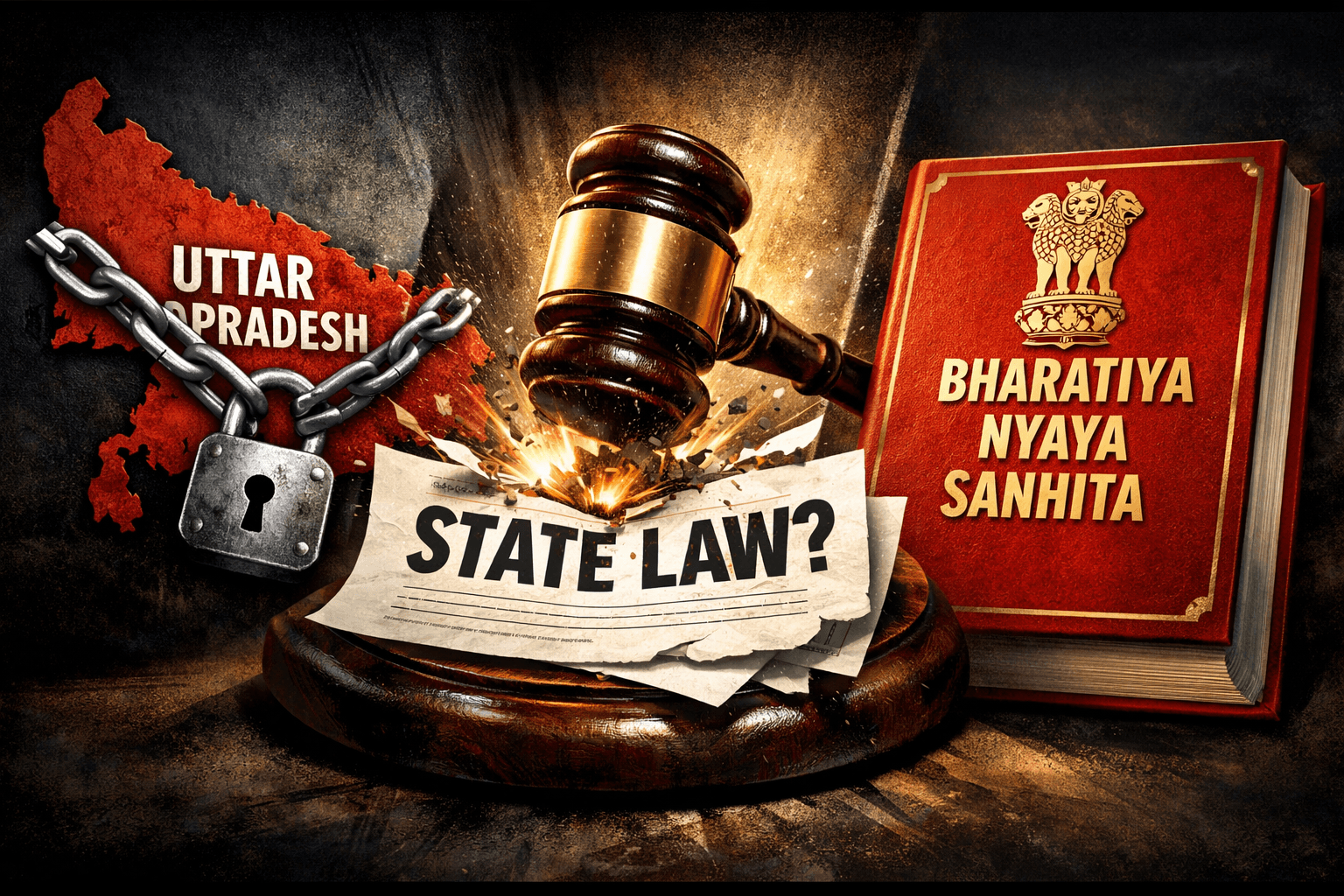
New Delhi: In a constitutional challenge that could have ripple effects across state-specific criminal laws in India, the Supreme Court has agreed to examine whether the Uttar Pradesh Gangsters and Anti-Social Activities (Prevention) Act, 1986, stands repugnant to the newly enacted Bharatiya Nyaya Sanhita (BNS), 2023.
A Bench comprising Justice J.B. Pardiwala and Justice K.V. Viswanathan issued notice to the State of Uttar Pradesh, asking it to respond to arguments that Section 111 of the BNS (which defines and punishes "Organised Crime") has effectively occupied the field, rendering the state law void under Article 254 of the Constitution.
The petitioners, represented by Senior Advocates Amit Anand Tiwari, Siddhartha Dave, and Vinay Navare, argued that for decades, "Organised Crime" was not defined in the central Indian Penal Code (IPC). This allowed states like Uttar Pradesh and Maharashtra (MCOCA) to enact their own special laws.
However, with the enactment of the BNS in 2023, Parliament has now specifically legislated on "Organised Crime" under Section 111. The petitioners contend that:
- Occupied Field: Parliament intended Section 111 to be an exhaustive code on organised crime.
- Repugnancy: Since both laws cover the same subject (Concurrent List), and the central law (BNS) is later in time, the central law must prevail.
- Implied Repeal: Consequently, the draconian provisions of the UP Gangsters Act—which allow for property attachment and strict bail conditions—should be deemed inoperative.
The petitioners relied heavily on the Supreme Court's 2021 judgment in Forum for People's Collective Efforts v. State of West Bengal, where the Court struck down the West Bengal Housing Industry Regulation Act (HIRA) because it conflicted with the central RERA Act. They argued the same logic applies here: a state cannot run a parallel "Gangster Act" when the Centre has enacted a comprehensive "Organised Crime" law.
Additional Solicitor General K.M. Nataraj, appearing for the State of UP, acknowledged that the issue of repugnancy requires deep study. The Court has granted the State three weeks to file a counter-affidavit specifically addressing the tests of repugnancy laid down in the Forum for People case.
If the Supreme Court rules against the UP Gangsters Act, it could trigger a domino effect. Similar special laws in other states (like MCOCA in Maharashtra or GUJCOC in Gujarat) might also face challenges. Furthermore, thousands of ongoing cases in UP involving the attachment of property worth crores could be jeopardized if the state law is found to be "repugnant" to the new central code.