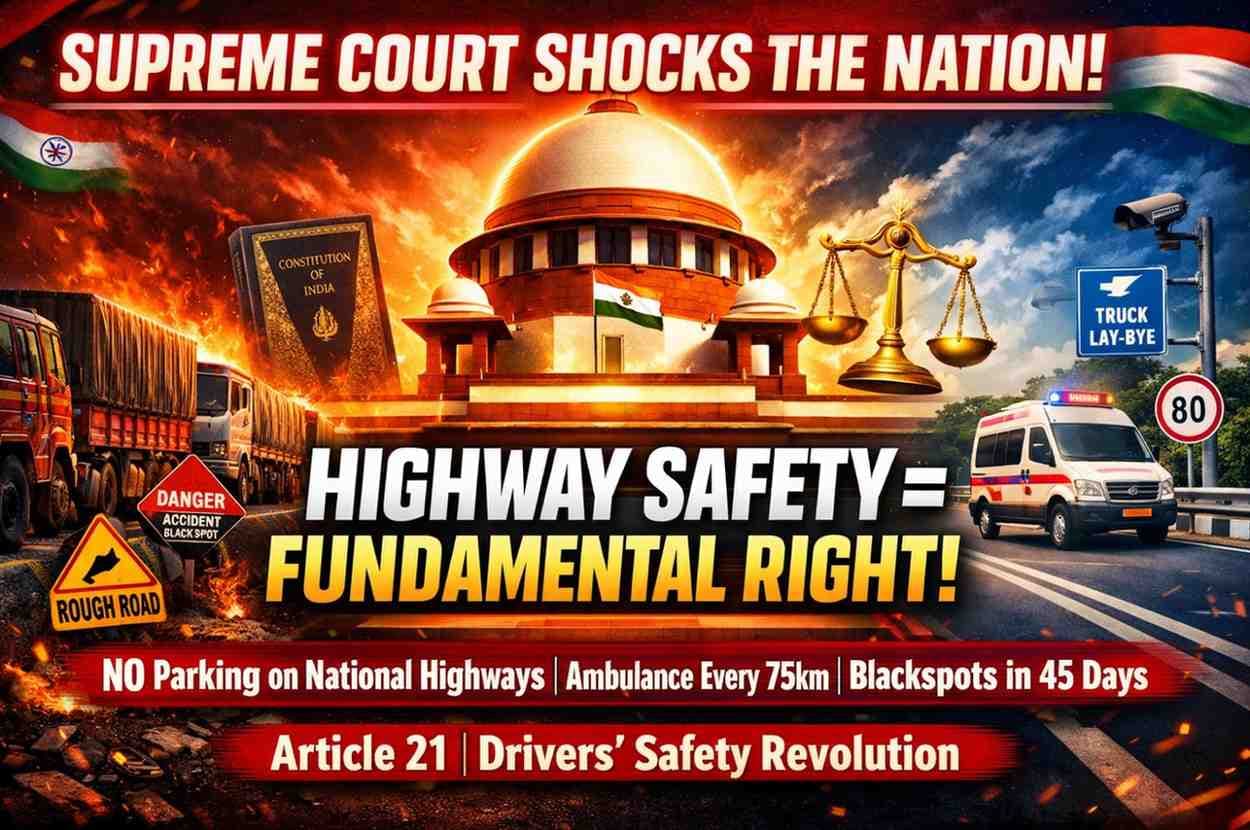
The Supreme Court has recently issued a comprehensive set of directions on highway safety, declaring that the right to safe and motorable roads is an essential component of the fundamental Right to Life under Article 21 of the Indian Constitution. A bench comprising Justice JK Maheshwari and Justice AS Chandurkar observed that administrative or financial limitations cannot be used as an excuse to compromise public safety. The Court emphasized that no "pecuniary or administrative constraint" can outweigh the sanctity of human life.
Central to the Court’s directives is the strict regulation of highway usage. The Court has banned the parking of heavy and commercial vehicles on National Highway carriageways or paved shoulders, except at designated lay-bys. Furthermore, it ruled that no licenses or trade approvals shall be granted or renewed within highway safety zones without the explicit prior approval of the relevant highway authorities, ensuring that commercial growth does not impede traveler safety.
To ensure effective enforcement, the Court ordered the constitution of District Highway Safety Task Forces in every district through which a National Highway passes. These task forces, led by District Magistrates, are mandated to oversee local safety conditions. Additionally, state police and transport departments have been directed to deploy dedicated highway surveillance teams for continuous patrolling to deter traffic violations and assist in emergencies.
The Court also set a strict 45-day timeline for authorities to identify and publish "accident blackspots"—locations with high frequencies of collisions. Once identified, these zones must be equipped with adequate lighting, warning signage, and speed enforcement systems. This data-driven approach aims to proactively reduce fatalities in known high-risk areas across the national network.
Emergency medical response also received a significant boost in the ruling. The Court directed that ambulances and recovery cranes must be stationed at regular intervals, not exceeding 75 kilometers, along all highways. This ensures that the "Golden Hour" for accident victims is prioritized, providing a critical lifeline in remote stretches where medical facilities are often far from the site of an accident.
For the welfare of long-haul drivers, the Court mandated the development of wayside amenities and safe parking facilities for trucks. These "truck lay-byes" must include essential services such as rest areas, washrooms, food services, and first-aid stations. By providing these facilities, the judiciary aims to combat driver fatigue, which remains a primary cause of major highway accidents in India.
Technology-based monitoring is set to become the standard for highway management. The directives include the operationalization of a network of surveillance cameras, speed detectors, and emergency call boxes. Furthermore, authorities must establish toll-free helplines and digital complaint systems, allowing the public to report encroachments or safety hazards in real-time.
The ruling draws a clear link between Article 21 and Article 19(1)(g), noting that the fundamental right to free movement is effectively meaningless without safe and well-maintained roads. By holding the State constitutionally obligated to maintain public infrastructure, the Supreme Court has moved toward a more accountable model of governance regarding road travel.
Ultimately, these directions represent a shift from viewing road safety as a mere policy goal to recognizing it as a non-negotiable legal right. The Court’s proactive stance aims to curb the high rate of road fatalities in India by imposing a unified, technologically integrated safety framework. All eyes are now on the implementation phase, as state and central agencies work to meet the court-mandated deadlines.