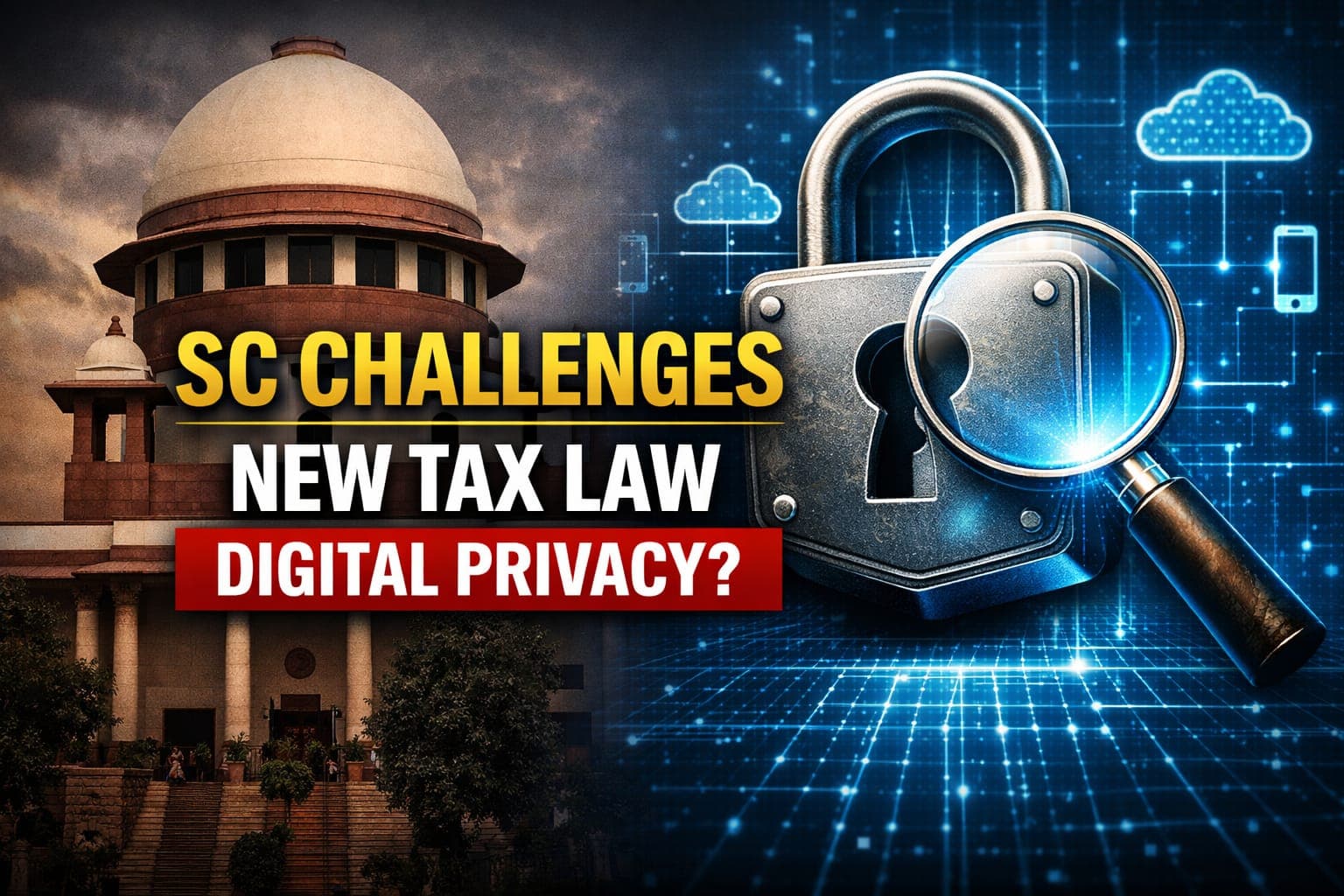
NEW DELHI: In a significant development that touches upon the intersection of modern technology and constitutional rights, the Supreme Court of India has been moved through a Public Interest Litigation (PIL) challenging the sweeping powers granted to tax authorities under the new legal framework. The petition specifically targets provisions that allow Income Tax officials to search and seize personal digital devices, including mobile phones, laptops, and data stored in "virtual digital spaces" like cloud storage.
This legal battle marks a pivotal moment in Indian jurisprudence, as it forces the judiciary to reconcile the government’s need for effective tax administration with the individual's Fundamental Right to Privacy in an era where our entire lives are digitized.
The controversy stems from the newly introduced provisions in the Income Tax Act, 2025 (and related amendments), which have replaced the decades-old 1961 Act. While the government maintains that these changes are necessary to tackle "black money" and sophisticated financial crimes in a digital economy, the petitioners argue that the language used in the statute is dangerously broad.
Under the new law, specifically provisions mirroring Section 247, authorized officers are empowered to enter any premises to search for "electronic media" or "computer systems." However, the definition of these terms has been expanded to include not just the physical hardware found on-site, but also the "virtual digital space" connected to those devices. This effectively means that if a tax officer seizes a phone, they claim the right to access every email, WhatsApp message, social media account, and cloud-stored document (like Google Drive or iCloud) linked to that device, regardless of whether that data is physically located in India or on a remote server.
The PIL, filed by concerned citizens and legal professionals, highlights several "draconian" aspects of the new law that distinguish it from traditional physical searches:
- Lack of Judicial Oversight: Unlike many western democracies where a specific warrant from a Magistrate is required to search digital content, the new law allows tax officials to initiate searches based on their own "reason to believe." The petitioners argue that the executive should not be the judge and jury in determining the scope of a digital search.
- The "Everything" Problem: When a house is searched, officers look for specific documents or cash. However, a digital device is a "storehouse of a person’s entire life." It contains privileged communication between lawyers and clients, private medical records, and intimate family conversations that have absolutely no relevance to tax evasion. The current law lacks a "filter" mechanism to protect this unrelated data.
- The Power to Compel Passcodes: One of the most controversial aspects is the power given to officials to demand passcodes and decryption keys. Refusal to provide these can lead to criminal penalties, which the PIL argues violates the right against self-incrimination under Article 20(3) of the Constitution.
The bedrock of the petitioner's argument is the landmark 2017 judgment in K.S. Puttaswamy v. Union of India, where a nine-judge bench of the Supreme Court declared privacy to be a Fundamental Right. The Court had established a strict "proportionality test" for any law that seeks to infringe upon privacy.
For the new Income Tax provisions to be valid, they must pass four hurdles:
- Legality: There must be a clear law (which exists).
- Need: There must be a legitimate state aim (preventing tax evasion).
- Proportionality: The intrusion must be the least restrictive way to achieve the goal.
- Safeguards: There must be procedural checks to prevent abuse.
The PIL argues that the 2025 Act fails miserably on the "Proportionality" and "Safeguards" fronts. It contends that searching a person’s entire cloud backup to find one suspected invoice is an "unreasonable and excessive" intrusion.
The petition draws comparisons to international standards. In many jurisdictions, digital searches are strictly limited by "specificity." Officers are only allowed to look for files related to the crime mentioned in the warrant. In contrast, the Indian law, as it stands, offers a "blanket access" to the digital universe of the taxpayer.
Furthermore, the PIL points out that while the Digital Personal Data Protection (DPDP) Act, 2023, aims to protect citizen data from private companies, the government seems to be exempting its own agencies from similar standards of accountability when it comes to tax investigations.
During the preliminary hearings, the Bench has shown an inclination to examine these constitutional questions deeply. While the government argues that "honest taxpayers have nothing to fear," the Court has noted that "constitutional rights are not for the convenience of the state but for the protection of the citizen."
The Court will likely have to decide if a "Digital Search Protocol" needs to be established—similar to the guidelines issued for the search of devices belonging to journalists—to ensure that tax authorities do not go on "fishing expeditions" through a citizen's private life.
This case is about more than just tax law; it is about the "Right to be Let Alone" in a world where we can never truly be alone because of our devices. If the Supreme Court upholds the broad powers of the tax department, it may set a precedent that other agencies (CBI, ED, Police) will follow, leading to a state of permanent digital surveillance.
As the matter moves toward a final hearing, the eyes of the legal world are on the Apex Court. Will it allow the taxman to enter the "virtual bedroom" of the citizen, or will it draw a line in the sand to protect the digital soul of the Constitution?