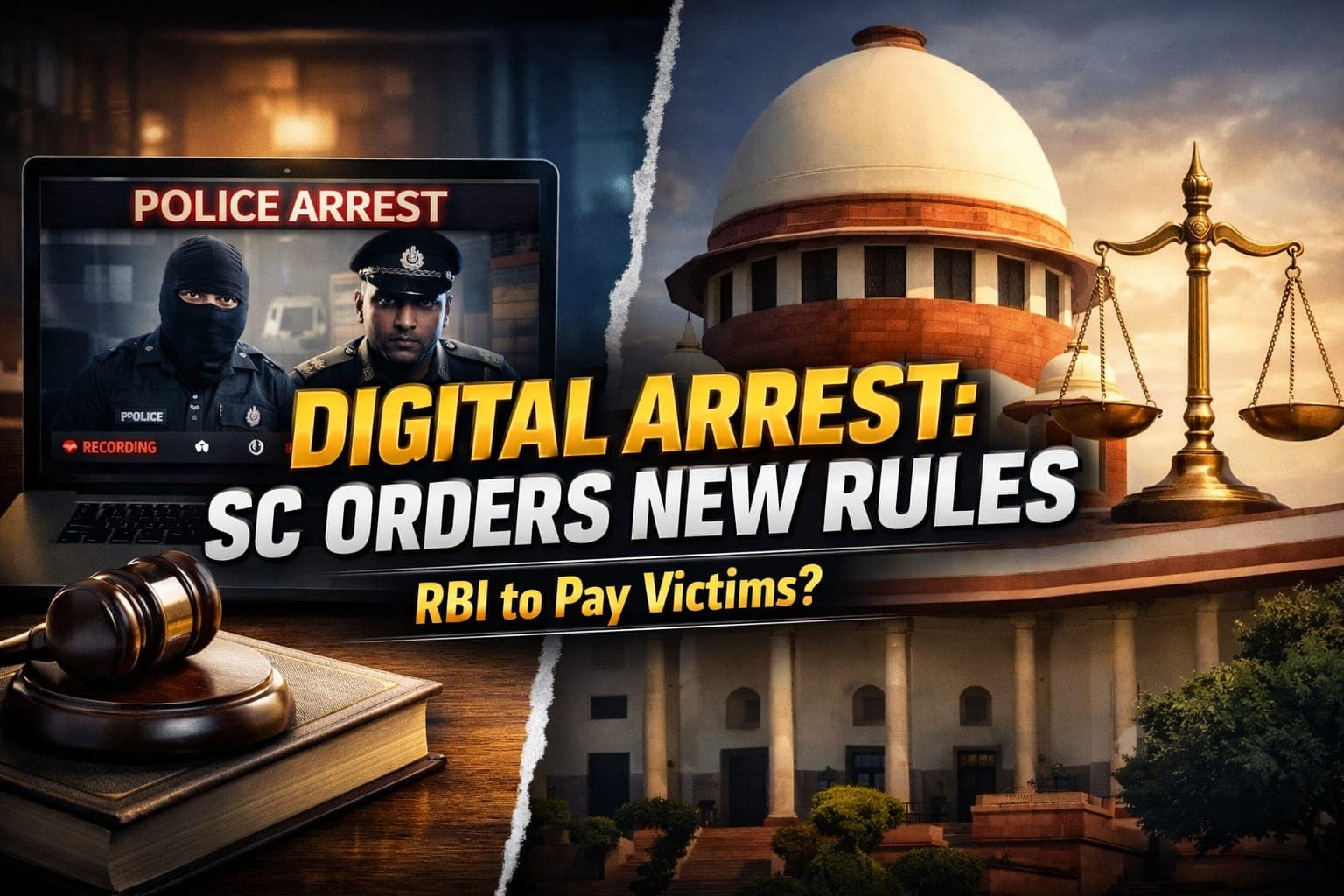
In a major move to protect citizens from the rising tide of cybercrime, the Supreme Court of India is closely monitoring the menace of "digital arrest" scams. These scams, where fraudsters pose as law enforcement officers to virtually "arrest" and extort money from innocent people, have become a national concern.
Hearing a suo motu case (a case taken up by the court on its own), a bench comprising Chief Justice of India Surya Kant, Justice Joymalya Bagchi, and Justice NV Anjaria is pushing for a robust system to stop these crimes and help victims get their money back. Recent status reports filed by the Ministry of Home Affairs (MHA), the Reserve Bank of India (RBI), and other departments reveal a massive nationwide plan to overhaul cyber security and banking accountability.
For the uninitiated, a "digital arrest" is a deceptive tactic where scammers call victims via platforms like WhatsApp or Skype. They claim to be from the CBI, ED, or Police, alleging that the victim’s identity has been used for illegal activities like drug trafficking or money laundering. The victims are told they are under "digital arrest" and are forced to stay on camera for hours or days until they transfer large sums of money as "clearance fees" or "bail."
The Supreme Court recognized that this isn't just a simple fraud; it is a psychological attack that exploits the fear of the law.
The Ministry of Home Affairs (MHA) has submitted a detailed status report to the Supreme Court. The centerpiece of this report is a proposed Standard Operating Procedure (SOP) designed to streamline how the government handles cyber financial fraud.
Key highlights of the MHA plan include:
- Fast-Track Fund Restoration: A new "Online Money Restoration Module" will be used to refund defrauded money to victims as quickly as possible.
- Managing Bank Accounts: Clear rules for freezing and unfreezing bank accounts linked to scams to ensure that while criminals are blocked, innocent people aren't harassed.
- Grievance Redressal: A time-bound system where people can complain if their accounts are wrongly frozen.
One of the most significant updates comes from the Reserve Bank of India (RBI). For a long time, victims have struggled to get banks to take responsibility when money is stolen through "mule accounts" (fake accounts used to funnel stolen money).
The RBI's new stance includes:
- Staff Accountability: Banks will now face strict action if their employees are found negligent in following KYC (Know Your Customer) rules or are complicit in helping scammers. The RBI even suggested using the Prevention of Corruption Act against such staff.
- Mule Account Detection: 26 banks have already started using AI tools like "MuleHunter.ai" to spot suspicious accounts before they can be used for fraud.
- Shared Liability Framework: The RBI is looking into a "liability framework" to decide how much compensation banks should pay victims for fraud induced by deception.
The Department of Telecommunications (DoT) and the Ministry of Electronics and Information Technology (MeitY) are also taking drastic steps:
- Stricter SIM Card Rules: The government is working on the "User Identification Rules, 2025." This will involve biometric identification to stop the issuance of "mule SIMs" used by scammers.
- Pressure on WhatsApp: MeitY noted that while platforms like Microsoft are cooperating, WhatsApp needs to do more. Since most digital arrests happen via WhatsApp calls, the government is pushing for "SIM binding" to ensure that the person using the app is actually the owner of the phone number.
- Blocking International Spoofing: Measures are being implemented to block international calls that appear to be coming from Indian numbers—a common trick used by overseas scammers.
The Central Bureau of Investigation (CBI) has also been roped in. The agency will now specifically investigate digital arrest cases where the loss is ₹10 crore or more. This ensures that major international syndicates operating these scams face the full force of India’s premier investigating agency.
The Supreme Court’s intervention has forced various government wings to stop working in silos and start working together. By focusing on Victim Compensation, Staff Accountability, and Technological Blocks, the legal system is finally building a shield for the common man.
While the government builds these systems, the best defense remains awareness. Remember: No police officer or government agency will ever "arrest" you over a video call or ask you to transfer money to "verify" your innocence.