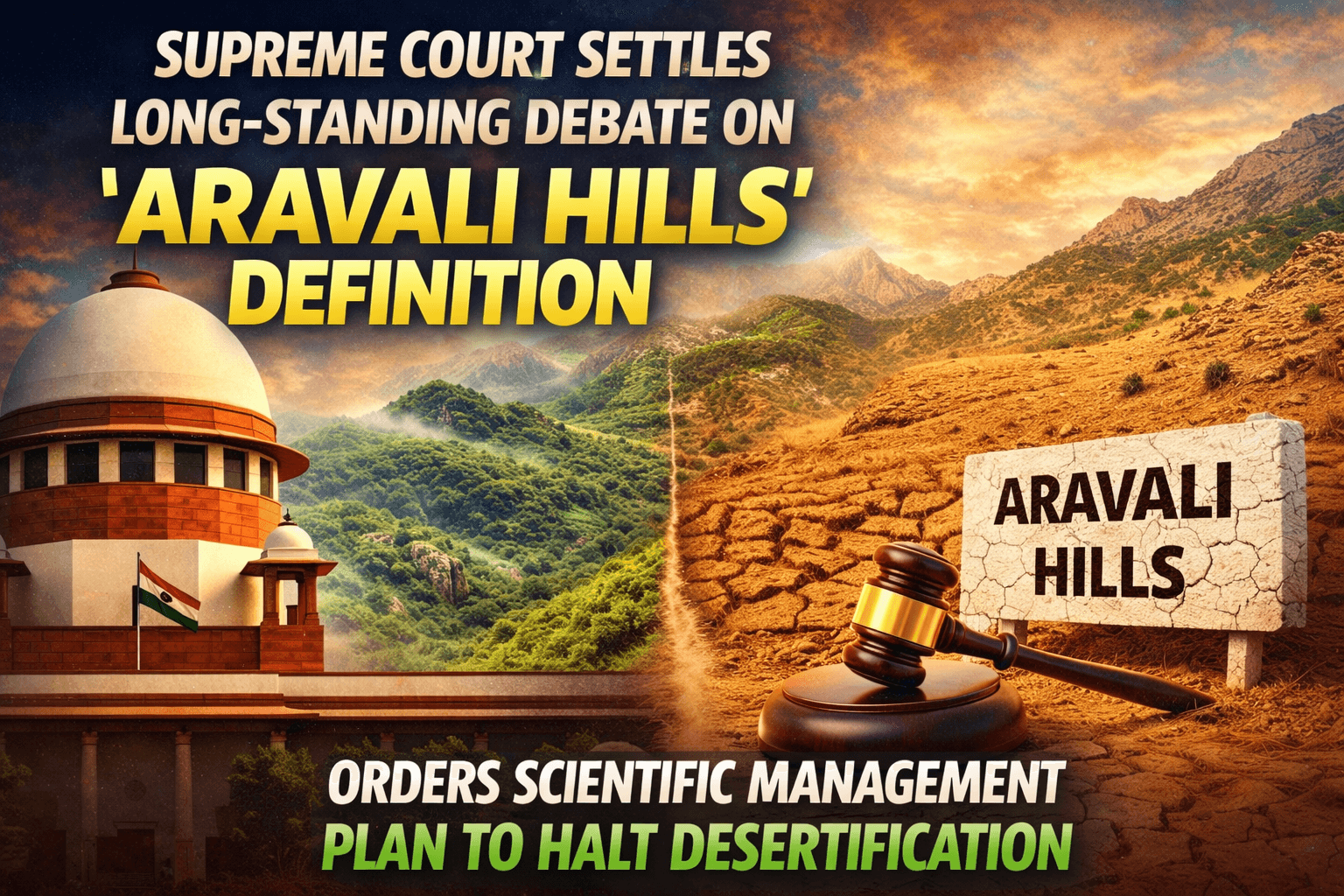
In a significant move to protect one of the world’s oldest geological features, the Supreme Court of India has finally cleared the air on what legally constitutes the "Aravali Hills and Ranges." In a detailed judgment delivered on November 20, 2025, a Special Bench comprising Chief Justice B.R. Gavai, Justice K. Vinod Chandran, and Justice N.V. Anjaria emphasized that the Aravalis are not just mountains but a "green shield" protecting North India from becoming a desert.
The ruling addresses the states of Delhi, Haryana, Rajasthan, and Gujarat, aiming to end decades of confusion caused by different states using different definitions to permit or restrict mining activities.
For years, the lack of a uniform definition allowed various interpretations of where a "hill" started and ended. This ambiguity often benefited mining interests at the cost of the environment. The Court noted that illegal mining was flourishing largely because of these "different definitions" adopted by various state governments.
To solve this, the Court had previously formed a high-level committee including officials from the Ministry of Environment, Forest and Climate Change (MoEF&CC), the Forest Survey of India (FSI), and the Geological Survey of India (GSI).
The Supreme Court has now officially accepted a technical yet practical definition for mining regulations:
Aravali Hills: Any landform in the Aravali districts with an elevation of 100 metres or more from the local relief. This includes the hill itself, its supporting slopes, and associated landforms.
Aravali Range: If two or more such hills are within 500 metres of each other, they are considered part of a "Range." This ensures that the continuity of the mountain chain is protected, preventing "gap mining" that could break the ecological link.
The most impactful part of the judgment is the moratorium on new mining. The Court has directed the MoEF&CC to prepare a Management Plan for Sustainable Mining (MPSM) through the Indian Council of Forestry Research and Education (ICFRE).
Key highlights of the Court’s directions include:
Freeze on New Leases: Until the MPSM is finalized, no new mining leases or renewals of old leases will be granted in the Aravali region.
Inviolate Zones: Mining is strictly prohibited in "core" areas, including Protected Areas (National Parks/Sanctuaries), Tiger Reserves, Tiger Corridors, and critical wetlands like Ramsar sites.
Scientific Assessment: The plan must identify which areas are "conservation-critical" (where mining is banned) and where "sustainable mining" can potentially occur without destroying the ecosystem.
While the Court took a tough stance on new mining, it avoided a "complete ban" on existing legal operations. Citing previous experiences, the Bench observed that a total ban often leads to the rise of "mining mafias" and illegal extraction.
"A total ban on mining is not conducive even to the interest of the environment, inasmuch as it gives scope for illegal mining," the Court noted. Therefore, existing legal mines can continue, provided they strictly follow the environmental safeguards and recommendations laid out by the expert committee.
The judgment highlights that the Aravalis act as a natural barrier preventing the eastward spread of the Thar Desert toward the Indo-Gangetic plains, Haryana, and Western Uttar Pradesh.
With forest cover declining over the last two decades and groundwater levels hitting "Dark Zone" status in places like Gurgaon and Faridabad, the Court emphasized that the "precautionary principle" must guide all future human activity in the region.
By ordering a scientific, geo-referenced ecological assessment, the Supreme Court has shifted the focus from "permission-based mining" to "data-based conservation." The upcoming Management Plan is expected to serve as the master document for the ecological restoration of the landscape, ensuring that the "lungs of North India" are preserved for future generations.
The Bench concluded the proceedings with a note of appreciation for the Amicus Curiae, Mr. K. Parameshwar, and the legal teams involved for their tireless work in protecting India's wildlife and ecology.
Case Details: In Re: T.N. Godavarman Thirumulpad v. Union of India & Ors. (Writ Petition (C) No. 202 of 1995)
Date of Judgment: November 20, 2025
Bench: B.R. Gavai, CJI; K. Vinod Chandran, J.; N.V. Anjaria, J.
Judgment Link : https://share.google/mfxzYrWIcQ8jINlKX