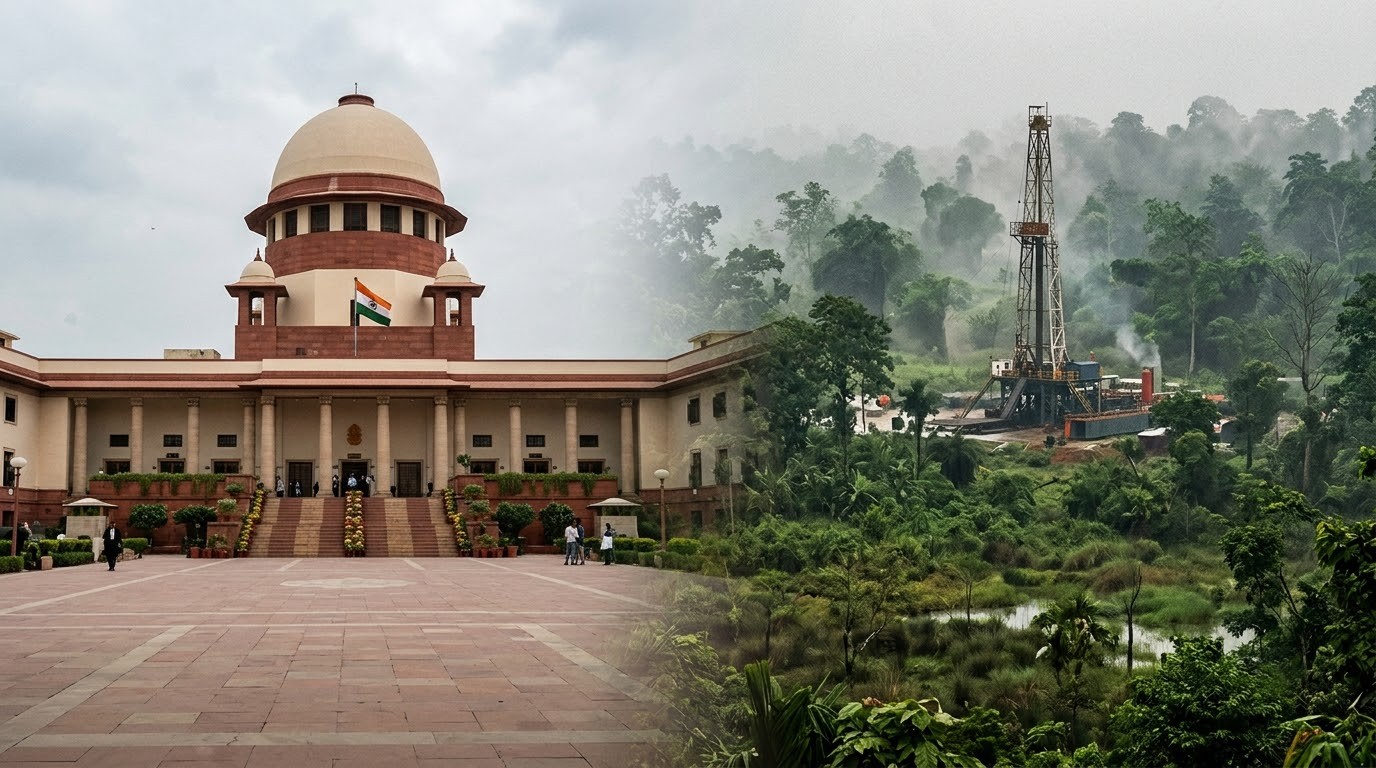
The Supreme Court on November 3 sought responses from the Ministry of Petroleum and Natural Gas and the Assam government on a petition filed by Oil India Limited (OIL) challenging the refusal to approve the use of 0.069 hectares of forest land for hydrocarbon extraction beneath the Dibru-Saikhowa National Park in Tinsukia district. A bench comprising Chief Justice Surya Kant and Justices Joymalya Bagchi and V Mohana took up the matter after senior advocate Rakesh Dwivedi, appearing for the public sector undertaking, submitted that the issue was extremely urgent as the company was unable to carry out exploration work in the area.
The core legal dispute centres on whether deep directional hydrocarbon extraction qualifies as prohibited mining under the court's April 26, 2023 judgment, which banned mining within national parks, wildlife sanctuaries, and within one kilometre of their boundaries. Oil India has argued that Extended Reach Drilling (ERD) is distinct from conventional mining. The company submitted that the drilling infrastructure would remain entirely outside the national park, accessing hydrocarbon deposits at a depth of approximately 3,500 to 4,000 metres. Dwivedi informed the bench that the area near the park is estimated to hold three per cent of India's total hydrocarbon reserves and that the operations would not harm the park's flora and fauna.
In its fresh plea, Oil India challenged the Forest Advisory Committee's (FAC) decision of July 4, 2024, and the subsequent order of the Ministry of Environment, Forest and Climate Change dated August 2, 2024, refusing approval for the forest land diversion. The company contended that the authorities had wrongly applied the 2023 mining prohibition judgment. It argued that hydrocarbon exploration and production through ERD is governed by a separate legal and regulatory framework and involves drilling from sites outside the protected area to reach reserves several kilometres below the surface.
The petition also relied on the Supreme Court's 2017 orders which had permitted Oil India, subject to conditions and safeguards, to extract hydrocarbons beneath the national park through Extended Reach Drilling. The company highlighted that the Standing Committee of the National Board for Wildlife had recommended the proposal and the court had subsequently allowed underground hydrocarbon extraction subject to compliance with environmental and wildlife protection conditions. Additionally, Oil India cited the environmental clearance granted in May 2020 for drilling and testing hydrocarbons at seven locations beneath the park, noting that drilling in forest areas required separate prior approval under the Forest (Conservation) Act.
The bench observed that it could permit the exploration work based on research and development reports from the authorities, including the Ministry of Environment, Forest and Climate Change. The matter has been posted for further hearing after November 17.
What Is the Legal Distinction Between Extended Reach Drilling And Mining Under The 2023 Supreme Court Ban?
The 2023 judgment prohibited mining within national parks and a one-kilometre eco-sensitive zone. Oil India argues ERD is not mining because the surface infrastructure remains outside the protected area, the drilling occurs at depths of 3,500–4,000 metres, and hydrocarbon extraction is governed by a distinct statutory framework separate from mining laws. The authorities rejected the proposal applying the mining ban; the Court has now sought their response on this classification.
Aspect | 2017 Supreme Court Orders | 2023 Judgment & 2024 Rejection |
|---|---|---|
Permission Status | Allowed ERD subject to conditions and safeguards | Proposal rejected by FAC and MoEFCC citing 2023 mining ban |
Regulatory Basis | Standing Committee of NBWL recommended; Court permitted underground extraction | Authorities applied April 26, 2023 order banning mining in parks and 1km zone |
Oil India's Stance | Compliance with conditions for hydrocarbon extraction | ERD is distinct from mining; separate regulatory framework applies; 2017 permission valid |
The procedural history reveals that on September 2, the same bench had allowed Oil India to withdraw an interim application filed in the long-pending T.N. Godavarman Thirumulpad vs Union of India (1995) case and directed the company to file a fresh petition challenging the Centre's rejection. The Chief Justice had observed that the registry could not list the interlocutory application due to an existing order, granting liberty to file a fresh petition if there was a fresh cause of action. The current petition seeks the cancellation of the environment ministry's August 2, 2024 order and the FAC minutes of July 4, 2024, along with a direction to grant approval under the Forest (Conservation) Act for the proposed ERD operations.