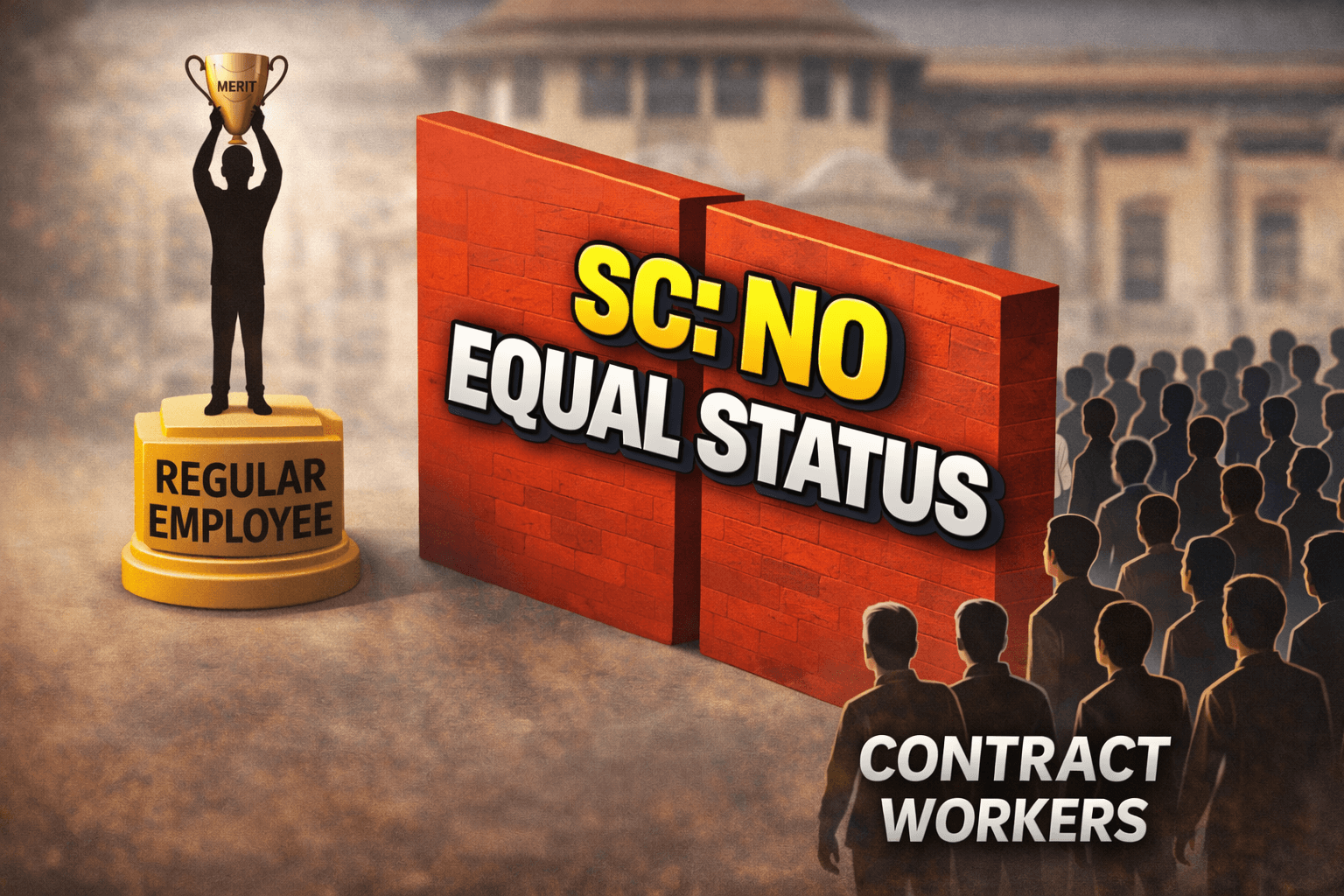
In a significant judgment affecting the labor landscape in India, the Supreme Court has ruled that workers engaged through third-party contractors cannot claim equal status or parity in benefits with regular government employees. The Court held that blurring the distinction between the two would violate the constitutional principles of transparent public recruitment.
The Division Bench of Justice Ahsanuddin Amanullah and Justice Vipul M. Pancholi set aside the lower court's order that had granted parity to contract workers, emphasizing that public employment is a "public asset" that must be accessible to all eligible citizens through a fair selection process.
The judgment hinged on the fundamental difference in how regular and contract employees are recruited:
- Regular Employees: Are appointed through a rigorous, transparent process involving advertisements, competitive exams, and merit lists. This ensures compliance with Articles 14 and 16 of the Constitution (Right to Equality in Public Employment).
- Contract Workers: Are often hired at the absolute discretion of the private contractor. There is no statutory requirement for a competitive process, making their entry into the workforce "arbitrary" in the context of public rules.
The Bench observed:
"If the persons who are employed through a contractor... are given equal benefit and status as a regular employee, it would amount to giving premium and sanction to a process which is totally arbitrary... This cannot be permitted in law."
The respondents (contract workers) argued that they performed duties identical to regular employees and had served for decades. They invoked the principle of "Equal Pay for Equal Work."
However, the Court rejected this application, stating that the mode of recruitment is a valid "intelligible differentia" (a legal distinction). If the Court were to mandate equal status, it would essentially allow a "backdoor entry" into public service, bypassing the millions of qualified candidates who wait for official government recruitment drives
While laying down the strict law, the Supreme Court exercised its extraordinary powers to grant limited relief to the specific respondents in this case.
- Noting that these workers had served the Municipal Council for decades without interruption and had not been sent back to the contractor, the Court directed the Council to consider their regularization.
- Crucial Caveat: The Court explicitly stated that this relief is "passed in the special facts and circumstances... and shall not be treated as a precedent." This means other contract workers cannot cite this specific part of the order to demand similar regularization automatically
This judgment reinforces the "fence" between principal employers and contract labor.
- For Public Sector Undertakings (PSUs): It provides legal immunity against claims for regularization from outsourced staff, provided the contract is genuine and not a sham.
- For Contract Workers: It highlights the legal precarity of their position. Length of service alone does not transmute a contract job into a permanent government post.