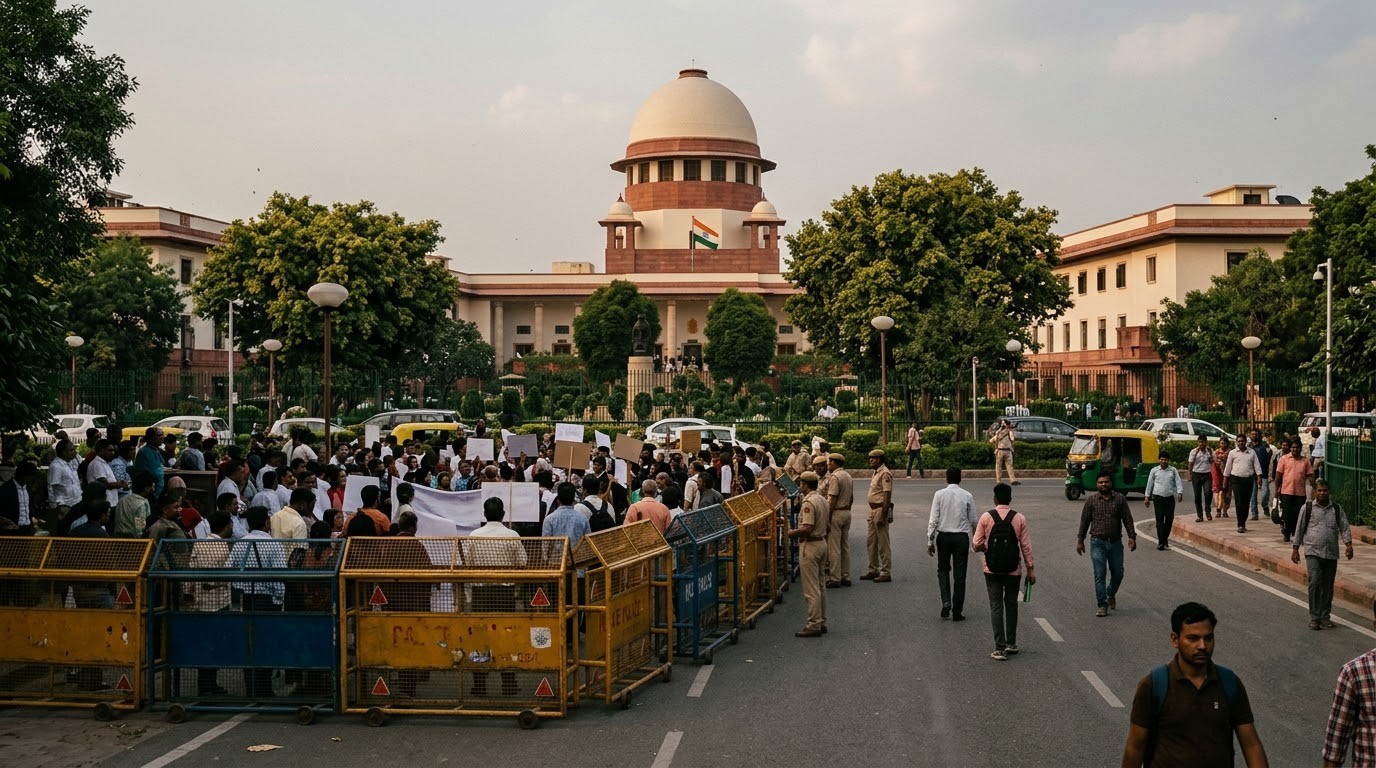
A bench comprising Chief Justice of India Surya Kant, Justice Joymalya Bagchi and Justice V. Mohana made the observations on Tuesday while hearing a batch of petitions arising from recent demonstrations in Delhi against Chief Election Commissioner Gyanesh Kumar. The matters included pleas from traders alleging severe business losses, as well as petitions raising allegations of police excesses, detentions, and restrictions imposed during the protests.
What did the Supreme Court hold regarding indefinite occupation of protest sites?
The Court held that the constitutional right to protest cannot extend to indefinite occupation of a designated protest site, as this would deny farmers, workers, trade unions, the homeless and other groups the opportunity to exercise the same right. Sites must be allotted for identified periods to ensure equitable access for all citizens.
Constitutional right to protest versus indefinite occupation
The Chief Justice of India orally observed that no single group can occupy a protest site for all time. He questioned where farmers, journalists and other citizens would go if a site remained permanently occupied by one group. The bench emphasised that designated sites must be allotted for designated periods so that various sections of society, including farmers, workers, trade unions and the homeless, can also exercise their right to protest. The Court stressed the necessity to balance the right to protest with the right to trade and earn a livelihood, particularly for daily-wage workers.
Submissions on permission and duration of occupation
Solicitor General Tushar Mehta submitted that permission for the July protest had been granted only for a single day, yet the Jantar Mantar site remained occupied for a longer period. Senior Advocate Mukul Rohatgi, appearing for traders, submitted that businesses had suffered losses running into thousands of crores. He sought a two-month restriction on protests, especially during the festive season. Traders' counsel claimed that approximately 50 lakh people reside in areas surrounding the protest site and that shops in locations such as Connaught Place remained shut with minimal commercial activity.
Directions on impleadment and notice
The Court issued notice on the plea by the Kirana Committee Delhi seeking a halt to protests during the festive period. However, the bench directed the traders' associations to implead the organisers of the anti-CEC protests as parties, noting that it could not fully adjudicate the grievances otherwise.
Allegations of police action and surveillance concerns
Other petitioners alleged unlawful detentions, custodial assault, barricading and excessive police action during the October demonstrations. The Court also issued notice on a petition questioning the legal framework for facial recognition surveillance and the use and security of collected data. It agreed to hear separately, after Diwali, a plea concerning alleged harassment of women journalists and a request for a separate investigative committee.
Lawyers' bodies raise access and detention issues
Lawyers' bodies raised issues concerning the detention of advocates, internet disruption, and restrictions on access to courts and chambers. Petitions regarding alleged assault, detention, seizure of devices and police action against journalists, including contempt proceedings, were also taken up by the bench.
Categorisation of petitions for separate hearings
The Court decided to divide the connected petitions into nine categories for separate hearings and sought proposed arguing sequences and time estimates from counsel. It indicated that fresh writ petitions would not ordinarily be entertained unless the Advocate-on-Record certified that they raised an entirely new and distinct issue. Senior Advocates Indira Jaising, N Hariharan, Menaka Guruswamy, Arundhati Katju, CU Singh and PV Dinesh appeared for various petitioners questioning police action and State restrictions. Senior Advocate Mahesh Jethmalani appeared for a petitioner seeking a standard operating procedure to regulate the participation of foreigners in protests.
Category of Petition | Key Issues Raised |
|---|---|
Traders' grievances | Business losses, request for protest restrictions during festive season |
Police action allegations | Unlawful detentions, custodial assault, barricading, excessive force |
Journalists' rights | Alleged harassment of women journalists, assault, seizure of devices, contempt proceedings |
Surveillance framework | Legality of facial recognition, use and security of collected data |
Lawyers' access | Detention of advocates, internet disruption, restricted access to courts and chambers |
Foreign participation | Need for SOP regulating participation of foreigners in protests |
The bench had previously directed the Union to produce the orders issued under Section 163 of the Bharatiya Nagarik Suraksha Sanhita imposed in Delhi during the protests. The matters are listed for further hearing after the Diwali vacation.