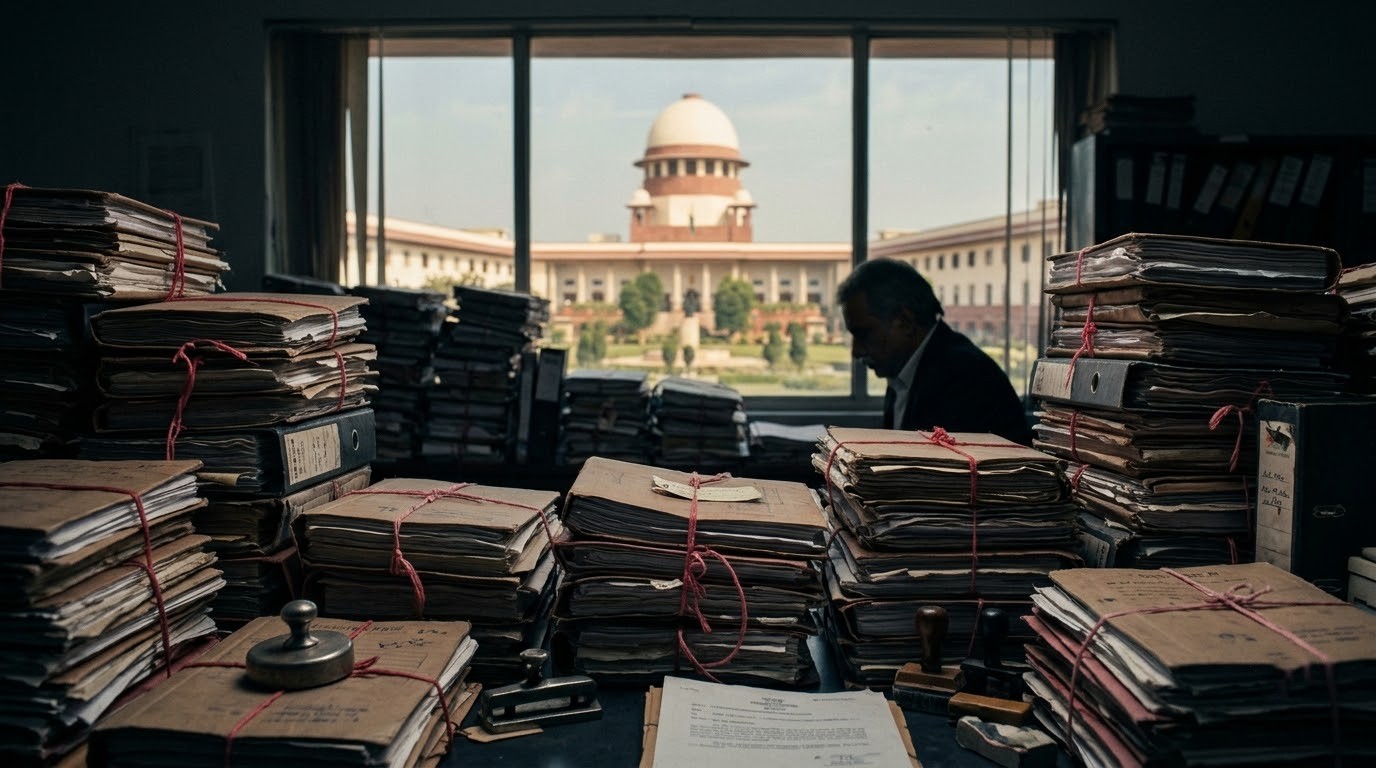
On 6 March 2026, the Union Public Service Commission declared the final results of the Civil Services Examination (CSE) 2025 and recommended 958 candidates for appointment. Five days later, the Supreme Court decided Union of India v. Rohith Nathan (2026 INSC 230), dismissing appeals by the Union against concurrent High Court rulings from Madras, Delhi, and Kerala. More than seven months later, not one of the recommended candidates has been allocated a service, and the Foundation Course remains suspended. No stay has been granted and no review petition is pending. The delay stems from an application filed by the Union seeking 'clarification' of the March judgment, a plea the Court heard and reserved orders on 24 September.
What the March 2026 Judgment Decided
The creamy layer test for Other Backward Classes originates in the Department of Personnel and Training (DoPT) Office Memorandum (OM) of 8 September 1993, issued pursuant to Indra Sawhney v. Union of India (1992). The 1993 OM applies a status-based criterion for government servants: children of Group A officers, and of parents who both hold Group B posts, are excluded solely by virtue of the parent's post, not the salary attached to it.
For employees of Public Sector Undertakings (PSUs), banks, insurance companies, universities, and private employers, the OM directed that the same criteria apply to 'equivalent or comparable posts'. As a fallback, until such equivalence was evaluated, families in these sectors would face an Income/Wealth Test under which income from salaries and agricultural land was excluded from computation.
A clarificatory letter dated 14 October 2004 altered this framework in practice. Where equivalence had not been fixed, the letter permitted the inclusion of parents' salary income. The effect was that the child of a PSU or bank employee could be pushed into the creamy layer based on salary alone, while the child of a government servant at a comparable level remained eligible for reservation.
A Bench comprising Justice P.S. Narasimha and Justice R. Mahadevan held that the 2004 letter could not introduce a substantive condition absent from the 1993 policy. The differential treatment, the Court ruled, amounted to hostile discrimination violating Articles 14 and 16 of the Constitution. The Bench dismissed the Union's appeals and directed the DoPT to reconsider the claims of affected candidates within six months.
What the Union Seeks Through the Clarification Application
On 25 August, the Solicitor General mentioned the matter before the Chief Justice's Bench. A special Bench of the same two judges who authored the March judgment was constituted, and notice was issued on 1 September. The application insists it does not seek a review. It asks for clarification on the 'temporal operation' of the judgment. In substance, the Union seeks four specific reliefs: first, that the judgment not reopen completed selections, service and cadre allocations, seniority, or admissions; second, clarity on recruitments already underway as on 11 March; third, two years to establish equivalence of posts and frame a uniform mechanism; and fourth, interim permission to allocate services to the CSE 2025 batch under the 'existing' 1993 OM.
Does the Union's Interim Prayer Seek to Bypass the Judgment?
The March judgment enforced the 1993 OM as originally drafted. The regime the DoPT had actually been applying was the 1993 OM read with the 2004 letter. A request to allocate the 2025 batch under the 'existing' regime, read plainly, is a request to continue using the very criterion the Court struck down, for a batch whose allocation was still pending on the date of judgment.
Scale of Impact Cited by the Union
The Union's application cites extensive figures to underscore the potential disruption. It states that more than 5.69 lakh reserved vacancies, including 3.70 lakh OBC vacancies, were filled in Central ministries and departments between 2016 and 2025. It warns that civil services allocations going back to 2012 could be reopened, and that 18 States and Union Territories following the 1993 OM would face similar complications.
Criterion | 1993 Office Memorandum (Original) | 2004 Clarificatory Letter (Struck Down) |
|---|---|---|
Government Servants (Group A / Dual Group B) | Exclusion based on status of post held by parent | No change; status-based test retained |
PSU / Bank / University / Private Sector Employees | Equivalence to government posts to be determined; fallback Income/Wealth Test excludes salary and agricultural income | Where equivalence not fixed, salary income included in creamy layer computation |
Effect on Candidates | Uniform status-based exclusion across sectors | Hostile discrimination: PSU/Bank employees' children disadvantaged vis-à-vis government servants' children at comparable levels |
Judicial Precedent on 'Clarification' Applications
The Supreme Court has previously scrutinised applications styled as 'clarification' or 'modification' that effectively seek to reargue a concluded case. In Delhi Administration v. Gurdip Singh Uban (2000), the Court warned against such procedural devices being used to circumvent the finality of judgments. The present application, filed nearly six months after the judgment and seeking prospective reliefs that alter the operative effect of the ruling, invites similar scrutiny. The Court reserved orders on 24 September; the 958 recommended candidates and the DoPT await the decision.