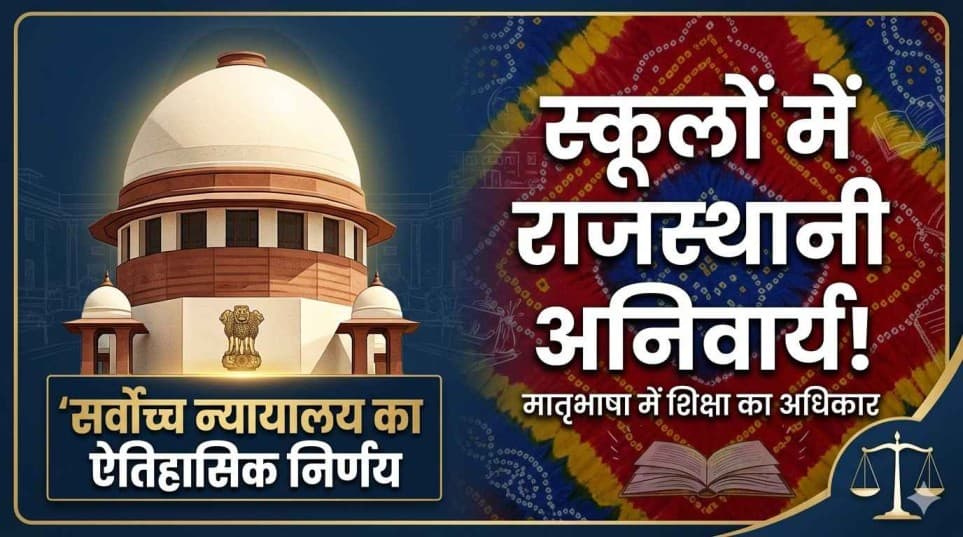
In a landmark decision that celebrates cultural identity and linguistic rights, the Supreme Court of India has directed the Rajasthan government to introduce Rajasthani as a subject in all schools across the state. This ruling, delivered by a bench of Justice Vikram Nath and Justice Sandeep Mehta, emphasizes that the state cannot remain a "silent spectator" to the dilution of rights recognized by the Constitution. By making Rajasthani a mandatory part of the curriculum in both government and private institutions, the court has taken a massive step toward preserving one of India’s most vibrant regional languages.
The court’s directive addresses a long-standing "pedagogical vacuum" in the state’s education system. Despite being spoken by over 4.3 crore people and taught at the university level, the Rajasthani language had previously been excluded from primary and secondary schooling. The state government’s earlier stance—that only languages included in the Eighth Schedule of the Constitution could be taught—was dismissed by the court as a "pedantic approach." The bench noted that a language's academic recognition at the higher education level itself proves its institutional acceptance.
Central to the court’s reasoning was the National Education Policy (NEP) 2020, which advocates for mother-tongue-based education. The bench underscored that imparting education in a language intelligible to a child is a constitutional obligation. By introducing Rajasthani at the foundational and preparatory stages, the state ensures that young learners can connect with their education more naturally, fostering a deeper understanding of their heritage while improving overall learning outcomes.
The judgment also carries significant weight for professional educators in the state. The petitioners specifically sought to include Rajasthani in the Rajasthan Eligibility Examination for Teacher (REET) syllabus. The court’s order now necessitates a shift in how teachers are trained and assessed, ensuring that the instructors themselves are proficient in the language they are tasked to teach. This systemic change is expected to create new opportunities for linguistic scholars and educators specialized in Rajasthani literature and grammar.
Implementing this order will require a phased and progressive approach. The Supreme Court has directed the state to formulate a comprehensive policy framework by September 2026. This includes developing standardized textbooks, training modules for teachers, and a roadmap for gradually adopting Rajasthani as a medium of instruction. The court made it clear that while it respects the state’s role in policy formulation, it will intervene when there is a clear failure to realize constitutional rights.
Critics and policy analysts have noted that this move could set a precedent for other regions with rich linguistic traditions not yet recognized in the Eighth Schedule. For Rajasthan, it is a moment of pride. Advocates for the language argue that this mandate will revive local folk traditions, literature, and history that were slowly being sidelined by a more homogenized curriculum. It is a transition from viewing Rajasthani merely as a "dialect" to recognizing it as a formal tool of empowerment.
In conclusion, the Supreme Court’s mandate is more than just a change in the school timetable; it is a restoration of dignity to a language that defines the spirit of Rajasthan. As the state moves toward compliance in the coming months, the focus will be on ensuring that the implementation is as robust as the judgment itself. For the next generation of students in Rajasthan, the classroom is about to sound a lot more like home.