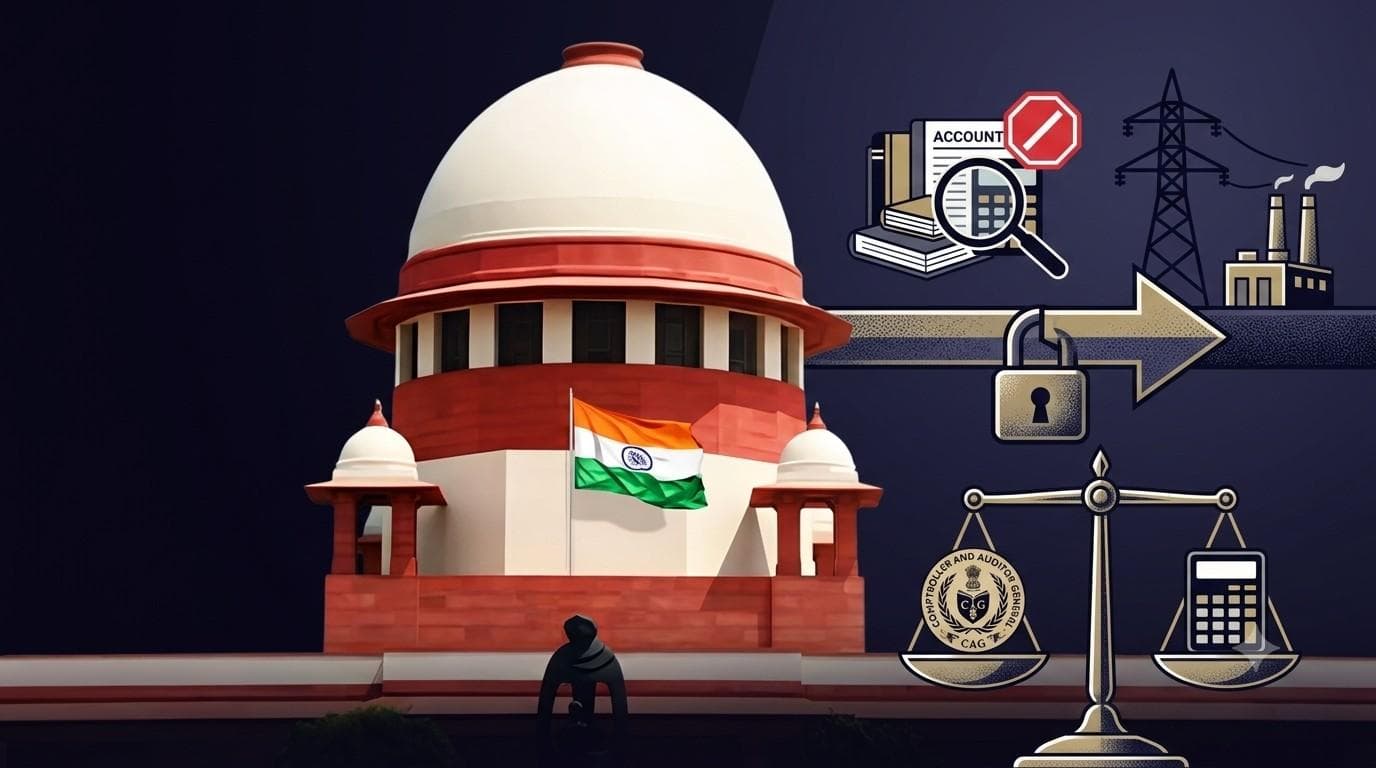
The Supreme Court, comprising Justice KV Viswanathan and Justice Shree Chandrashekhar, passed an order on 3 July 2026 directing that the audit of Delhi’s electricity distribution companies (discoms) by an independent chartered accountant appointed by the Comptroller and Auditor General (CAG) be kept in status quo. The bench issued notice on a petition filed by the Delhi Electricity Regulatory Commission (DERC) challenging an order of the Appellate Tribunal for Electricity (APTEL) dated April 2026.
APTEL had held that it was impermissible for DERC to assign the audit of the discoms to the CAG and had directed that an independent chartered accountant, not linked to the CAG, be appointed to conduct the audit. DERC assailed that tribunal order, contending that the CAG‑appointed auditor possesses the requisite expertise and independence to examine the financial statements of the discoms. The petition sought to set aside the APTEL direction and to uphold the CAG‑based audit mechanism.
The bench, while issuing notice, observed that the matter required consideration of its own judgment delivered in August 2025 on the issue of regulatory assets. In that judgment the Court had directed electricity regulatory commissions to undertake strict and intensive audits of the circumstances under which power discoms continued to operate without recovering regulatory assets. The Court had emphasised that regulatory assets, which are created to insulate consumers from abrupt tariff increases, ought not to remain unresolved for prolonged periods. Notably, the August 2025 judgment did not prescribe any particular agency or professional body to carry out the envisaged audit.
In light of that silence, the present bench concluded that the audit presently being conducted by the CAG‑appointed chartered accountant should be kept in abeyance until the scope and implications of the August 2025 pronouncement are examined. The Court therefore directed status quo on the audit proceedings and listed the matter for further hearing on 15 July 2026, to be heard by the same division bench.
During the hearing, the Solicitor General Tushar Mehta appeared on behalf of DERC, arguing that the CAG‑appointed auditor satisfies the requirement of independence and possesses the statutory mandate to scrutinise the accounts of public sector utilities. Senior Advocate Dr Abhishek Manu Singhvi, representing the Forum of Regulators and the discoms, contended that the APTEL direction correctly identified a conflict of interest in allowing the CAG to nominate the auditor and that an independent chartered accountant, free from any governmental affiliation, is necessary to ensure objectivity.
The Court’s order does not express any opinion on the merits of the competing positions; it merely preserves the existing state of affairs while the bench considers whether the earlier regulatory assets judgment imposes any limitation on the choice of auditor for the discoms. The decision underscores the Court’s approach of avoiding piecemeal interference in ongoing audit processes until a comprehensive view of its prior pronouncements is formed.
Implications of the status quo direction include the continuation of the CAG‑appointed auditor’s work, subject to any future modification that the bench may issue after the July hearing. The parties will have an opportunity to elaborate on the interplay between the regulatory assets directive and the statutory audit framework governing electricity distribution companies. The matter remains pending, and the forthcoming hearing will determine whether the audit shall proceed under the CAG‑nominated chartered accountant or whether an alternative independent auditor must be appointed as per the APTEL direction.