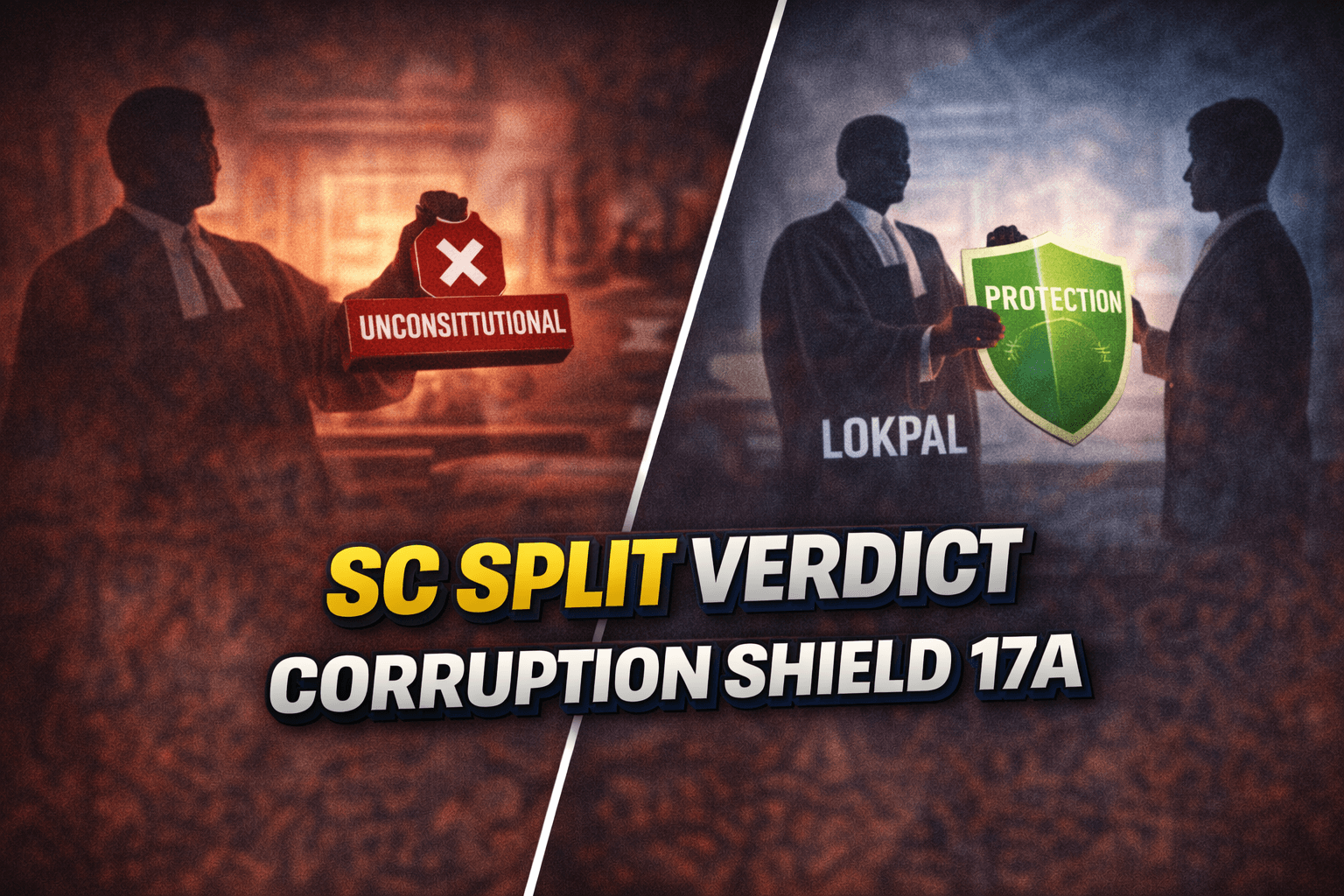
The Supreme Court of India has delivered a significant split verdict on the constitutional validity of Section 17A of the Prevention of Corruption (PC) Act, 1988. This controversial provision, introduced via a 2018 amendment, mandates that investigating agencies must obtain prior sanction (approval) from the competent government authority before commencing an enquiry or investigation into any decision made by a public servant in the discharge of their official functions.
The Division Bench comprising Justice B.V. Nagarathna and Justice K.V. Viswanathan held diverging views on whether this "protective shield" for bureaucrats facilitates fearless decision-making or merely insulates corrupt officials.
1. Justice B.V. Nagarathna: "Unconstitutional Shield" Justice Nagarathna struck down Section 17A, declaring it unconstitutional.
- Reasoning: She observed that the provision creates an unreasonable classification and acts as a barrier to independent investigation. In her view, the requirement for prior executive approval effectively "protects the corrupt" and undermines the very purpose of the anti-corruption law. It places the power to block investigations in the hands of the very executive that might be complicit.
2. Justice K.V. Viswanathan: "Valid but Read Down" Justice Viswanathan upheld the validity of Section 17A but with a significant caveat to prevent abuse.
- Reasoning: He argued that striking down the provision entirely would be like "throwing the baby out with the bathwater." He emphasized that honest officers need protection from frivolous and vexatious complaints to prevent "policy paralysis."
- The Caveat: To balance this protection with accountability, he read down the provision. He directed that the power to grant or deny sanction should not lie with the government/executive but must be exercised by an independent body—specifically, the Lokpal (at the Centre) or the Lokayukta (at the State level). This ensures that the screening process is insulated from political interference.
Since the two judges disagreed, the matter has been referred to the Chief Justice of India to constitute a larger bench (likely a 3-judge bench) to settle the question of law.
Why is Section 17A Controversial? Critics, including the petitioner (Centre for Public Interest Litigation), argued that Section 17A effectively brings back the "Single Directive" protection that the Supreme Court had famously struck down in the Vineet Narain and Subramanian Swamy judgments. They contended that requiring government permission to investigate a government officer creates a conflict of interest, often stalling sensitive probes into high-level corruption.
The government, on the other hand, argued that without this filter, bureaucrats would be paralyzed by the fear of malicious prosecution for every administrative decision they take.
Until a larger bench decides, the status of Section 17A remains in a judicial limbo, though functionally, the provision is still in the statute book. However, Justice Viswanathan’s suggestion to shift the sanction power to the Lokpal offers a potential "middle path" for future reform.