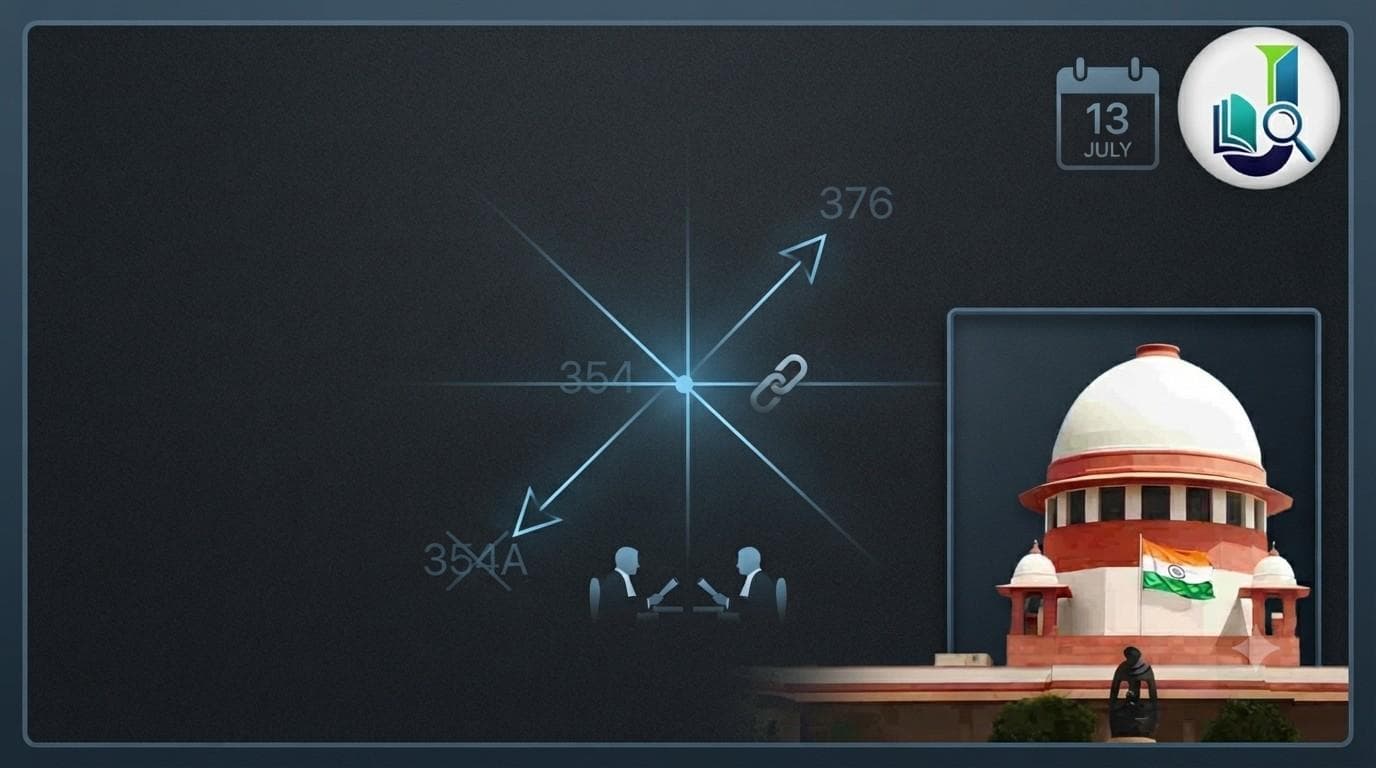
The Supreme Court bench comprising Justice JB Pardiwala and Justice K Vinod Chandran issued notice in the matter of THE STATE OF KARNATAKA Vs REVANNA H.D., Diary No. 25514/2026, after the Karnataka Government filed a petition challenging the Karnataka High Court’s order that discharged HD Revanna from the charge of outraging a woman’s modesty under Section 354 of the Indian Penal Code. The High Court had, however, retained the charge of sexual harassment under Section 354A IPC and directed the trial court to examine whether the limitation period for taking cognizance could be extended.
The High Court was originally hearing a petition filed by HD Revanna seeking the quashing of the first information report registered against him under Sections 354, 354A, 506 and 509 IPC. During the pendency of that petition, the police filed a chargesheet and the trial court took cognizance of the offences under Sections 354 and 354A IPC. HD Revanna contended that the cognizance could not be sustained because the complaint was lodged after a delay of approximately three years, which exceeds the period of limitation prescribed under Section 468 of the Code of Criminal Procedure for offences punishable with imprisonment of three years or less.
Relying on that limitation argument, the trial court subsequently discharged HD Revanna also from the charge under Section 354A IPC. The Karnataka Government, dissatisfied with the High Court’s order that set aside the Section 354 charge while retaining Section 354A, approached the Supreme Court seeking intervention.
Appearing for the State, Senior Advocate S Nagamuthu informed the bench that there are two accused in the case, namely HD Revanna and his son Prajwal Revanna, the latter being charged under Section 376 IPC (rape) by the same complainant, who was formerly employed as a house help. Nagamuthu submitted that the limitation period must be determined with reference to the most serious offence among those framed in the chargesheet, which, in his submission, is Section 376 IPC.
Justice JB Pardiwala orally questioned the State’s position, asking how the High Court could have suggested modifying the charge from Section 354 to Section 354A after the trial court had already taken cognizance. He remarked, “You should have challenged the order when the Court decided to take cognisance for outraging the modesty; Section 354 and other charges in the chargesheet were dropped.”
On the limitation issue, Nagamuthu argued that the period of limitation is to be assessed vis‑a‑vis the offence that is gravest among the charges levelled. Justice Pardiwala responded by asking whether the State intended to prosecute HD Revanna for the offence of rape merely because a more serious charge existed against another accused in the same transaction. Nagamuthu replied that cognizance is taken against the offence, not against the offender, and therefore the limitation should be linked to the gravest offence in the chargesheet.
The bench, however, expressed skepticism. Justice Pardiwala illustrated his point with an analogy: “There is a charge of 302 against A and B and there is a charge under Section 201[destroying evidence] against C. C has to be charged and tried only for that offence. Will you say just because A and B are facing charges for 302, [C should also face the same charges?]” He emphasized that no cognizance had been taken against HD Revanna under Section 376 IPC, and consequently the limitation period applicable to that offence could not be imported to affect the proceedings against him.
Nagamuthu reiterated that because the alleged acts formed part of a common transaction, a single chargesheet was filed and a common cognizance of all offences was recorded, which, in his view, required the limitation period to be evaluated with reference to the most serious offence contained therein.
The Supreme Court, having heard the submissions, issued notice to the Karnataka Government and directed the parties to file their respective counter‑affidavits. The matter is now listed for further hearing, during which the Court will examine the interplay between Section 468 CrPC, the doctrine of common transaction, and the propriety of modifying charges after cognizance has been taken.