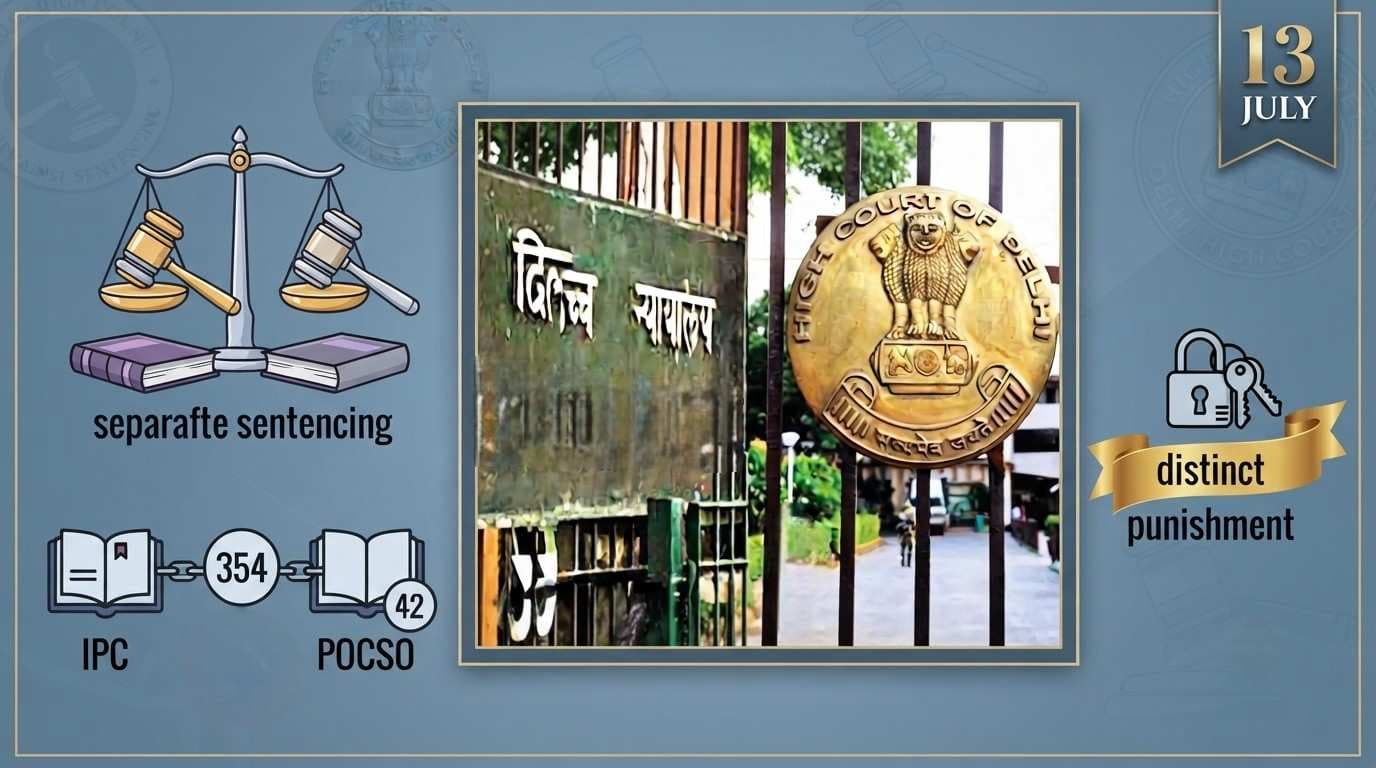
The Delhi High Court, in a recent judgment, addressed the interaction between Section 354 of the Indian Penal Code (IPC) and Section 42 of the Protection of Children from Sexual Offences (POCSO) Act, 2012. The bench observed that the trial court had committed an error by failing to award a distinct sentence for the offence under Section 354 IPC in a case involving the sexual assault of a six‑year‑old girl. The court clarified that Section 354 IPC does not fall within the ambit of IPC offences that are covered by the non‑obstante provision of Section 42 of the POCSO Act.
According to the record, the trial court had convicted the accused under both the POCSO Act and Section 354 IPC. While a sentence was imposed for the offence under the POCSO Act, no separate punishment was awarded for the offence under Section 354 IPC. The trial court appeared to have treated the IPC offence as being subsumed by the POCSO provisions, relying on Section 42 of the POCSO Act which, in certain circumstances, limits punishment to that prescribed under the POCSO Act when an act is punishable under both statutes.
The High Court, however, examined the language of Section 42 and concluded that its applicability is restricted to specific IPC offences that are expressly envisaged under the POCSO framework. The bench noted that Section 354 IPC, which deals with assault or criminal force to a woman with intent to outrage her modesty, is not listed among those offences. Consequently, the non‑obstante clause of Section 42 does not operate to bar an independent punishment under Section 354 IPC when the same conduct also constitutes an offence under the POCSO Act.
The court emphasized that where Section 42 does not apply, the offender may be liable to punishment under each statute separately, and the trial court’s omission to impose a separate sentence resulted in an inadequate penalty. The bench directed the trial court to reconsider the sentence and to impose a distinct punishment for the offence under Section 354 IPC, in addition to the sentence already awarded under the POCSO Act.
This pronouncement underscores the principle that legislative provisions intended to avoid double jeopardy must be interpreted strictly, and that offences not expressly covered by the protective non‑obstante clause remain punishable independently. The decision clarifies the scope of Section 42 of the POCSO Act for lower courts and reinforces the need to examine the precise applicability of the provision before concluding that an IPC offence is barred from separate sentencing.
The judgment is expected to influence future proceedings where charges under both the POCSO Act and IPC Sections such as 354 are framed, ensuring that sentencing reflects the cumulative culpability of the accused where the law permits.