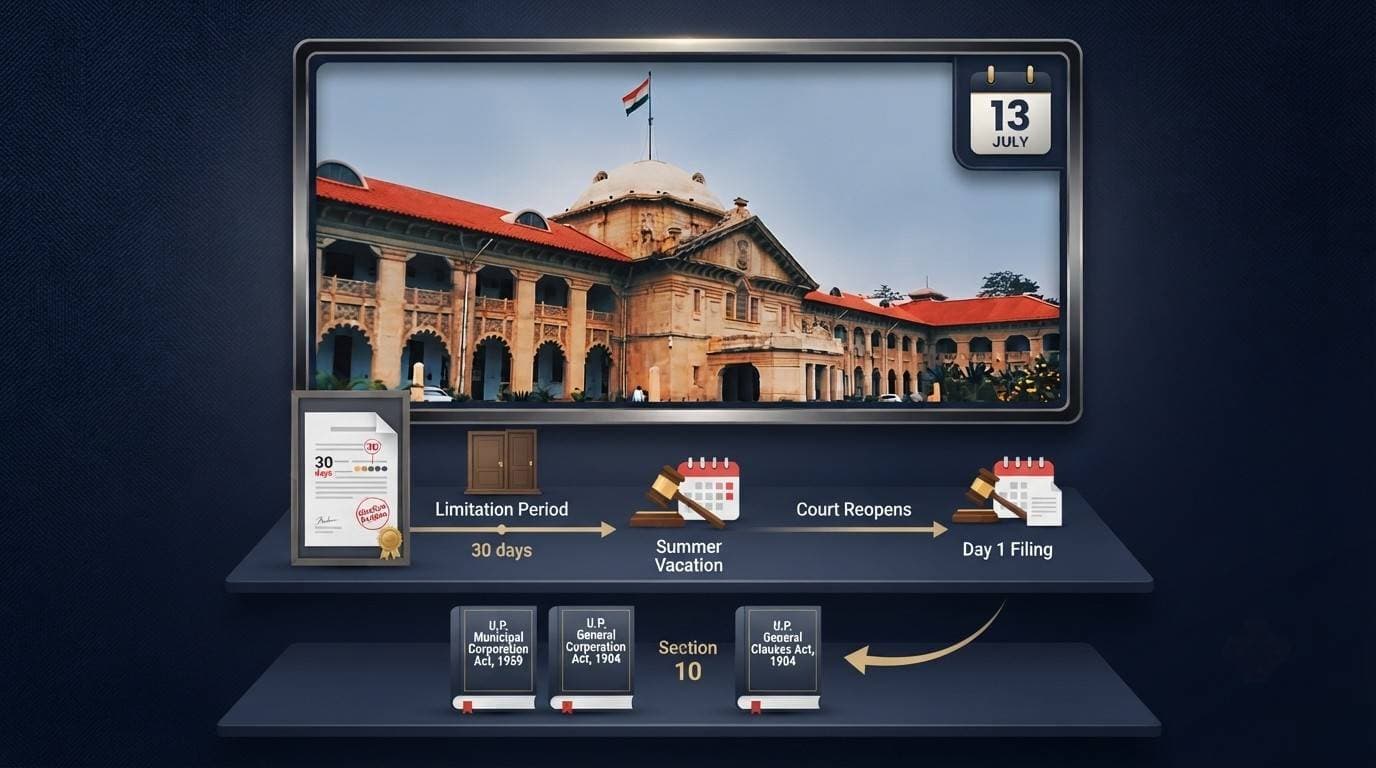
The matter before the Allahabad High Court arose from an election petition filed by Ajeet Nigam challenging the election of a Corporator under the provisions of the U.P. Municipal Corporation Act, 1959. The petition was presented on the day the District Court reopened after the summer vacation. The respondents, comprising the Additional District Judge and five other parties, objected that the petition was time‑barred because the thirty‑day period prescribed for filing such an election petition had elapsed while the court‑under the relevant statutory provision‑had expired during the vacation.
The court examined the interplay between the limitation period stipulated under the U.P. Municipal Corporation Act, 1959 and the provisions of the U.P. General Clauses Act, 1904. Section 10 of the General Clauses Act deals with the computation of time when the last day prescribed for doing an act falls on a day when the court is closed. It provides that, in such a circumstance, the act may be done on the next day when the court is open, unless a notification is issued permitting the act to be performed during the closure.
Justice Vikas Budhwar, delivering the judgment, observed that the limitation period for filing the election petition under the U.P. Municipal Corporation Act, 1959 is thirty days from the date of the declaration of the election result. In the present case, the thirtieth day fell within the period of the summer vacation when the District Court was not functioning. The court noted that the State Government had not issued any notification under Section 10(2) of the U.P. General Clauses Act, 1904 authorising the filing of election petitions during the vacation.
Accordingly, the court held that the limitation period was effectively extended by the operation of Section 10, and the petition filed on the first working day after the vacation was within the extended time. The judgment emphasized that the purpose of Section 10 is to prevent a litigant from being deprived of a remedy merely because the last day of limitation coincides with a judicial holiday, and that this protection operates only when the legislature has not expressly allowed the act to be performed during the closure.
The court further clarified that the absence of a notification permitting filing during the vacation is a material fact; had such a notification been issued, the petition would have been required to be filed within the original thirty‑day window, irrespective of the court’s closure. The judgment thus reinforces the principle that statutory limitation periods are suspended when the court is closed, unless the competent authority expressly directs otherwise.
In terms of implications, the decision provides clarity for election petitioners under the U.P. Municipal Corporation Act, 1959, confirming that they may rely on the benefit of Section 10 of the General Clauses Act when the limitation period expires during a court vacation and no contrary notification exists. It also serves as a reminder to the State Government to issue appropriate notifications if it intends to allow the filing of certain petitions during judicial vacations, thereby avoiding ambiguity.
The judgment disposes of the preliminary objection raised by the respondents and permits the election petition to proceed on its merits. The case is cited as Ajeet Nigam v. Additional District Judge and Others, decided by Justice Vikas Budhwar of the Allahabad High Court on 13 July 2026.