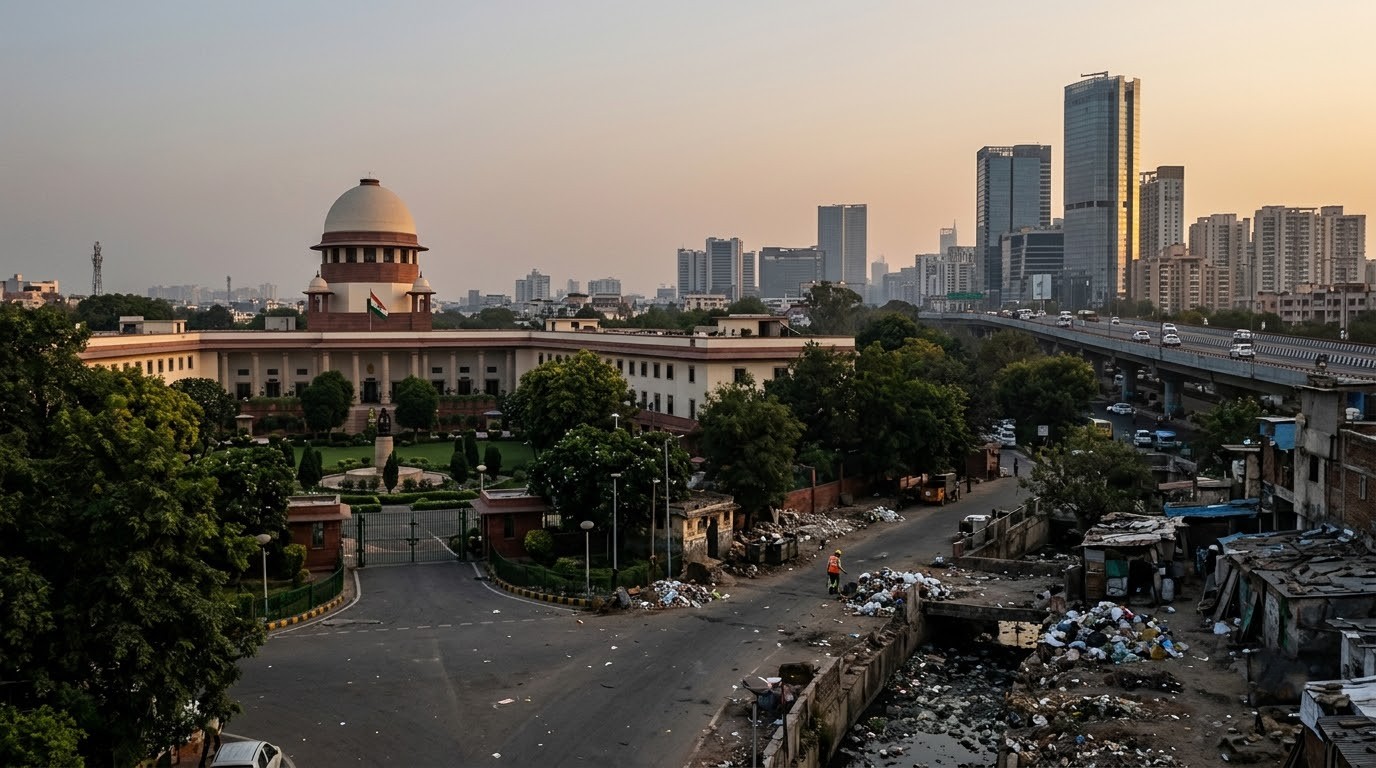
A bench of the Supreme Court comprising Justice S.V.N. Bhatti and Justice N.V. Anjaria on November 17 expressed serious concern over the failure of stakeholders to implement the Solid Waste Management (SWM) Rules, 2026, observing that the economic growth achieved by the country in other fields is being completely negated by poor sanitation performance. The bench was reviewing a progress report submitted by the Supreme Court Monitoring Committee (SCMC) regarding compliance across states and local bodies.
Court Observes Economic Growth Negated by Sanitation Failures
The Court noted that Bharat is now a rich country but has poor sanitation performance, stating that the growth achieved in other fields is completely negated by the negative impact from this manageable dereliction by all stakeholders. The bench emphasised that poor sanitation and solid waste management affect the outlook of society and the country. It pointed out that similar economies, within India and outside, have succeeded in their sanitation and hygiene objectives, adding that existing resources make this possible through unwavering implementation by statutory enforcing authorities and adherence by citizens.
What Directions Did the Supreme Court Issue for Monitoring SWM Rules Compliance?
The Supreme Court directed District Collectors nationwide to conduct drone surveys and video-call inspections to monitor implementation of the SWM Rules, 2026, and assess ground-level conditions at waste management facilities. Chief Secretaries must ensure District Collectors upload geotagged, timestamped photographs showing facility status as of November 21, 2026, and progress as of January 1, 2027. The SCMC will collate this data for a district-wise status report on verifiable parameters.
Deficiencies in State Compliance Highlighted
The progress report revealed significant gaps in statutory compliance. Approximately 400 districts are yet to establish Special Cells to assist District Collectors. Only nine out of 28 states have met the target for urban bylaws. Sixteen states have not reported the incorporation of rural bylaws, and eighteen states have not reported four-way segregation of rural solid waste. The Court also flagged inadequate reporting on notices issued to residential, commercial, and business establishments for non-compliance, along with a lack of information on public-private participation and waste-to-energy initiatives.
Compliance Parameter | Status Reported |
|---|---|
Districts with Special Cells | ~400 districts yet to establish |
States Meeting Urban Bylaws Target | 9 out of 28 |
States Reporting Rural Bylaws Incorporation | 12 states reported; 16 states not reported |
States Reporting Four-Way Rural Waste Segregation | 10 states reported; 18 states not reported |
Railways Directed to Achieve Full Compliance in Eight Weeks
The bench expressed specific concern over the Railways' compliance record. It noted that only 630 out of 8,809 railway stations had been mapped to local bodies and merely 510 railway premises followed four-way waste segregation. The Railways have been directed to ensure complete compliance within eight weeks.
Municipal Duties and CSR Obligations Reiterated
Emphasising that municipalities cannot evade their duty to maintain public health and hygiene by citing financial constraints, the Court referred to its 1980 decision in Municipal Council, Ratlam v. Shri Vardhichand. The bench also reiterated that industries must utilise Corporate Social Responsibility (CSR) contributions to improve solid waste management infrastructure in the local bodies where they operate, including through compressed biogas plants and waste-to-energy technologies.
Additional Directions to SCMC and Authorities
The Court issued further directions for necessary action by the SCMC to be incorporated in its next report. District Collectors are required to report category-wise, including private establishments and bulk waste generator identified establishments, the deficiencies noted, and steps taken including notices issued for non-compliance. The Education Departments of states were called upon to comply with earlier orders without further delay. The matter has been listed for further hearing on January 12, 2027.