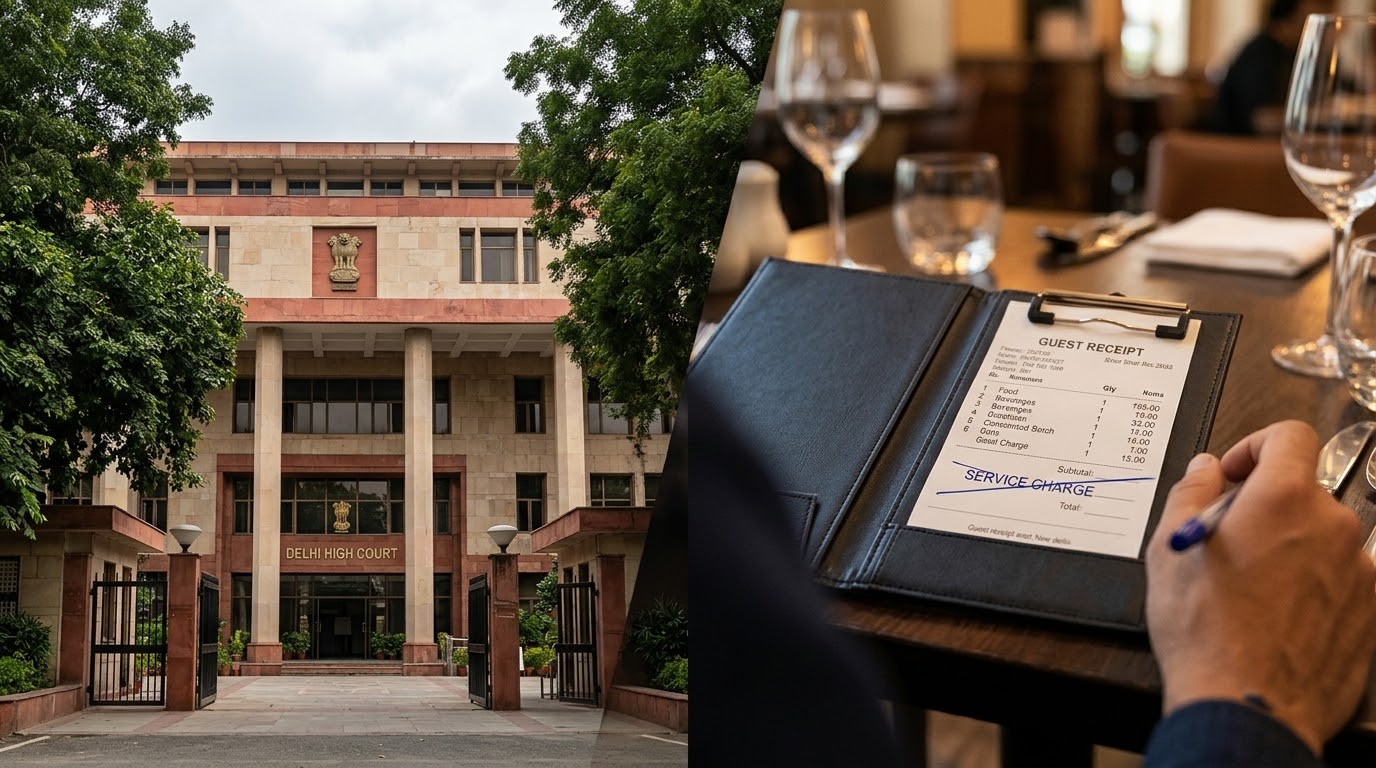
The Delhi High Court on Thursday made it unequivocally clear that restaurants and hotels cannot impose mandatory service charges on consumers, as no interim protection has been granted against a judgment upholding the Central Consumer Protection Authority's (CCPA) ban on the practice.
A Division Bench comprising Acting Chief Justice Nitin Wasudeo Sambre and Justice Sanjay Sharma delivered the clarification while hearing appeals filed by the National Restaurant Association of India (NRAI) and the Federation of Hotel and Restaurant Associations of India (FHRAI). The industry bodies were challenging a March 28, 2025 judgment of a single judge that had upheld the CCPA's July 4, 2022 guidelines.
During the hearing, Additional Solicitor General Chetan Sharma, appearing for the government, submitted that several establishments continued to levy service charges compulsorily despite the single judge's ruling. He contended that such conduct violated the directions issued by the Court and the CCPA guidelines, which prohibit the automatic or default addition of service charges to food bills.
What did the Division Bench rule regarding interim relief for restaurants?
The Division Bench held that it had not granted any interim order staying the operation of the single judge's judgment or protecting restaurants from the CCPA guidelines. Consequently, the authorities are at liberty to take appropriate enforcement action against establishments that continue to impose mandatory service charges.
Responding to the government's submission, Acting Chief Justice Sambre observed that the Court had not passed any interim order in favour of the appellants. The Bench stated that the ball was in the government's court to take action, emphasising that no interim relief had been granted to the restaurant associations. The appeals were admitted for hearing, but the request for interim protection was declined.
Background of the CCPA Guidelines and Single Judge Ruling
The dispute originates from guidelines issued by the CCPA on July 4, 2022, following numerous consumer complaints. The guidelines expressly prohibited hotels and restaurants from adding service charges automatically or by default, collecting them under any other nomenclature, or making them a precondition for providing services. The practice of levying charges ranging between 5% and 20% without customer consent was identified as the primary concern.
The NRAI and FHRAI had challenged the guidelines before the High Court, arguing that the collection of service charges was a longstanding industry practice spanning several decades. They contended that the charges were linked to arrangements concerning employees' wages and compensation and questioned the CCPA's statutory authority to regulate the practice under the Consumer Protection Act, 2019.
In the March 2025 judgment, Justice Prathiba M Singh dismissed the petitions and upheld the validity and enforceability of the CCPA guidelines. The single judge held that service charges and tips constituted voluntary payments and could not be imposed as a compulsory component of a restaurant bill. The ruling established that consumers are required to pay only the prices of food and beverages displayed on the menu, along with applicable statutory taxes. Any additional amount imposed without consent was held to amount to an unfair trade practice under the Consumer Protection Act.
Statutory Authority and Consumer Rights
The single judge further held that the CCPA was statutorily empowered to issue guidelines for preventing unfair trade practices and protecting consumer interests. The Court emphasised that the collective rights of consumers could not be subordinated to the commercial interests of restaurant establishments. It noted that describing such payments as 'service charges' could mislead consumers into believing they were statutory levies akin to service tax or GST.
The judgment suggested that the CCPA could consider permitting alternative descriptions, such as 'voluntary contribution', 'staff contribution', or 'staff welfare fund', provided the payment remained entirely discretionary. The Division Bench's refusal to grant interim relief ensures that the single judge's directions remain fully operative pending the final disposal of the appeals.
Stage | Authority / Bench | Key Holding |
|---|---|---|
Guidelines Issued | Central Consumer Protection Authority (CCPA) | Prohibited automatic/default addition of service charges; barred collection under other names or as condition for service (July 4, 2022). |
Single Judge Judgment | Justice Prathiba M Singh, Delhi High Court | Upheld CCPA guidelines; held service charge is voluntary, not compulsory; mandatory levy is unfair trade practice (March 28, 2025). |
Division Bench Order | Acting CJ Nitin Wasudeo Sambre & Justice Sanjay Sharma | Admitted appeals by NRAI & FHRAI; refused interim stay; clarified no interim protection granted; authorities free to enforce (November 2025). |
The Division Bench's order reinforces the enforceability of the CCPA guidelines during the pendency of the appeals. Establishments continuing to impose mandatory service charges now face the direct prospect of regulatory action, as the judicial shield they sought has been explicitly denied by the appellate court.