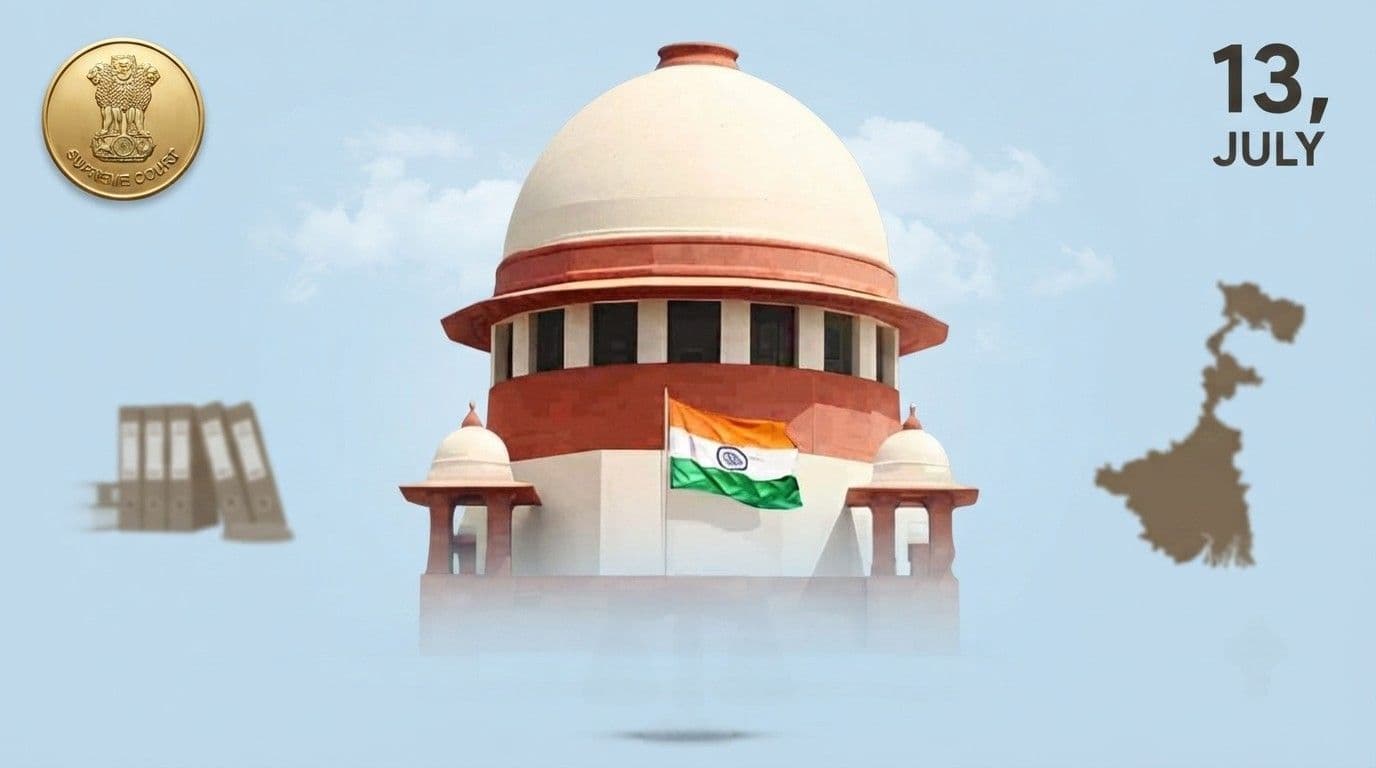
The Supreme Court of India has delivered a decisive verdict in a long-standing legal battle involving over 350 teaching and non-teaching staff members from recognized madrasas in West Bengal. In a judgment that brings finality to a complex dispute, a bench comprising Justices Dipankar Datta and Augustine George Masih dismissed a batch of petitions that sought the regularization of services and access to state-funded salary benefits under the government’s grant-in-aid scheme.
The heart of this controversy lies in the implementation of the West Bengal Madrasah Service Commission Act, 2008. For years, the validity of appointments made in various madrasas remained in legal limbo, caught between evolving High Court rulings and subsequent Supreme Court interventions. While the top court had previously upheld the constitutionality of the 2008 Act in 2020, the status of those appointed during the intervening years—after the High Court had initially struck down the Act but before the Supreme Court's validation—remained a point of intense contention.
To resolve these claims, the Supreme Court had earlier constituted a special committee to scrutinize each appointment. The committee eventually submitted a report concluding that these appointments were invalid under the prevailing legal framework. The petitioners, feeling aggrieved by this finding, approached the Supreme Court to challenge the report and demand government-sanctioned pay.
During the final hearing, the Supreme Court adopted a rigorous approach to justice. The bench opted to examine a representative sample of 13 cases from the larger group of over 350 petitioners. The court’s reasoning was clear: if even one of these cases could be substantiated, it would open the door for a broader review of the remaining claims. However, after a thorough evaluation, the judges found that none of the petitioners could provide evidence or legal grounds sufficient to merit the requested relief.
"Unfortunately, none of the 13 petitioners could impress us," the bench observed. Because the representative cases failed to meet the necessary legal threshold, the court determined that the entire batch of over 40 writ petitions was devoid of merit. Consequently, the claims of all remaining petitioners, not just those scrutinized in the sample, were dismissed.
This ruling underscores the court's commitment to procedural integrity. By refusing to regularize appointments that did not align with the established statutory requirements, the Supreme Court has reaffirmed the necessity of following due process in public appointments, even within the context of minority-run educational institutions.
For the hundreds of staff members involved, this judgment marks the end of a difficult chapter. It serves as a stark reminder that while the law provides avenues for redress, success in such matters requires strict adherence to legislative norms and the ability to demonstrate a clear legal right to the relief being sought. The decision effectively closes the door on a debate that has simmered in West Bengal’s educational sector for over a decade.