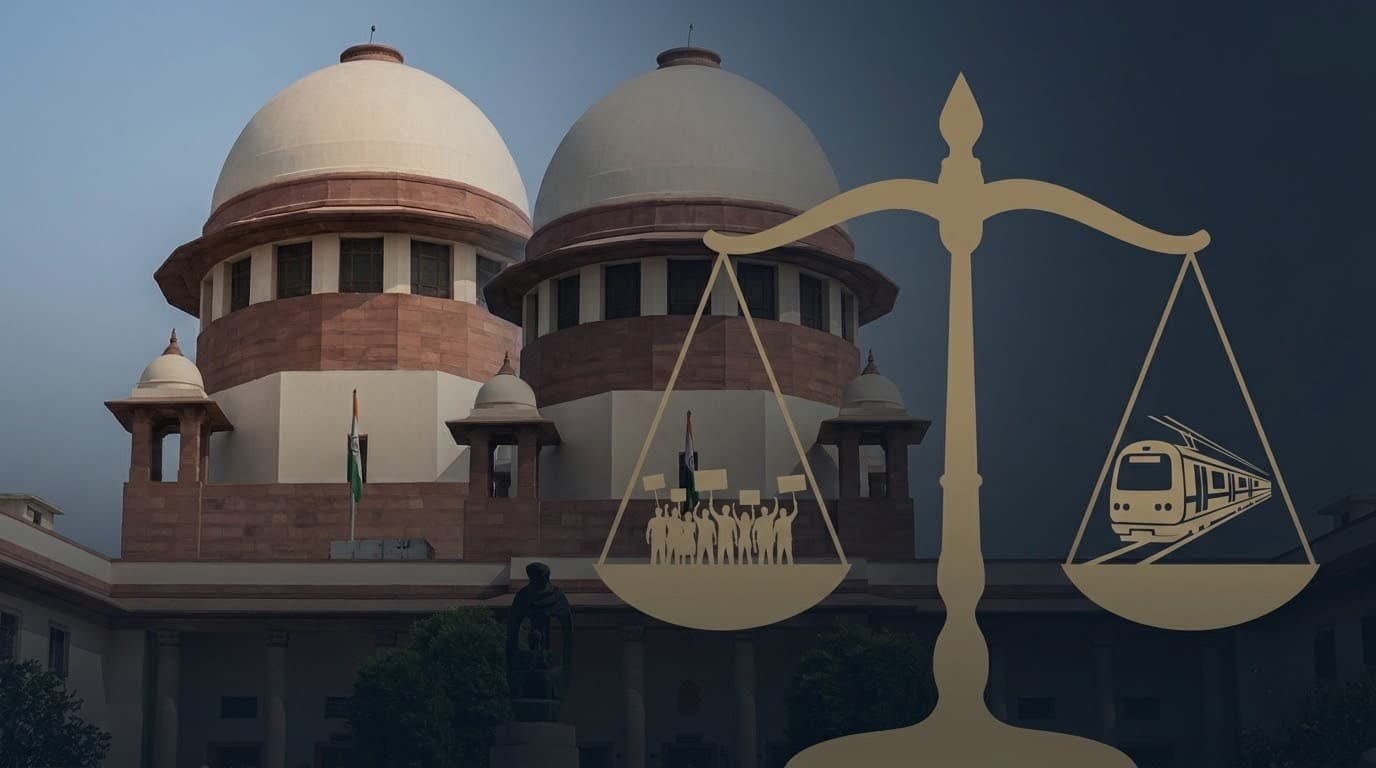
The Supreme Court of India, during a hearing related to protests against the Citizenship Amendment Act, issued specific directions to authorities regarding the conduct of law enforcement and the maintenance of public order. The bench emphasized that peaceful protesters must not be subjected to illegal detention under any circumstances.
The Court observed that while maintaining law and order is a legitimate function of the state, any action taken must conform to constitutional guarantees, particularly the right to peaceful assembly and freedom of movement. It stated that the detention of individuals merely for participating in peaceful protests, without any violation of law, constitutes an infringement of fundamental rights under Articles 19 and 21 of the Constitution.
The bench further directed that normal metro and rail services must not be disrupted or suspended as a measure to curb protests, unless there is a clear and present threat to public safety that justifies such action under the law. It emphasized that the suspension of public transport services disproportionately affects ordinary citizens and cannot be used as a tool to deter lawful dissent.
In addition, the Court directed authorities to ensure the free movement of persons and vehicles, unless restricted by a lawful order passed in accordance with due process. It clarified that blanket restrictions on movement in urban areas, particularly without specific territorial or temporal limits, are not permissible unless strictly necessary and proportionate.
The Supreme Court also stressed the importance of maintaining undisturbed internet access during protests. It noted that shutting down internet services, especially over broad geographical areas or for extended durations, impedes the right to freedom of speech and expression, the right to carry on trade and business, and access to essential services. Any such restriction must be temporary, geographically limited, and subject to judicial review.
The bench made it clear that these directions are not intended to hinder legitimate police action in cases of violence, arson, or other criminal acts. However, it reiterated that the burden lies on the state to demonstrate that any restrictive measure is necessary, proportionate, and the least intrusive means available to achieve a legitimate objective.
The Court concluded by stating that the preservation of public order must coexist with the protection of constitutional freedoms. It urged law enforcement agencies to act with restraint, discretion, and strict adherence to legal safeguards when dealing with assemblies, even those that may be critical of government policy. The directions were issued as part of the Court’s ongoing monitoring of the situation to ensure that executive actions remain within constitutional boundaries.