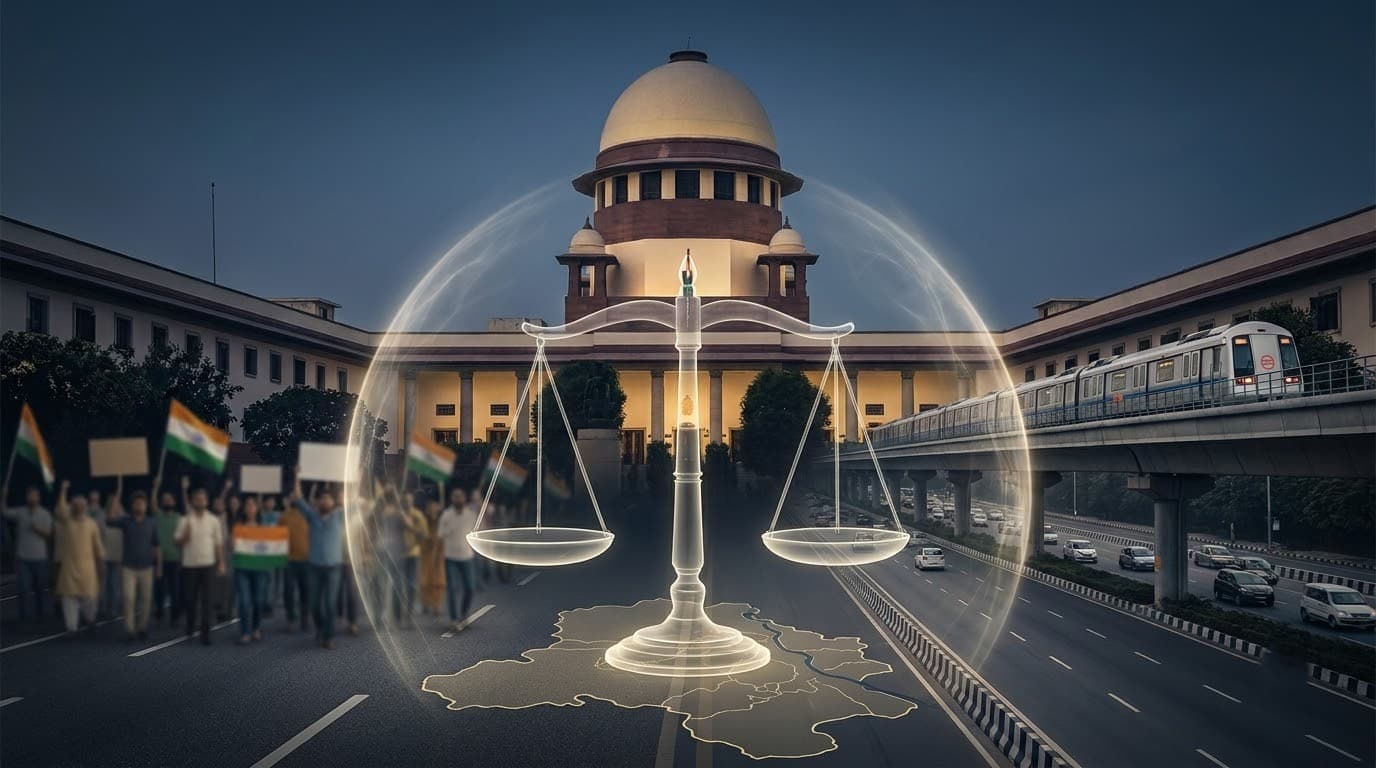
The Supreme Court on Sunday directed Delhi authorities to show cause why contempt proceedings should not be initiated against them for the closure of metro stations on October 10 during the Cockroach Janta Party protests. A Bench comprising Justices Joymalya Bagchi and V Mohana issued notice to Union Home Secretary Govind Mohan, Delhi Police Commissioner Anurag Kumar, and Delhi Metro Rail Corporation Chairperson D Thara, asking them to file an affidavit explaining their actions.
The Court noted that a total of 45 metro stations, primarily located in and around Central Delhi, were shut on October 10 in view of protests at Jantar Mantar against Chief Election Commissioner Gyanesh Kumar and the Special Intensive Revision of electoral rolls. This closure, along with the detention of key protest leaders and opposition members, had prompted multiple petitions before the Court.
The principal matter before the Bench was a contempt petition filed by advocate Shailendra Mani Tripathi, alleging that the Delhi Metro stations remained closed on October 10 despite the Supreme Court’s order on October 9, which had directed that there should be no complete shutdown of public transport ahead of the protests.
During the special sitting, the Bench took note of submissions from various individuals and Central government authorities before issuing a series of directions. It directed the authorities concerned to submit a short affidavit showing cause why contempt proceedings should not be initiated and to file a compliance report regarding the terms of its earlier order.
The Court outlined specific operational guidelines for maintaining public order while upholding fundamental rights. It directed that metro and rail facilities shall function normally unless regulations are required to be imposed, keeping in mind the disturbance to public order as envisaged under Article 19(2) of the Constitution. Free movement of people in the city shall be permitted, subject to traffic regulations, and smooth movement shall not be hindered and shall be allowed in accordance with law.
The Bench further directed that barricades imposed in the city shall be reviewed forthwith, with the requirement of their imposition reassessed in light of law and order and prevailing traffic conditions. Internet facilities shall remain undisturbed as per law, although the Court clarified that this direction does not take away powers available under the Information Technology Act.
On the issue of detention, the Court stated that there shall be no illegal detention, save and except as per procedure established by law, particularly concerning the assemblage of people beyond the area where restrictions are lawfully imposed. It affirmed that assembly shall be permitted in accordance with law, especially in respect of peaceful assembly of people beyond the area where Section 163 of the Bharatiya Nagarik Suraksha Sanhita is in operation.
The Court specifically ordered that a notice board installed outside the Supreme Court premises, stating that Section 163 BNSS had been imposed in and around the vicinity, shall be taken down. The Bench observed that such a board impedes access to justice for citizens and lawyers alike and directed the concerned authority to remove it if not already done.
Reminding those present of their responsibilities, Justice V Mohana urged protesters to undertake that they would protest peacefully and not instigate any other person, emphasizing that such an undertaking should also come from their side regarding conduct with peaceful demonstrators. Senior Advocate Gopal Sankaranarayanan echoed this sentiment, noting that both protesters and authorities must uphold peaceful conduct.
Justice Joymalya Bagchi reiterated the Court’s duty under Article 32 of the Constitution to protect and enforce fundamental rights, underscoring that the directions issued were aimed at ensuring that public order measures do not infringe upon constitutionally guaranteed freedoms.
The Court also noted that alongside Tripathi’s contempt petition, another plea was filed by Trinamool Congress MP and Senior Advocate Menaka Guruswamy, challenging the preventive detention of opposition leaders, including four former Chief Ministers, in connection with the same protests.