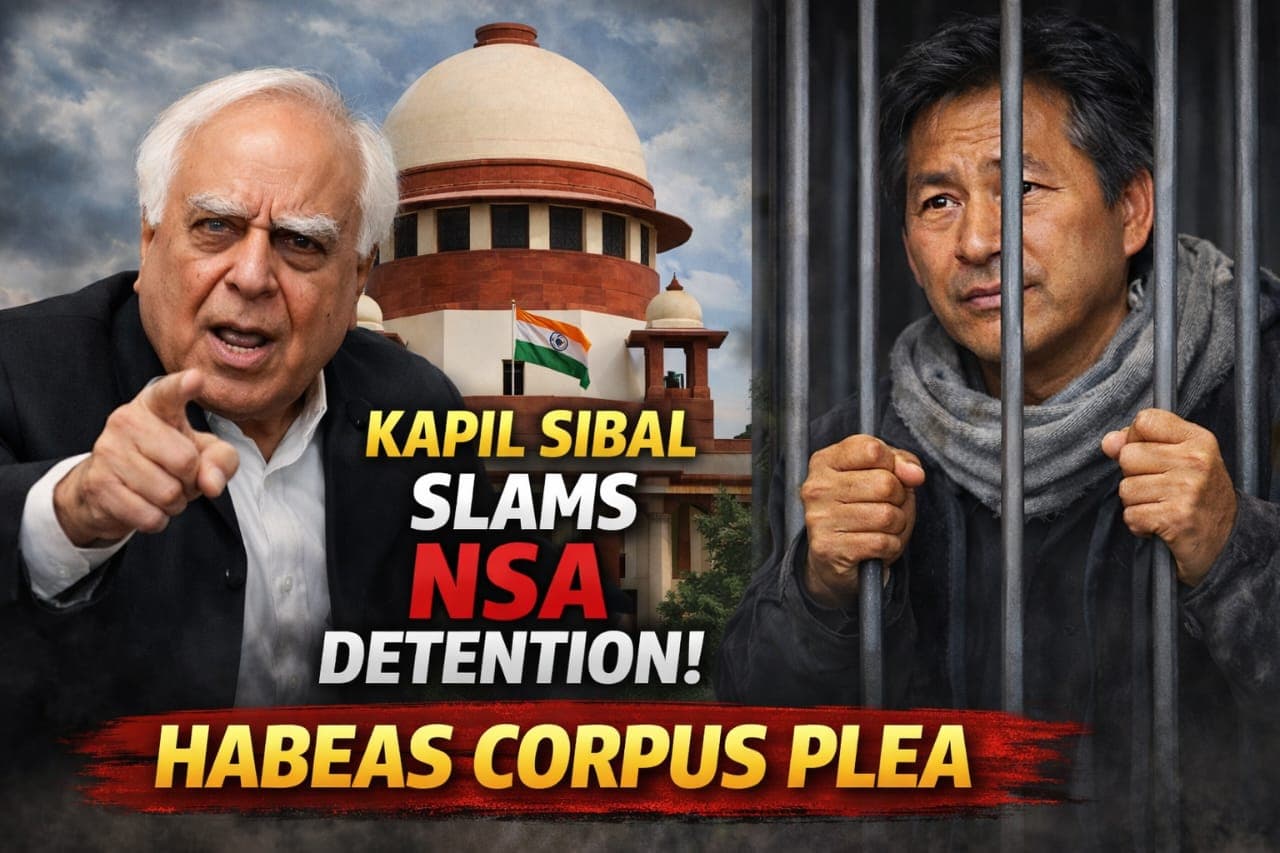
New Delhi: The Supreme Court of India on Thursday heard a habeas corpus petition challenging the detention of renowned Ladakh-based climate activist and education reformer, Sonam Wangchuk, under the stringent National Security Act (NSA), 1980.
A Bench comprising Justices Aravind Kumar and Prasanna B. Varale (though earlier listed with Justice NV Anjaria) deliberated on the plea filed by Dr. Gitanjali Angmo, Wangchuk’s wife. The petition contends that the detention is not only arbitrary but also legally unsustainable due to critical procedural failures by the authorities.
Senior Advocate Kapil Sibal, appearing for the petitioner, led a sharp offensive against the detention order dated September 26, 2025. He argued that the constitutional safeguards provided under Article 22 were bypassed, rendering the entire process "vitiated" and illegal.
Sibal’s primary contention revolved around the "right to make an effective representation"—a fundamental right for any person detained without trial. Under the law, the state must provide the detainee with all the material it relied upon to justify the detention.
Sibal pointed out that the detention order primarily leaned on four videos dated September 10, 11, and 24, 2024. However, while the written grounds for detention were handed over on September 29, the actual video files were missing.
"The law is well-settled: if you rely on a document to lock someone up, you must give them that document. Failure to supply relied-upon material renders the detention illegal, regardless of whether the person already knows what is in those videos," Sibal argued.
He further informed the Court that although a laptop was provided to Wangchuk on October 5, it did not "cure" the initial illegality of the late and incomplete disclosure.
In a dramatic moment during the hearing, Sibal played a video clip from September 24, the day Wangchuk ended his hunger strike. The authorities had cited this period of time as the trigger for the detention, following violence during protests in Ladakh.
However, Sibal argued that the speech in the video showed the exact opposite of what the state claimed. In the clip, Wangchuk is seen appealing for peace, distancing himself from unlawful acts, and urging protesters to adhere to Gandhian principles of Satyagraha.
"This speech was rooted in non-violence. It actually quells violence rather than incites it," Sibal told the Bench. He alleged that the authorities "deliberately suppressed" this exculpatory (favorable) evidence from the detaining authority to make Wangchuk look like a threat to public order.
The defense also placed the detention within a timeline of escalating pressure on Wangchuk. Sibal noted that soon after the Ladakh agitation for Sixth Schedule status intensified, Wangchuk’s institutions faced a flurry of adverse actions, including:
- Cancellation of land leases.
- New CBI inquiries.
- Fresh income tax notices.
These actions, Sibal suggested, pointed toward a "malicious" intent behind the NSA invocation.
Representing the Union, Solicitor General Tushar Mehta had previously defended the move, stating that due process was followed. An affidavit filed by the Leh District Magistrate further asserted that the detention was lawful, citing Wangchuk’s alleged role in inciting violence that led to casualties and injuries in the region. The DM maintained that Wangchuk was informed of the grounds and the case had been forwarded to the Advisory Board as per statutory requirements.
To support his case, Sibal cited landmark Supreme Court judgments, including:
- Ahmed v. Union of India: Establishing that the "timely supply" of all material is a constitutional mandate.
- Khudiram Das v. State of West Bengal: Emphasizing that the detaining authority must have all relevant facts before it to reach a valid "subjective satisfaction."
The Bench, having watched the video evidence on a laptop provided in court, has asked Sibal to conclude his submissions in the next session.
The matter is now listed for further hearing on Monday, January 12, 2026, at 2 PM.
Previously, the Court had allowed Wangchuk to seek virtual appearance and permitted his wife to add additional facts to the record. As the legal battle intensifies, the Supreme Court’s decision will likely set a significant precedent on the limits of preventive detention when used against civil rights activists.
Case Title: Dr. Gitanjali J. Angmo vs. Union of India & Ors.
Bench: Justices Aravind Kumar and Prasanna B. Varale
Next Hearing: January 12, 2026