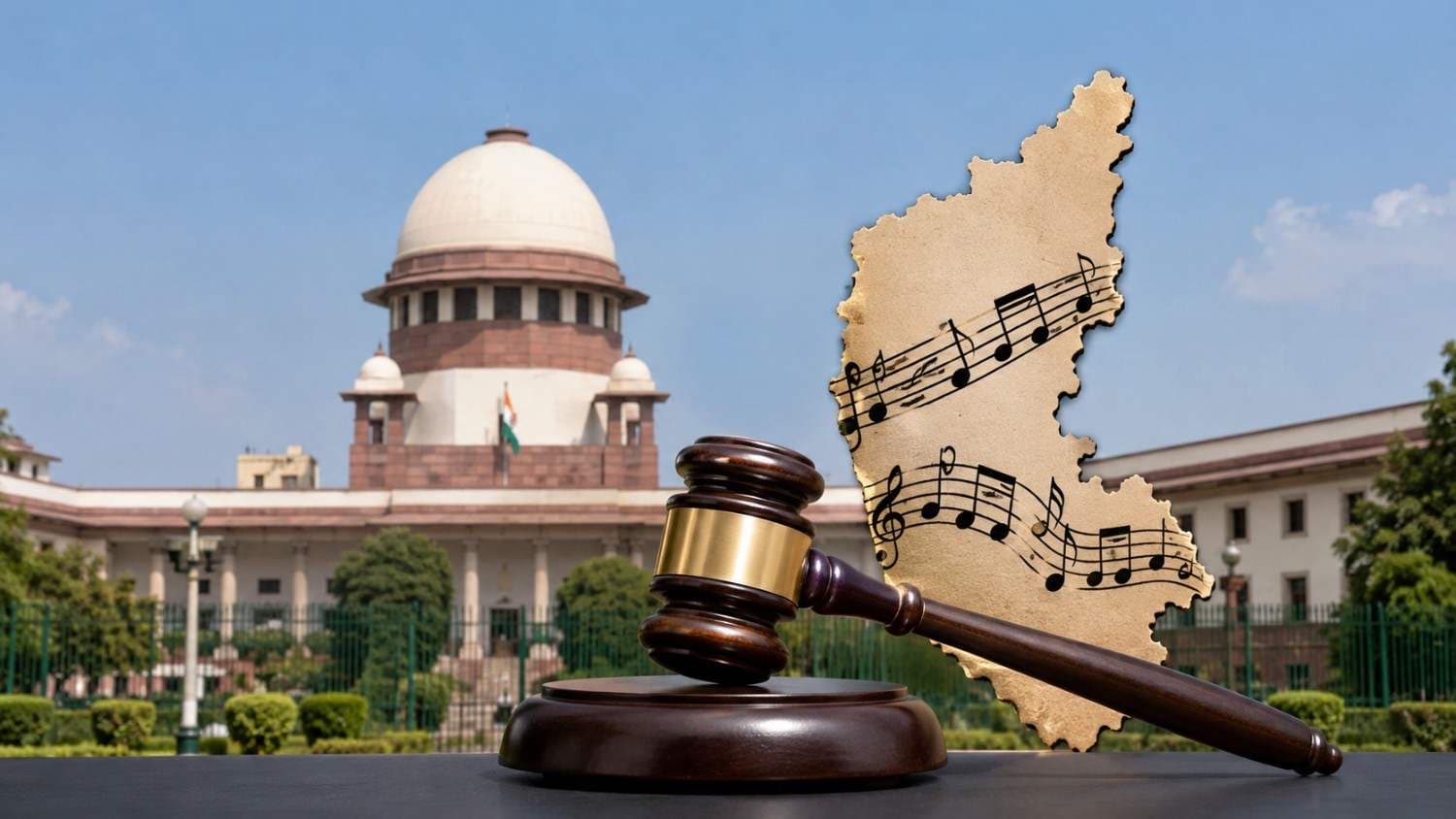
The Supreme Court of India recently affirmed the necessity of uniformity in the rendition of the Karnataka State Anthem, 'Jayabharatha Jananiya Tanujate', by dismissing a special leave petition challenging a state government order that prescribed a specific tune and duration for its performance. A bench comprising Justice BV Nagarathna and Justice R Mahadevan refused to intervene in the matter, thereby upholding the Karnataka High Court's earlier decision.
Background to the Challenge
The legal challenge originated from a government order issued by the State of Karnataka on September 25, 2022. This directive stipulated that the State Anthem, 'Jayabharatha Jananiya Tanujate', was to be sung for a precise duration of two and a half minutes, adhering strictly to a tune composed by the renowned musician Mysore Ananthaswamy. The objective behind this governmental mandate was to standardise the performance of the anthem across all official and public renditions within the state, ensuring a consistent and dignified presentation of the 'Naada Geethe'.
High Court's Initial Ruling
Following the issuance of this order, singer Kikkeri Krishnamurthy filed a writ petition before the Karnataka High Court. The petitioner contested the state government's authority to prescribe a particular raga, or melodic framework, for the rendition of the State Anthem. The core of Krishnamurthy's argument was that such a governmental mandate encroached upon artistic freedom or was otherwise beyond the executive's purview in matters of cultural expression. He contended that the government could not legitimately dictate the musical composition for the anthem.
The High Court, however, dismissed Krishnamurthy's petition after a thorough consideration of the arguments. In its detailed observations, the High Court specifically noted that the 'Raga' in question had been composed by an expert in the field. The court further held that the petitioner's contention, asserting that the government lacked the power to prescribe a raga for the anthem's rendition, was not sustainable in law. Crucially, the High Court concluded that the government's directive did not infringe upon any fundamental or legal rights of the petitioner or any other individual, thereby finding no merit in the challenge against the standardisation order.
Supreme Court's Affirmation of Uniformity
Dissatisfied with the High Court's ruling, Kikkeri Krishnamurthy proceeded to file a special leave petition before the Supreme Court of India. During the proceedings before the apex court, Senior Advocate V Katarki represented the petitioner, presenting arguments against the High Court's decision and the original government order.
The Supreme Court, after carefully considering the submissions made by the petitioner's counsel, declined to entertain the plea. The bench, comprising Justice BV Nagarathna and Justice R Mahadevan, underscored a fundamental principle regarding the rendition of state anthems. The Court explicitly observed that there must be an unequivocal uniformity in the performance of the State Anthem. This uniformity, the bench clarified, is crucial not only concerning the raga, or the specific melodic framework that defines the song, but also with respect to the overall duration of the song. The Court's pronouncement, "There has to be uniformity in the rendition of the State Anthem both with regard to the raga as well as with regard to the duration of the song," served as the cornerstone of its decision.
The Supreme Court's reasoning highlighted the profound importance of a consistent and standardised performance of the State Anthem. The Court implicitly recognised that variations in tune, tempo, or timing could potentially detract from the anthem's solemnity, its symbolic significance, and its role in fostering a collective sense of identity and respect among the citizens. Ensuring a singular, prescribed rendition helps maintain the dignity and reverence associated with such a significant state symbol.
Disposition of the Case
In light of these considerations and the imperative for uniformity, the Supreme Court found no compelling reason to interfere with the impugned order issued by the Karnataka High Court. The apex court concluded that the High Court's decision was well-reasoned and did not warrant intervention. Consequently, the Special Leave Petition (Civil) Diary No(s). 20297/2026, titled KIKKERI KRISHNA MURTHY v THE STATE OF KARNATAKA & ORS., was dismissed. This definitive ruling by the Supreme Court effectively validates the Karnataka government's authority to prescribe specific parameters for the rendition of its State Anthem, thereby ensuring a unified and consistent performance across the state and reinforcing the cultural and symbolic integrity of the 'Naada Geethe'.