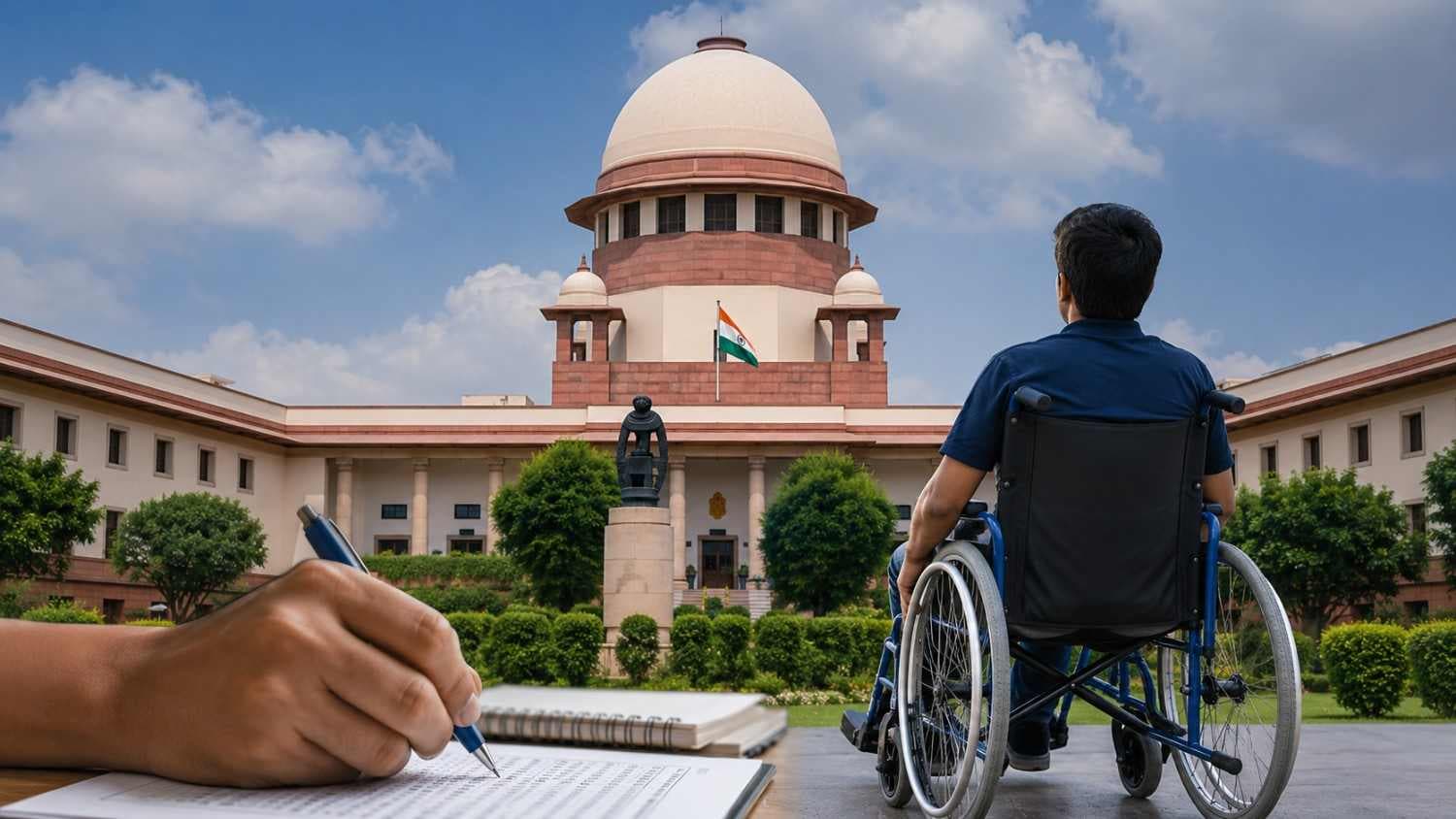
The Supreme Court of India will hear on September 21, 2026, a special leave to appeal filed by Muazzama Tanveer challenging the existing procedure for identity verification of candidates with disabilities appearing for the National Eligibility cum Entrance Test (Undergraduate). The bench comprising Justice PS Narasimha and Justice Alok Aradhe is seized of the matter.
During the hearing, Senior Advocate Gopal Shankaranarayanan appeared for the petitioner. The Court noted that interim relief was not granted as the petitioner had already been permitted to appear for the re-conducted NEET-UG examination held this year. However, the bench declined to dispose of the larger question concerning the feasibility and necessity of alternative verification methods for candidates with disabilities.
The Court observed that the issue raises important considerations requiring detailed examination. Accordingly, it directed Senior Advocate Gopal Shankaranarayanan to assist the Court in the matter, acknowledging the complexity of the questions involved.
The matter has been listed for final hearing on September 21, 2026. No interim order has been passed, and the petition remains pending adjudication on the core issue of whether alternative identity verification mechanisms can be mandated for differently abled NEET-UG aspirants under the current regulatory framework.
The case is registered as Special Leave to Appeal (C) No. 2737 of 2026, titled Muazzama Tanveer v Union of India & Ors. Appearances for the petitioner include Mr. Dawneesh Shaktivats, AOR, and advocates Mohd Yasin, Swati Khanna, Aayushman Aggarwal, Pradyut Kashyap, Aman Sabir Saifi, Himanshi Mehta, Nikita Arora, and Kaustubh Khera. The respondent side is represented by Mr. Ankit Goel, AOR, and advocates Varun Yadav, Pankhuri Shrivastava, Neelam Sharma (AOR), Rajeev Sharma, Atreya Gc, and Mukul.
The Court’s direction to seek assistance from senior counsel indicates that the matter involves interpretive questions under the Rights of Persons with Disabilities Act, 2016, and the operational guidelines governing the conduct of NEET-UG by the National Testing Agency. The bench has refrained from expressing any opinion on the merits at this stage, focusing instead on securing adequate assistance to address the substantive issues raised in the petition.
The petition seeks a direction to the respondents to formulate and implement alternative, accessible methods of identity verification that do not rely solely on biometric or physical markers that may be inaccessible or difficult for certain candidates with disabilities to provide. The exact nature of the proposed alternatives has not been detailed in the orders passed thus far.
By keeping the issue alive and directing assistance, the Court has signalled its willingness to examine whether the current verification protocol adequately accommodates the diverse needs of disabled candidates appearing for one of the country’s most competitive entrance examinations. The outcome may have implications for the conduct of other national-level examinations as well.