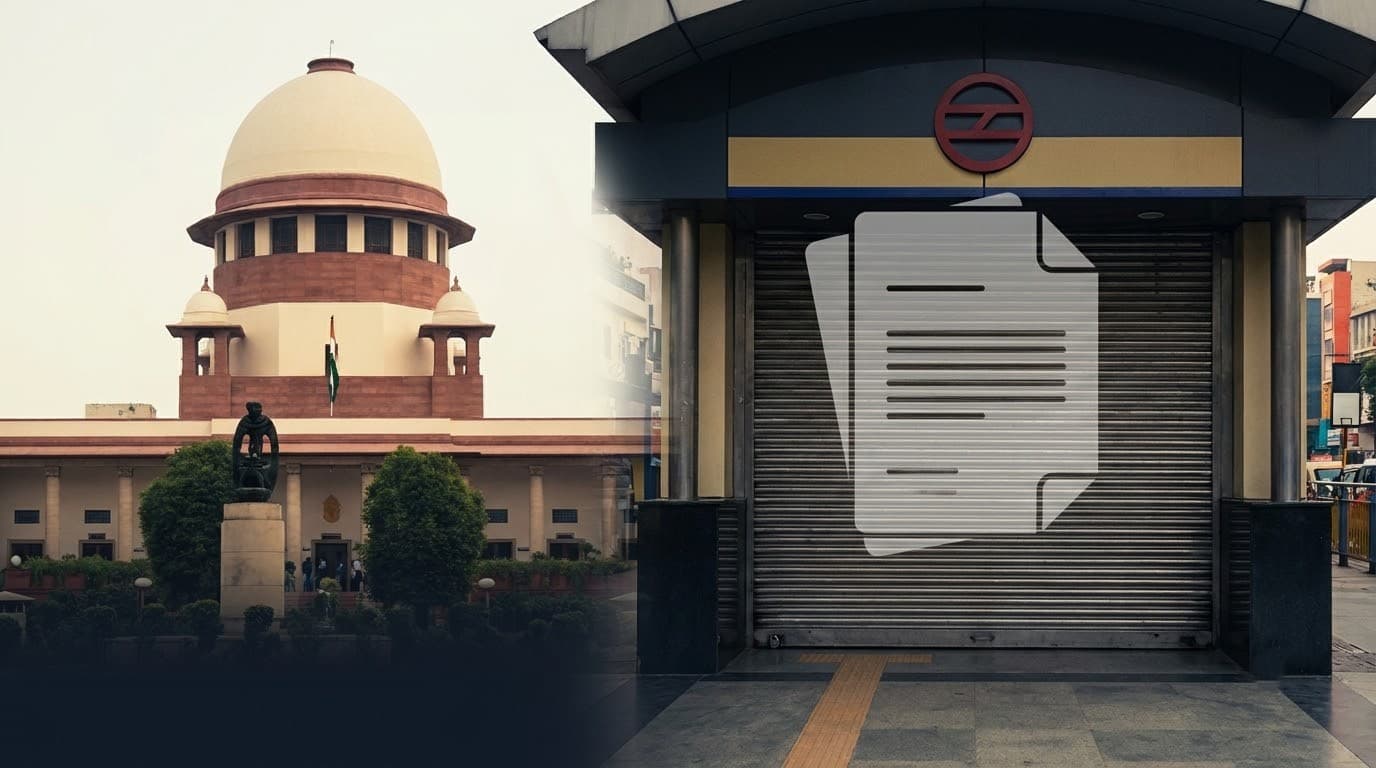
On October 9, 2026, the Supreme Court mentioned a batch of petitions filed against the closure of Delhi metro stations and cancellation of long-distance trains in the national capital, ahead of protests planned for October 10 by various opposition parties and youth organisations demanding the removal of Chief Election Commissioner Gyanesh Kumar. The matter was brought before a bench comprising Chief Justice of India Surya Kant, Justice Joymalya Bagchi and Justice V Mohana at around 1 pm on Friday, seeking an urgent hearing.
Senior Advocate Kapil Sibal, appearing for Member of Parliament MA Baby, highlighted the impact of the restrictions, stating that all trains had been cancelled, metro stations were closed, and movement across the city had been severely curtailed. He said that Nizamuddin was inaccessible and Resident Welfare Associations were being instructed not to allow people to come out. Emphasising the peaceful nature of the proposed protest, Sibal questioned how such sweeping measures could be justified in a democracy.
Advocate Prashant Bhushan echoed these concerns, stating that the entire city of Delhi had effectively been shut down. Senior Advocate Gopal Sankaranarayanan specifically alleged that 57 metro stations had been closed, noting that no such restrictions were in place that morning. He pointed out that a petition had also been filed before the Delhi High Court by the Indian Youth Congress, which had declined to grant an urgent hearing and scheduled the matter for Monday.
Sankaranarayanan argued that the right to peaceful protest is a fundamental right and that shutting down an entire city over the prospect of protests constituted a disproportionate measure. He maintained that preventive actions of this scale were unjustified when no incident had yet occurred.
In response, Justice Bagchi acknowledged the fundamental right to association but stressed that it must be exercised in accordance with the law, requiring prior permission for protests. He noted that if permission is denied or delayed, recourse to the courts is available. Sankaranarayanan countered that waiting for judicial redress would be futile given that the protest was scheduled for the following day, and that citizens of Delhi were already suffering from the effects of what he described as disproportionate state action.
Justice Bagchi clarified that even a protest without permission does not lose its essential character as a lawful expression of dissent, though participants may face prosecution. He stated that the court would need to balance the rights of protesters seeking to assemble against the rights of the broader public to access essential facilities and transportation. He observed that the State stands between these competing interests and must ensure that its actions do not create an imbalance.
Sibal replied that the measures taken by the State appeared to be broad-spectrum and disproportionate, especially if the anticipated protest were to be peaceful and unarmed. The bench indicated that it would need to examine the grounds for the restrictions before arriving at any conclusion.
Solicitor General Tushar Mehta urged the Court not to arrive at any final conclusion at that stage, cautioning that doing so would resemble a social media verdict rather than a reasoned judicial determination. The matter was adjourned for further hearing at 2 pm the same day.