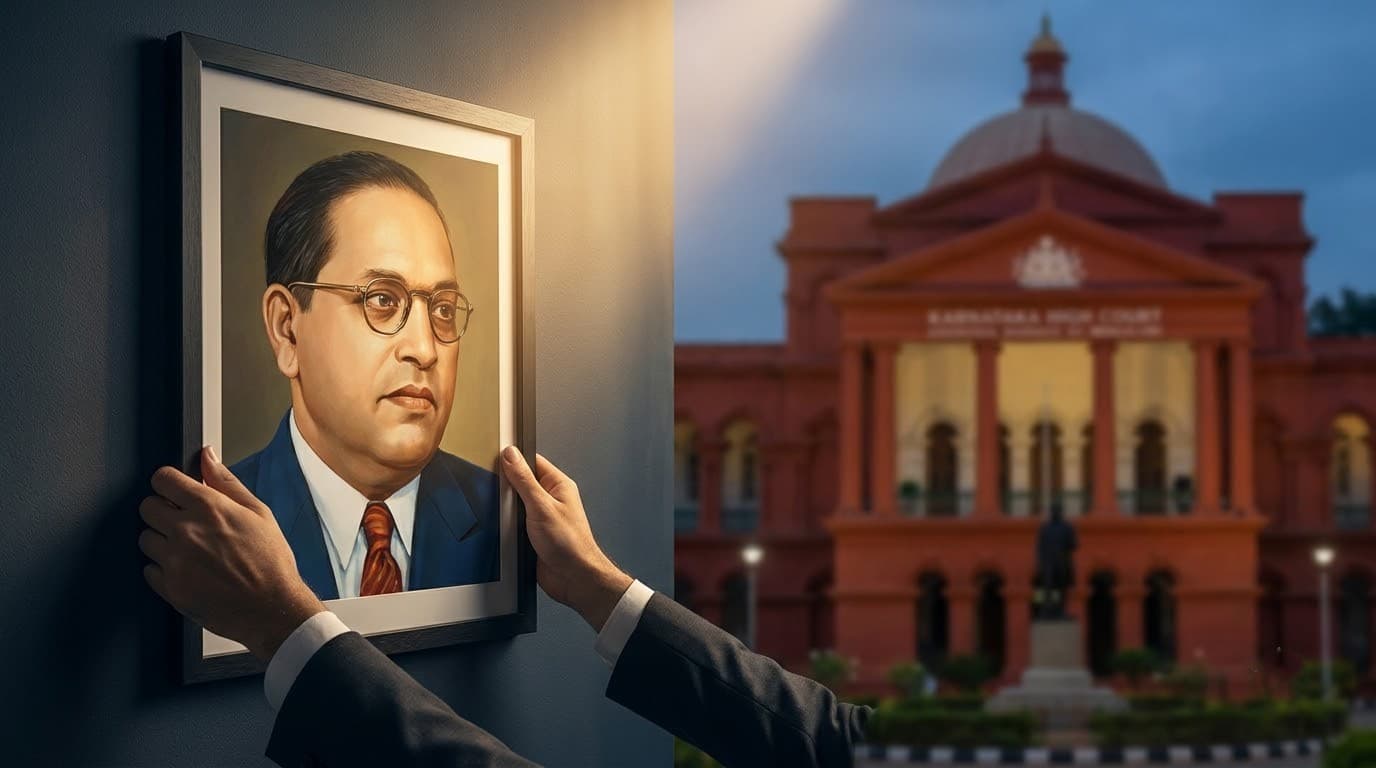
The Karnataka High Court has confirmed the acquittal of 26 persons who were booked in 2009 under the Scheduled Castes and Scheduled Tribes (Prevention of Atrocities) Act, 1989, for allegedly pulling down a portrait of Dr B R Ambedkar. The court, while dismissing the state’s appeal against the trial court’s order of acquittal, held that the prosecution failed to prove the essential ingredients of the offence beyond reasonable doubt.
The bench, comprising Justices [Names not specified in evidence], examined the record of the case arising from an incident reported in 2009 where it was alleged that the accused had removed a portrait of Dr B R Ambedkar from a public place. The prosecution invoked Sections 3(1)(r) and 3(1)(s) of the SC/ST Act, which criminalise acts intended to insult or intimidate members of Scheduled Castes or Scheduled Tribes, including damaging or defiling objects held in respect by such communities.
After reviewing the evidence, the court noted that the prosecution’s case rested largely on oral testimonies which were found to be inconsistent and contradictory. The High Court observed that several key witnesses either turned hostile during trial or failed to corroborate the prosecution’s version of events. The bench emphasised that mere allegations, without reliable and consistent evidence, could not sustain a conviction under a statute as serious as the SC/ST Act.
The court further highlighted that the prosecution did not establish that the act of removing the portrait was done with the specific intent to insult or intimidate members of the Scheduled Castes or Scheduled Tribes. It held that the act, even if proven, would need to be shown to be motivated by caste-based animus to attract the provisions of the Act. No such motive was demonstrated on the record.
The High Court also took note of the delay in filing the complaint and the lack of contemporaneous documentation or photographic evidence to support the claim that the portrait was pulled down. It observed that the investigation suffered from procedural lapses and that the chain of custody of certain exhibits was not satisfactorily explained.
In upholding the acquittal, the bench reiterated that courts must be cautious in interpreting penal statutes, especially those carrying severe penalties, and must insist on strict proof of all ingredients of the offence. It warned against mechanical invocation of the SC/ST Act in cases where the evidence does not clearly establish caste-based motivation or intent to cause indignity.
The court clarified that its ruling did not diminish the respect due to Dr B R Ambedkar or the importance of protecting symbols associated with social reformers. Rather, it stressed that legal proceedings must adhere to evidentiary standards and that convictions cannot be based on suspicion or general allegations.
The state’s appeal, which sought to overturn the trial court’s acquittal and restore the charges, was accordingly dismissed. The 26 accused, who had been facing trial for over a decade, stand acquitted of all charges under the SC/ST Act. The judgment underscores the necessity of credible evidence in atrocity cases and reaffirms the principle that penal liability must be founded on proof, not presumption.