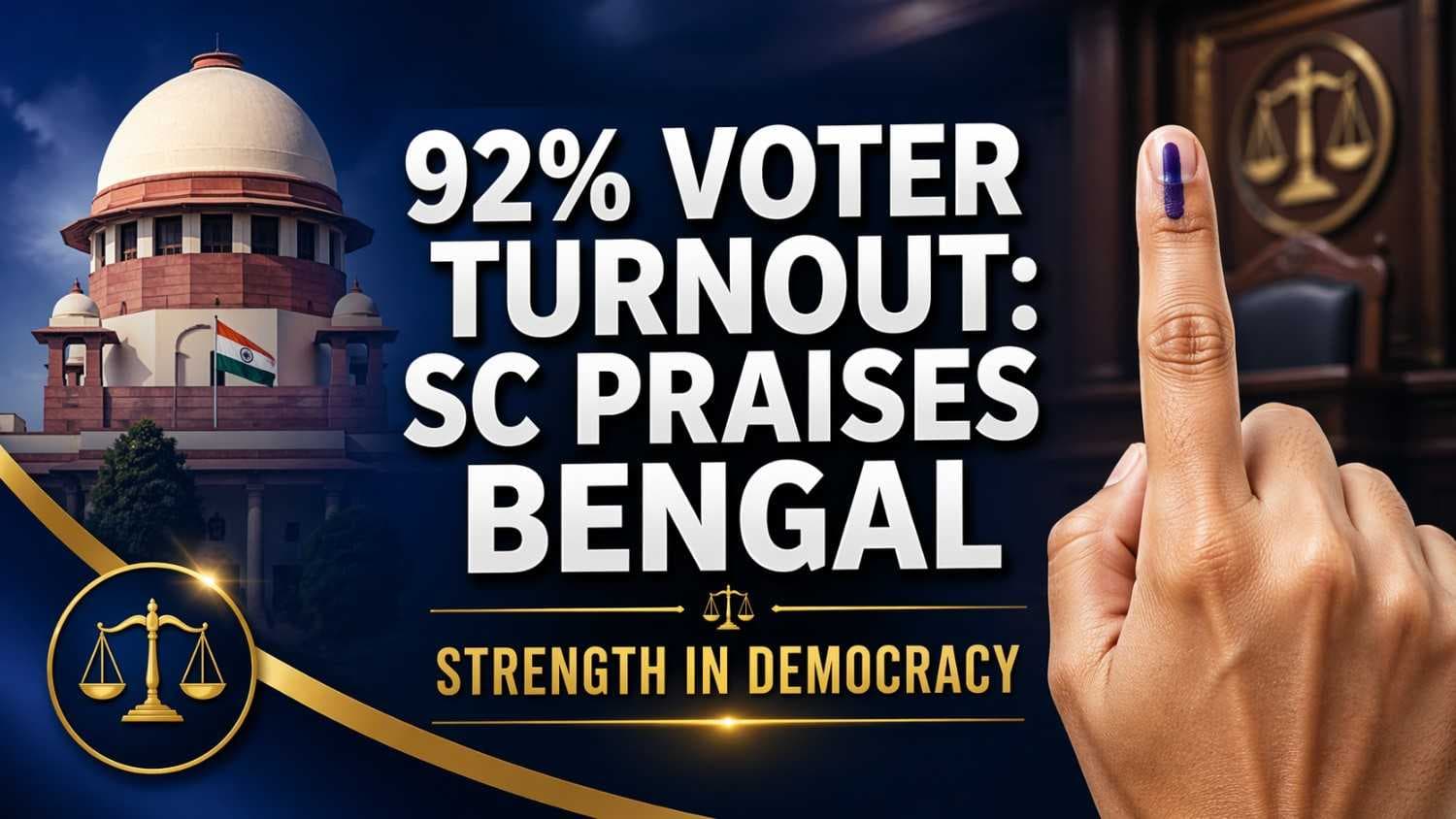
In a significant observation that reinforces the spirit of the Indian democratic setup, the Supreme Court of India on Friday expressed its deep appreciation for the historic 92% voter turnout recorded in the first phase of the West Bengal Assembly elections. The apex court also noted with satisfaction the absence of major violent incidents, remarking that when citizens realize the power of their vote, they move away from the path of violence.
The remarks were made by a bench comprising Chief Justice of India (CJI) Surya Kant, Justice Joymalya Bagchi, and Justice Vipul M. Pancholi while hearing matters related to the West Bengal Special Institutional Residents (SIR) and electoral roll inclusions.
The hearing took an optimistic turn when Senior Advocate Kalyan Banerjee, representing one of the parties, informed the bench that the first phase of the Bengal polls saw an unprecedented participation of 92%. He highlighted that even migrant workers had traveled from different parts of the country back to their home state specifically to exercise their right to franchise.
Reacting to this, CJI Surya Kant spoke not just as the head of the judiciary but as a concerned citizen. "As a citizen of India, I was very happy to see the percentage of voting. In this country, people need to participate in elections," the CJI remarked.
He further added that high voter participation is the strongest shield against lawlessness. "If people realize their power in a democracy—the power of the vote—and they follow the rule of law and democratic values, then they don't indulge in violence. Because then they know that strength lies in a democratic setup," the Chief Justice observed.
Justice Joymalya Bagchi supplemented the CJI’s observations by pointing out that the lack of reported violence was perhaps an even more significant achievement than the turnout itself. In a poignant moment during the exchange, Justice Bagchi quoted a famous Bengali proverb: "Rajaye rajaye yuddha haye, ulukhagrar pran jaye" (The kings fight, and the poor men suffer and die).
The use of this proverb underscored the court's concern for the common citizen who often bears the brunt of political clashes. The bench noted that a peaceful election ensures that the "common man" is protected and their voice is heard through the ballot rather than through conflict.
Solicitor General Tushar Mehta, appearing for the Central Government, concurred with the bench's sentiments. He credited the security forces for their commendable job in maintaining order, though he noted that while the phase was largely peaceful, a few isolated incidents had been reported.
The underlying legal battle pertains to the rights of "Special Institutional Residents" (SIR) and election duty officers in West Bengal. The Supreme Court had been petitioned regarding the exclusion of certain individuals from the electoral rolls, which potentially deprived them of their right to vote.
During the previous hearings, the court had expressed concern over election duty officers being left out of the rolls. In the current session, the bench granted liberty to any persons aggrieved by their exclusion or inclusion in the electoral rolls to approach the Calcutta High Court or the relevant Appellate Tribunal.
The bench clarified that while it appreciates the progress of the elections, the legal grievances regarding voter registration must be addressed through the proper statutory channels. By re-listing the matter, the court ensured that the door remains open for those seeking judicial remedy for their voting rights.
The Supreme Court’s praise for the 92% turnout reflects a broader constitutional value. In a country as diverse as India, the "Power of the Vote" is the ultimate equalizer. When voters turn out in such massive numbers—especially in a state like West Bengal, which has historically seen high-voltage and sometimes volatile political contests—it sends a message of faith in the constitutional machinery.
The CJI’s remarks serve as a reminder that:
- Participation is Protection: High turnout minimizes the scope for electoral malpractices and intimidation.
- Rule of Law: Following the "Rule of Law" means choosing the ballot over the bullet.
- Migrant Inclusion: The return of migrant workers to vote highlights the deep-rooted importance of local representation for the working class.
Legal experts often look at such "orbital remarks" (obiter dicta) by the Supreme Court as a way to set a moral and civic tone for the nation. By lauding the peaceful nature of the polls, the court is effectively putting pressure on all stakeholders—the Election Commission, the State Government, and political parties—to maintain this standard in the subsequent phases of the election.
The court’s decision to refer specific electoral roll grievances to the High Court and Tribunals also demonstrates "judicial restraint." While the Supreme Court oversees the larger constitutional question, it allows lower courts to handle the factual verification of individual cases, ensuring the legal process is not bypassed.
The West Bengal Assembly elections have often been under the scanner for security concerns. However, the first phase has set a high benchmark for the rest of the country. As the Supreme Court rightly pointed out, when 90% of a population chooses to stand in line to vote, they are not just choosing a representative; they are choosing the "Strength of Democracy" over the "Chaos of Violence."
As the case continues to be heard, the focus remains on ensuring that every eligible citizen—including those in special institutions or on election duty—can participate in this "festival of democracy" that the apex court so warmly commended today.