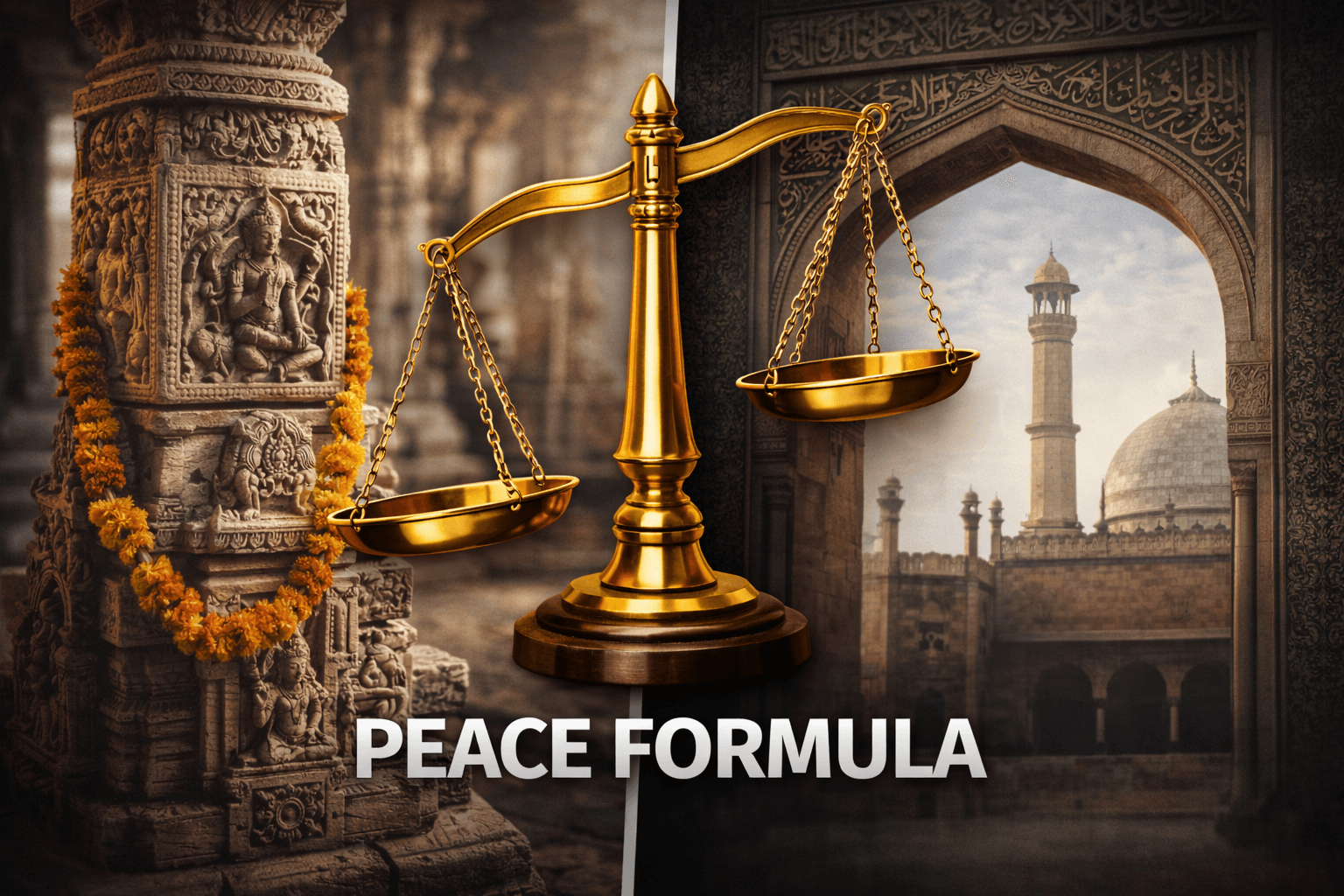
New Delhi: In a delicate balancing act to maintain communal harmony at the sensitive Bhojshala-Kamal Maula complex in Dhar, Madhya Pradesh, the Supreme Court on Thursday passed interim orders facilitating the peaceful conduct of both Basant Panchami rituals and Friday Juma Namaz on the same day—January 23, 2026.
The Bench, comprising Chief Justice of India Surya Kant, Justice Joymalya Bagchi, and Justice Vipul Pancholi, heard an application by the Hindu Front for Justice, which sought permission for day-long rituals for Goddess Saraswati (Vagdevi). The site, a protected 11th-century monument, is claimed by Hindus as a temple and by Muslims as a mosque.
The dispute arose because Basant Panchami (a festival dedicated to Goddess Saraswati) falls on a Friday this year. As per a 2003 arrangement, Hindus usually worship on Tuesdays and Muslims offer Namaz on Fridays. The clash of the festival and the weekly prayer created a potential flashpoint.
Advocate Vishnu Shankar Jain, representing the Hindu side, argued for uninterrupted puja from sunrise to sunset. Conversely, Senior Advocate Salman Khurshid, appearing for the Mosque Committee, stated that Juma Namaz has a fixed time (1 PM to 3 PM) which cannot be shifted.
Resolving the impasse, the Supreme Court accepted a suggestion by the Additional Solicitor General (ASG) K.M. Nataraj. The Court ordered:
- For Hindus: A designated space will be provided for day-long Basant Panchami ceremonies.
- For Muslims: A separate enclosure with separate entry and exit points will be created within the complex for Namaz between 1 PM and 3 PM.
- Entry Passes: The Muslim side agreed to provide a list of attendees to the district administration, which will issue entry passes to ensure security.
"We appeal to both sides to observe mutual respect and cooperate with the state and district administration for maintenance of law and order."
Beyond the immediate festival, the Supreme Court also disposed of the main petition regarding the site's character. It directed the Madhya Pradesh High Court to unseal the ASI survey report (which has been completed) and provide copies to both parties. The High Court has been asked to hear objections to the report and proceed with the final hearing on the title dispute.
This order is a significant test of India's secular fabric. By refusing to prioritize one religious practice over the other, the Supreme Court has crafted a "co-existence model" for disputed sites. The direction ensures that the devotees of Vagdevi can celebrate their festival without displacing the weekly prayers of the Muslim community, setting a precedent for handling such calendar conflicts in the future.