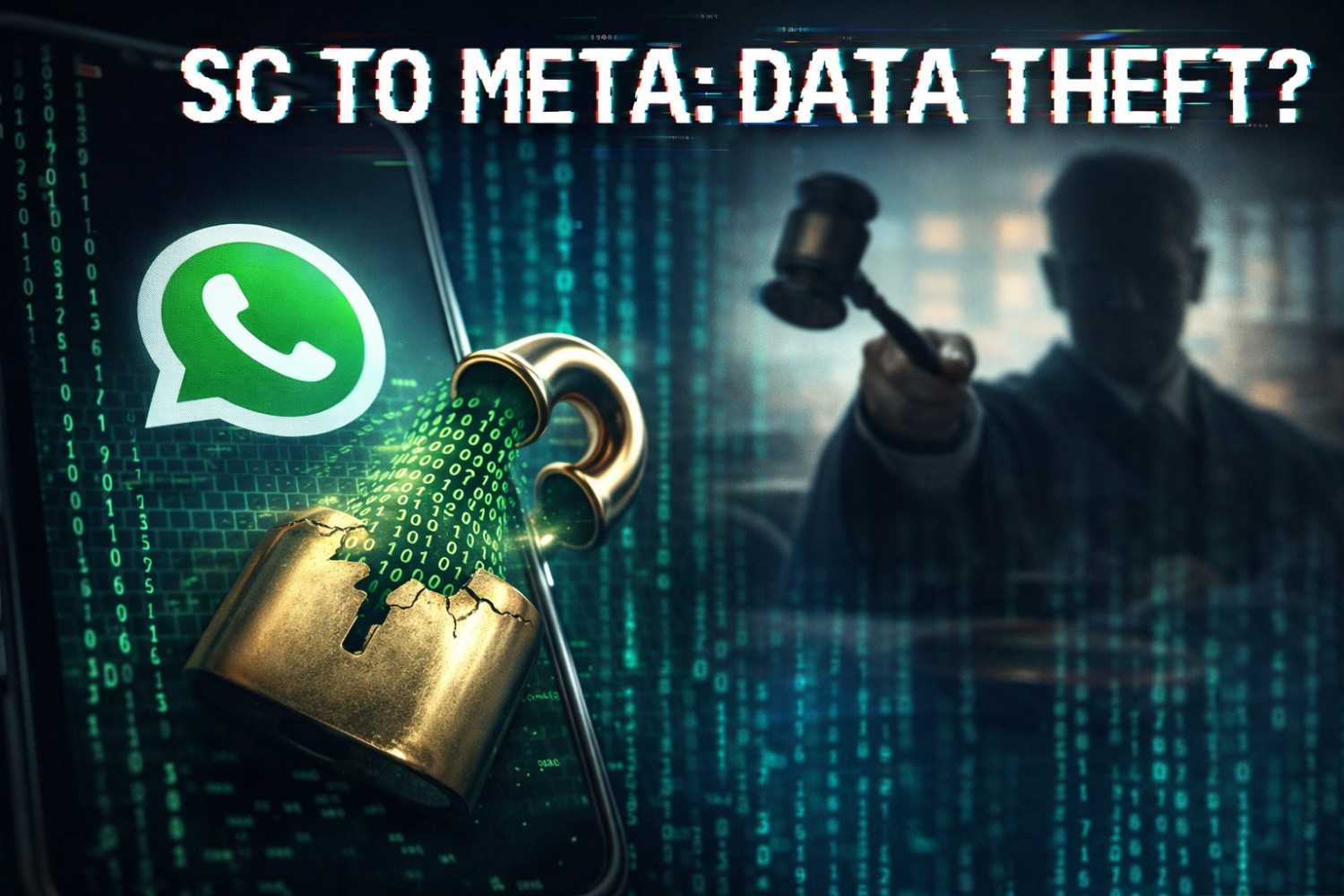
In a blistering critique of Big Tech's data practices, the Supreme Court of India has pulled up Meta Platforms and WhatsApp LLC over their controversial 2021 privacy policy. Hearing appeals against a penalty imposed by the Competition Commission of India (CCI), a bench led by Chief Justice of India Surya Kant expressed grave concerns about how the personal data of Indian users is being "monetized" and "exploited" for targeted advertising. The Court emphasized that a monopoly cannot hold users hostage with a "take-it-or-leave-it" policy.
Meta Platforms v. CCI: The proceedings arose from cross-appeals challenging a judgment by the National Company Law Appellate Tribunal (NCLAT). The NCLAT had previously upheld a ₹213.14 crore penalty imposed by the CCI on Meta for abusing its dominant position through WhatsApp’s 2021 policy update. While Meta challenged the penalty, the CCI appealed against the NCLAT's decision to allow data sharing for advertising purposes.
"Theft of Private Information" The Bench, also comprising Justice Joymalya Bagchi and Justice Vipul Pancholi, did not mince words. CJI Surya Kant termed the unauthorized use of data as a "decent way of committing theft," pointing out that the vast majority of users—from domestic helps to street vendors—cannot comprehend complex privacy terms.
"A poor woman selling fruits on the streets, will she understand the terms of your policy? Nobody will be available to understand... You might have taken the data of millions of persons. This is a decent way of committing theft of private information. We will not allow you to use it."
The Court rejected the argument that users have a choice to opt out, noting WhatsApp's effective monopoly in the messaging market. CJI Kant remarked, "You are making a mockery of the constitutionalism of this country... Consumer has no choice, you have created monopoly."
Targeted Ads & Data "Rent" Justice Joymalya Bagchi further probed the commercial aspect, questioning how user data is "rented out" for behavioral targeting. The Judge observed that unlike the EU, where data sharing has a recognized value, the Indian legal framework (including the yet-to-be-enforced DPDP Act) is still catching up.
Despite Senior Advocates Mukul Rohatgi and Akhil Sibal insisting that messages are end-to-end encrypted and cannot be read by the platform, the CJI cited personal anecdotes of seeing ads immediately after discussing medical issues on the app.
This hearing signals a potential judicial crackdown on the business models of "free" services that rely on data monetization. By impleading the Ministry of Electronics and IT (MeitY) and demanding a detailed affidavit from Meta, the Supreme Court is setting the stage for a landmark decision on digital privacy rights. It challenges the assumption that "consent" in a digital monopoly is ever truly voluntary, potentially forcing a rewrite of how global tech giants operate in India.